Now Reading: Resilient trade arteries: Azerbaijan’s growing role in Eurasian connectivity
-
01
Resilient trade arteries: Azerbaijan’s growing role in Eurasian connectivity
Resilient trade arteries: Azerbaijan’s growing role in Eurasian connectivity

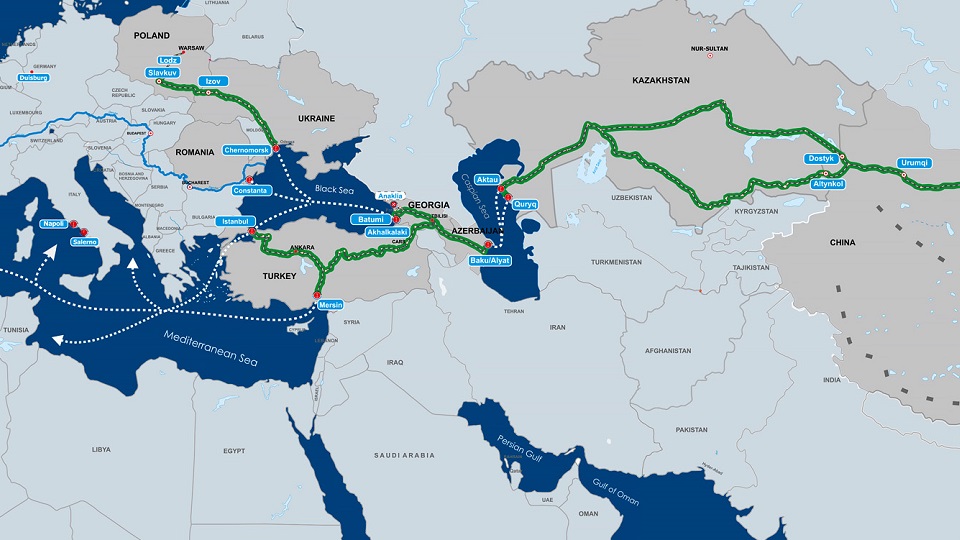
The ongoing global security crisis has exposed deep vulnerabilities in critical trade, transport, and travel routes. While the recent geopolitical turmoil around Iran since March 2026 has triggered a profound shift in the Gulf region’s historical status-quo, short-term ramifications are already disrupting regional stability, affecting flight paths and maritime trade, particularly through the Strait of Hormuz. The recent disturbance, once again, has underscored the urgent need to diversify trade and transport corridors. Against this backdrop, the Middle Corridor has emerged as a vital alternative: a safe and reliable route that traverses the South Caucasus, crosses the Caspian Sea, and connects Europe with Central Asia while bypassing traditional northern and southern transit routes.
In recent years, the Middle Corridor trade route has gained significant momentum amid tectonic geopolitical shifts across Eurasia. Its importance has only grown as a reliable channel for moving shipments, particularly if the current regional escalation in the Gulf continues to disrupt global supply chains. Air traffic along the traditionally busy east–west routes has already been forced into a narrow corridor over the South Caucasus, underscoring the strategic value of the Middle Corridor, the only route left standing, the only viable path in terms of trade and transport.
In terms of trade links, the Middle Corridor is the shortest geographical route between Europe and China, thus enabling the West, regional countries, and China to pledge billions to upgrade ports, railways, and roads along the route. Within this framework, Azerbaijan extensively upgraded its critical infrastructure, particularly maritime infrastructure, to enhance cargo flow from East to West, namely Baku-Tbilisi-Kars railway, which has already demonstrated high efficiency in supporting regional transport.
In this context, under a special decree, Baku Sea Port was merged with Azerbaijan Railways (ADY) in February 2025 to boost container flow. For example, in 2025, the Port of Baku achieved a landmark result of 100,000 TEU containers annually.
Consequently, closer coordination between maritime and rail operations accelerated cargo processing, improved route efficiency, and enhanced multimodal cooperation. The establishment of the Unified Transit Center at the port in September 2025 also played a key role by simplifying interaction between state agencies and logistics companies, enabling flexible workflow and supporting sustainable growth in cargo volumes.
Thanks to stable trade operations and well-developed infrastructure along the Middle Corridor, cargo traffic continues to expand. On April 5, first China-Europe block train departed from Wuhan, carrying electronic equipment, household appliances, and consumer goods destined for European markets. Notwithstanding the positive dynamics, the involved parties, including Azerbaijan, Kazakhstan, and China, reiterate that the Middle Corridor is not a replacement for other routes but a robust and strategically important complementary alternative.
In the mid-term, the Middle Corridor will likely remain an even more important route for moving goods, as disruptions to key maritime and land infrastructure in the wider region continue to affect alternative transit routes. Azerbaijan recognizes the strategic importance of the Caspian basin route and its extension into Europe as a means of ensuring the uninterrupted flow of international trade.
At the same time, Baku is advancing the rapid implementation of the Trump Route for International Peace and Prosperity (TRIPP), a strategic initiative designed to link the Nakhchivan exclave with Türkiye. On Azerbaijan’s side, the Horadiz–Aghband railway will integrate into this corridor at the interstate border, extend across Armenian territory, and link with Nakhchivan’s rail system. From there, it will extend into Türkiye’s network and form part of a broader international transport artery.
As another major transport artery, the TRIPP corridor is expected to handle up to 15 million tons of cargo annually, further strengthening Azerbaijan’s role as a regional hub. The US, which views TRIPP as a supply chain for critical minerals, has strongly supported the project, cemented by a strategic partnership agreement signed on February 10, 2026, during Vice President JD Vance’s visit to Baku.
Moreover, the growing interest in the Middle Corridor and the increasing volume of container traffic prompted other regional states to join the route. As such, in August 2025, a Memorandum of Understanding on Transport and Logistics Cooperation was signed between the Ministry of Digital Development and Transport of Azerbaijan, the Ministry of Railway Transport of Turkmenistan, and the Ministry of Transport of Uzbekistan, covering key areas such as the digitalization of the Middle Corridor, the development of freight transportation, and diagnostic assessments of the corridor.
Indeed, continuous efforts to build additional infrastructure, attract more foreign investment and companies, and introduce advanced crossborder collaboration mechanisms through improved cooperation among the major regional rail freight providers are part of a critical process to achieve host trade facilitation goals along the Middle Corridor route.