If we view Azerbaijan’s initiative to build the Zangezur Corridor solely from the perspective of a regional transport project — rather than through the lens of political speculation or the agendas of various power centers — a clear picture emerges: the road connecting Azerbaijan’s mainland to its exclave, the Nakhchivan Autonomous Republic, and Turkey, is not only of interest to Baku and Ankara, but to many transport and economic actors across a much broader geographic area. And there are plenty of reasons for that.
Looking back to the not-so-distant Soviet past, transportation between Azerbaijan and Nakhchivan was conducted via highway and the Transcaucasian railway. But with the collapse of the USSR and the outbreak of the Karabakh war, the railway was dismantled, and overland communication between mainland Azerbaijan and its exclave — the largest in the world, spanning 5,500 square kilometers and home to 450,000 people — was cut off. Today, access is limited to either air travel or a transit route through Iran.
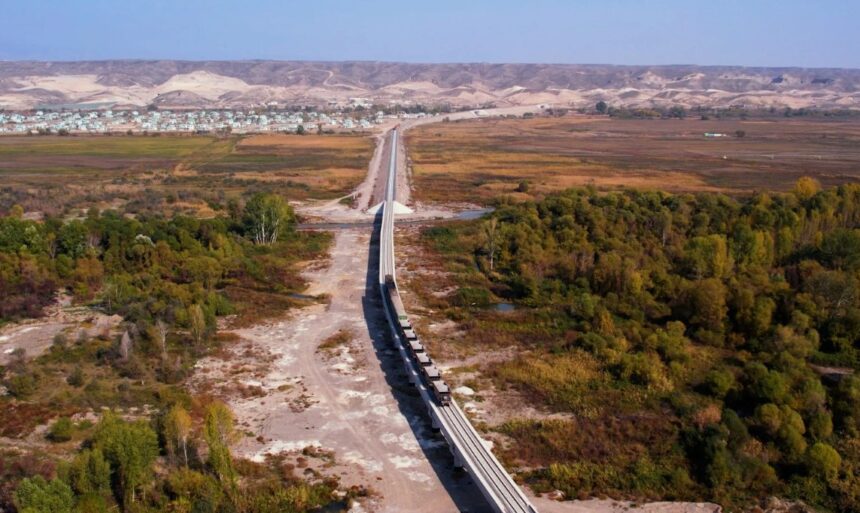
Azerbaijan’s victory in the Second Karabakh War opened the opportunity for direct access to its exclave and Turkey — through a mere 40 kilometers of Armenian territory. More importantly, the geographical placement of the Zangezur route allows it to become part of the Middle Corridor, an international transport route connecting China to Europe via Central Asia and Turkey. Its activation could increase the corridor’s cargo capacity by 10–12 million tons annually — a development met with great enthusiasm across the expansive region.
Following Azerbaijan’s victory, a trilateral ceasefire agreement was signed on November 9, 2020, between Azerbaijan, Armenia, and Russia. It included a provision to unblock all economic and transport links in the region. The Zangezur Corridor immediately attracted attention from numerous stakeholders, including political players with their own spheres of influence — a factor that continues to complicate and delay the project initiated by Azerbaijani President Ilham Aliyev.
Yet the Zangezur Corridor holds important transport and trade-economic value not only for Azerbaijan and Turkey with their route to Europe, but for the entire South Caucasus, including Armenia; the Central Asian states; Russia; and China. According to World Bank estimates, opening the corridor — including rail and road infrastructure — could increase global trade volumes by $50 to $100 billion annually by 2027. Bloomberg also forecasts that the corridor would reduce cargo transit time across Eurasia by at least 15 hours, resulting in billions of dollars in annual savings.
For Azerbaijan specifically, the corridor is expected to increase exports by more than $710 million and boost the non-oil GDP by 2%. It would also reduce the distance between Azerbaijan and Turkey by 342 kilometers. One concern that has been raised is whether the Baku–Tbilisi–Kars railway would become unprofitable. However, this is unlikely, as the growing flow of goods across Azerbaijan toward Turkey and Europe will allow both routes to complement each other amid rising logistical demand in the South Caucasus.
Turkey stands to gain significantly as well — securing a land route to the Caspian Sea and thus to the Turkic states of Central Asia. Azerbaijan and Turkey have already begun construction of a railway between Kars and Nakhchivan. This line will integrate with the existing Baku–Tbilisi–Kars railway (potentially forming part of the Zangezur Corridor) and increase cargo traffic between Central Asia and Europe.
As for Armenia, it would emerge from its state of transport isolation, which has until now been only partially mitigated by transit routes through Georgia and Iran — both insufficient for national development or regional integration. Just four years ago, in the context of unblocking transport communications, Armenia projected a 30% GDP growth. While this number may have been overly optimistic, any progress would clearly be substantial. Notably, the World Bank recently downgraded Armenia’s 2025 GDP growth forecast from 5% to 4%.
Central Asia, with its vast logistical potential and growing economic integration with China, also stands to benefit. China transports a significant volume of goods through Kazakhstan and Azerbaijan, and the corridor would accelerate and simplify trade with Turkey and onward to Europe. In essence, China would gain another viable route for freight transportation.
The entire Central Asian region would profit from faster delivery of goods to Europe, complementing its existing transit options through Iran and Russia. Just recently, Uzbekistan’s Ministry of Transport published an analytical report on the Zangezur Corridor, concluding that the corridor’s positive impact is evident for all countries along the Asia-Europe transport chain — particularly in terms of enhanced logistics and increased demand for transit services. The report also highlighted benefits for Armenia: in addition to direct railway links with Azerbaijan, the corridor could reconnect Armenia, Azerbaijan, and Iran via the Julfa junction in Nakhchivan — operational during Soviet times.
It’s worth recalling that landlocked Uzbekistan is actively developing transport routes. The Zangezur Corridor and the broader Middle Corridor initiative would grant it access to global ports.
Finally, Russia would also benefit — particularly in the context of developing the North–South International Transport Corridor. The Zangezur Corridor would connect Russia to Armenia, Iran, and Turkey through Azerbaijan (assuming the reopening of the Armenia–Turkey border).
The above is a brief summary of the clear regional benefits associated with the Zangezur Corridor. What follows, however, is a more complex political layer: the advancement of various national and international interests, including those of external players. Within the region itself, the corridor’s strategic appeal has already triggered unhealthy appetites — leading to speculation, behind-the-scenes maneuvers, distorted narratives, and misrepresentation of the project’s original goals as envisioned by Azerbaijan. But that is another — and far more multilayered — topic altogether.
Irina Dzhorbenadze
Translated from minval.az