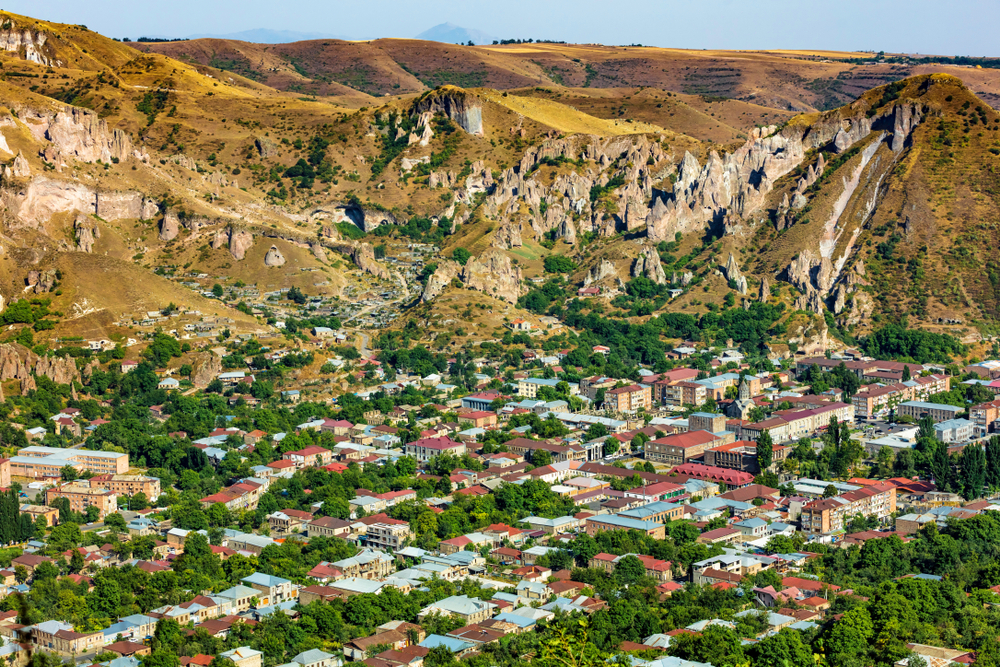
Now that Baku has succeeded in restoring control over Karabakh, it is now focusing on the Armenian region between the two non-contiguous parts of Azerbaijan, which Armenians call Syunik oblast and the Azerbaijanis and many others call Zangezur.
Addressing this problem is far more difficult than dealing with Karabakh because it involves not just Baku and Yerevan but all outside powers—including Russia, Iran, Türkiye, China, and the West—whose agendas are generally at odds in the region and many of whom are internally conflicted as well.
As a result, achieving any peace agreement between Baku and Yerevan remains problematic. This was underscored in early August when the two sides agreed to try to sign such an accord but only by agreeing not to address the central issue of transit corridors in the agreement (TRT Russian, August 8). Unless solutions on such routes are reached, Azerbaijan may well decide to force its goals given the success in Karabakh and the normalization of war as a result of Russian President Vladimir Putin’s expanded invasion of Ukraine (see EDM, October 3, 2023). Türkiye would almost certainly support such an attempt. It would likely prompt Russia and Iran, however, to react by sending their forces to the region—an intervention that could trigger a broader war.
Several efforts to forestall a broader conflict are now on the table, including:
- The creation of a Russian-monitored corridor through Zangezur, which Azerbaijan and Türkiye could use without being subject to Armenian monitoring and thus keep open Armenia’s bridge to Iran and north-south routes (Vpoanalytics.com, September 13);
- The transfer to a private Azerbaijani company of control over a narrow strip of land through Zangezur so as to remove the Russian Federal Security Service (FSB) from its role there (Sputnik Armenia, September 9); and
- The expansion of a transportation route between Azerbaijan proper and its non-contiguous exclave Nakhchivan through Iranian territory (Vpoanalytics.org, January 26; TRT Russian, September 12).
None of these propositions, however, have much of a chance to end the dispute, as both Armenia and Azerbaijan, as well as the major outside powers, will be unhappy with at least some of the arrangements.
The difficulties that all parties now face in resolving the dispute in the South Caucasus are the result of Soviet ethnic engineering intended to institutionalize conflict to help Moscow maintain control via a “divide-and-rule” strategy. The fact that all parties except Azerbaijan and Türkiye have been conflicted about what they want and that there have been shortcomings with all suggested resolutions since 1991 have further complicated the matter (Riddle Russia, October 27, 2020).
Having presented one of the earliest proposals, the so-called “Goble Plan” of 1992, which called for a territorial swap with Azerbaijan giving up Karabakh in exchange for Armenia giving up Zangezur lest Azerbaijan eventually become so strong that it could take back both, this author remains focused on the region even though Baku’s success in Karabakh has made the specifics of the “plan” mute (ReliefWeb, June 9, 2000). Other proposals offered in the intervening years have focused on smaller territorial exchanges or the insertion of outside forces, Russian or otherwise, to ensure that the conflict does not explode.
Baku’s military successes in the 2020 Second Karabakh War and in 2022 in reestablishing Azerbaijani control over all of Karabakh and the links between that region and Armenia have led many to assume that “the Karabakh conflict” is almost resolved. This is only true, however, if one defines that dispute as being about Karabakh alone. With a broader scope that includes difficulties with transportation corridors, that is not the case.
In the Moscow declaration ending the 2020 war, all three signatories—Russia, Armenia, and Azerbaijan—declared unblocking transportation links as essential. This has yet to happen, and the reasons for that lie in the fact that both countries most immediately involved and all outside powers want to see these routes unblocked but only in ways that serve their own interests. Azerbaijan wants direct access to Nakhchivan and does not want to rely on Iran. Given Yerevan’s recent turn to the West, Armenia wants to maintain sovereignty over Syunik oblast (Zangezur) but would like to do away with Russian guards there. Russia wants the corridors unblocked to expand its north-south trade with Iran and strengthen its influence in Azerbaijan (see EDM, September 12; Eurasia Today, September 19).
The Kremlin recently reiterated the position to cut Yerevan out, which views this as yet another Moscow betrayal of Armenian interests (Window on Eurasia, August 23). Azerbaijan, Türkiye, the West, Central Asia, and China want the routes opened to expand east-west trade and do not want this trade to go through the risky Iranian route. As a result, at present, Baku and Yerevan are not even negotiating the matter (Vzglyad, September 10; TRT Russian, September 12; Svpressa.ru, September 18).
According to Russian commentator Roman Chernikov, this puts Baku in “a win-win situation.” He argues that if Western countries do not agree to support the route through Iran, something they do not want, they will “continue pressuring Armenia” to open a corridor through its own territory.” Chernikov points out that Azerbaijani President Ilham Aliyev’s “hands will remain clean and no one will be able to say that he is blackmailing [Armenia] with what would be under current arrangements a war of invasion and conquest.” Aliyev has made clear in the past that he is prepared to solve the Zangezur “problem” by force if it is not resolved in ways he approves of at the negotiating table (OC Media, April 21, 2021).
This perspective helps explain both the anger at Moscow in Yerevan and Tehran and the urgency of Western efforts to promote a settlement, even though observers in the region say there is little chance for a comprehensive peace agreement between Armenia and Azerbaijan this year (Window on Eurasia, August 25). More tragically, what many still call “the Karabakh dispute” is likely to continue well into 2025 and beyond, given that none of the solutions now being proposed will please all parties involved. Many of them seem to believe that either resistance to any moves to address the needs of others or military action that would render diplomatic talks meaningless would be a better choice for their own interests.