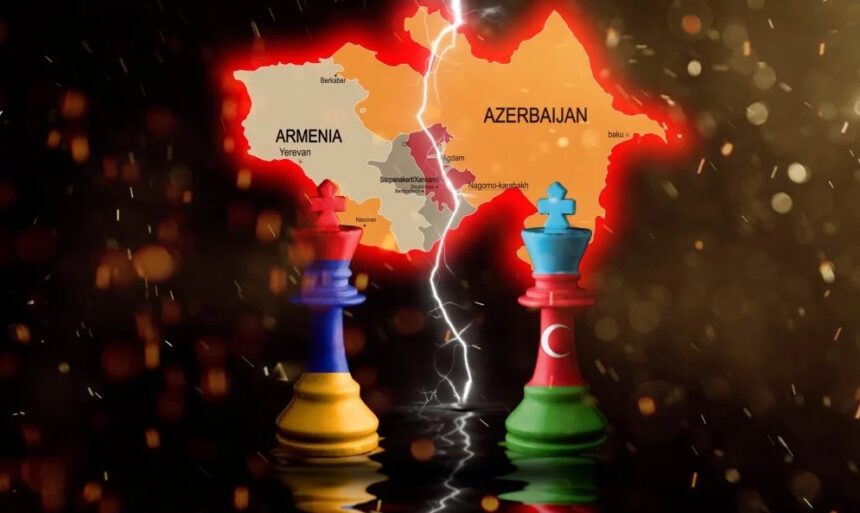
Though Ukraine was the focus of this year’s Munich Security Conference, interesting developments regarding a different conflict in Russia’s near abroad occurred on the sidelines of the conference: the Amernia-Azerbaijan conflict.
On February 18, Armenian prime minister Nikol Pashinyan and Azerbaijani president Ilham Aliyev held talks at a meeting hosted by U.S. Secretary of State Antony Blinken. Both leaders took the opportunity to discuss a number of important issues: the draft peace treaty between the two states, the delimitation of inter-state borders, and the opening of transportation communications.
This, of course, was not the first time such a high-level meeting between the two leaders was mediated by a third party—what differed this time around however was who was meditating between the two.
For a long period of time, Russia was the principal mediator between Armenia and Azerbaijan. However, since 2021, this role has been contested by the European Union. Moreover, due to the war in Ukraine, the OSCE Minsk Group—which since the 1990s has held the mandate to assist in negotiating a peaceful settlement between Armenia and Azerbaijan but was widely regarded as a failure—has effectively ceased to function.
Russia has not been receptive to this change: it has repeatedly criticized the EU’s mediation efforts, accusing the West of attempting “to hijack Armenian-Azerbaijani peace talks.” On February 17, the spokeswoman of the Russian foreign ministry, Maria Zakharova, expressed skepticism that U.S. mediation has “any added value.”
The change in meditator is important to consider, as Russia and the West have different motives to get involved in these peace talks—and these motives can shape negotiation outcomes in the Armenia-Azerbaijan conflict.
Russian Motives
As the traditional hegemonic power in the South Caucasus and arbiter in the decades-long Armenian-Azerbaijani conflict, Russia is inclined to cling to preserving its regional dominance. At the moment, its primary mechanism for doing so is by trying to extend the presence of its peacekeeping contingent, deployed after the end of the Second Karabakh War in 2020. Russia’s invasion of Ukraine, however, threatens its influence in the South Caucasus—the war is draining away Moscow’s military power and economic resources. Moscow worries that its declining influence will upset the region’s balance of power. The West, along with local middle-sized powers like Türkiye, have stepped into this breach and are seizing the opportunity to extend their influence in this strategically important region.
The Kremlin realizes that, once the conflict’s two belligerents come to a basic agreement, Moscow’s involvement will become redundant. The Russian peacekeeping troops deployed in 2020 have a fixed term ending in 2025—though an extension is theoretically possible. Baku, however, has made it clear that it considers the presence of these peacekeepers on its internationally recognized territory to be a temporary affair, and will not endorse an extension beyond 2025.
In other words, if Armenia and Azerbaijan reach an agreement under Western auspices, Russia’s influence in the region would be significantly degraded. For that reason, Moscow seeks to preserve its influence in the following ways:
First, Moscow seeks a long-term military presence on the ground. For that, it requires the occasional flare-up of inter-ethnic tensions in order to justify maintaining Russian peacekeepers in the Karabakh region.
Second, Moscow can further justify its presence by dividing Armenian political unity. It is conceivable, for example, that the Kremlin-orchestrated arrival of the Russian oligarch Ruben Vardanyan (who is of Armenia origin) is part of a scheme to only inflame tensions between local Armenians and Azerbaijan, but also to drive a wedge between Karabakh Armenians and the Western-leaning government in Yerevan. Vardanyan’s arrival caused a major standoff on the Lachin road between Azerbaijani government-backed activists and Karabakh Armenians—which only serves to further justify the presence of Russian peacekeepers.
Third, Moscow’s plan for a peace treaty contains a provision postponing resolving the status of Karabakh. In the words of the Russian envoy to Yerevan, “the status of Nagorno-Karabakh is an issue that should be left to the next generation.” This ambiguity provides Moscow with additional leverage in future bargaining with Baku.
Western Mediation
Since 2021, there have been complementary efforts by the Biden administration in the United States and European Council president Charles Michel to play an increasingly active role in mediating between Baku and Yerevan.
Both the United States and the EU are interested in ending the Armenia-Azerbaijan conflict, as its unresolved status has been a major stumbling block in the South Caucasus’ emancipation from Russia’s imperial projections of power. If the conflict were to be partly or fully resolved, it would undermine Moscow by removing the underlying source of Russian leverage in the region.
Additionally, the West is also pursuing its own interests by seeking to extend its influence in this traditionally Russia-linked sub-region. Due to geographic location and historic ties, Russia views this region as a key element of its strategy to avoid complete isolation. The West wants to reverse this by turning both Armenia and Azerbaijan away from Russia’s sphere of influence.
Finally, both the United States and EU believe that the normalization of ties between Baku and Yerevan depends upon the mutual recognition of territorial integrity and emphasizing the rights and security of ethnic Armenians in Nagorno-Karabakh. Western mediators are concerned about the fate of this Armenian population once it is fully re-integrated into Azerbaijan proper. Therefore, since mid-2022, both Washington and Brussels have proposed direct talks between Baku and representatives of the Armenian community in Xankəndi—which local Armenians call by its Soviet name, Stepanakert—with the intention of establishing credible guarantees. Promisingly, at this year’s Munich Security Conference, Aliyev stated that “it was agreed with our international partners that there will be discussions on the rights and security of the Armenian minority in Karabakh.”
What’s Next?
Which peace treaty proposal will prevail hinges upon what is acceptable to both Armenia and Azerbaijan, and the capacity of the mediator in being able to support a peace deal. So far, the EU and the United States seem to be outcompeting Russia in this regard. Azerbaijan will definitely favor the West’s proposal, which calls upon both sides to respect each other’s territorial integrity, and rejects the Russian proposal that risks delaying the status issue. Armenia, on the other hand, prefers the Russian proposal, though the Pashinyan government is cognizant of the risks associated with tying its future security with Russia. Despite its bilateral security alliance with Russia and its membership in the Russia-led Collective Security Treaty Organization (CSTO), the CSTO proved to be unreliable when Armenian troops clashed with the Azerbaijani military along the inter-state border—and the latter reportedly captured some strategic heights inside the Armenian territory—in September last year. This triggered the search for alternative security allies, and ultimately the establishment of a new two-year EU Mission in Armenia (EUMA). While the mission raised eyebrows in Russia and Azerbaijan, it could actually incentivize Yerevan to pursue a peace proposal offered by the West.
The competing logics of third-party interests will interfere and might complicate the process of reaching a final agreement unless Russia is completely exhausted by its war efforts in Ukraine. Once Russia stops scheming against a peace treaty, the chances are that the sides will finally agree on a lasting peace.
Farid Guliyev, Ph.D., is a Lecturer in Comparative Politics at the Department of Political Science and Philosophy at Khazar University in Baku. The views expressed herein are solely the responsibility of the author.