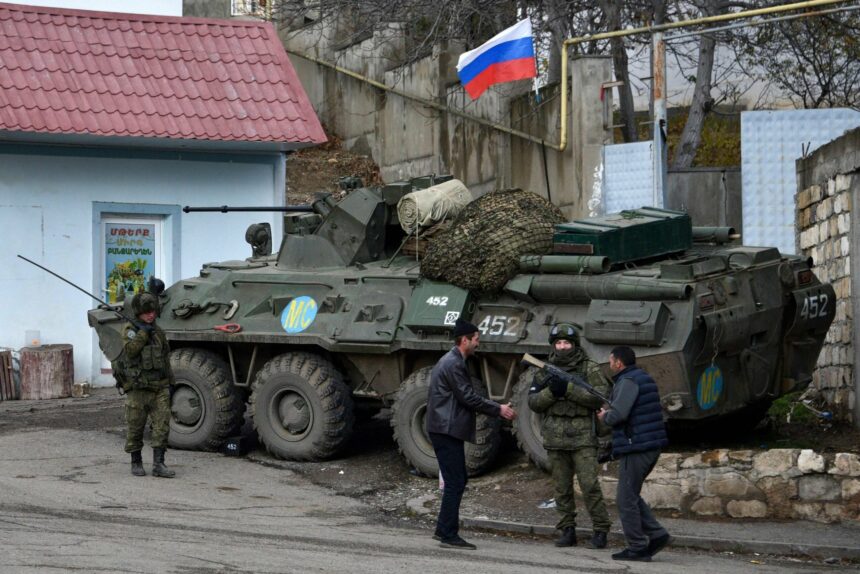
A month later, Azerbaijan declared that it had regained full control of the territory for the first time in over 30 years. Initially, the mission was supposed to remain in Karabakh until at least the expiration of its five-year term in November 2025, upon which it would have been withdrawn if either Baku or Yerevan made an official request. That’s why, for most outside observers, the news about the Russian forces’ exit seemed to come out of the blue, although the point of their presence had already become highly questionable after the bulk of the Armenian population left Karabakh in the wake of renewed military clashes in September 2023. In any case, the reasons behind the Russian decision to withdraw its peacekeepers remain a matter of intense debate; but it is possible to draw several important conclusions from its timing and consequences.
2020: Russia enters to freeze a new status quo
First, it must be emphasized that for Moscow, the political expediency of its Karabakh peacekeeper mission changed a lot since 2020. By deploying it, the Kremlin clearly envisaged creating an efficient tool for projecting influence and putting pressure on the two warring South Caucasus countries. Baku initially hoped that the peacekeepers would assist in the demilitarization of the part of Karabakh still in control of the de facto Armenian “authorities” and reintegrating the local Karabakh Armenians into Azerbaijan. But it soon became clear that Russia intended to preserve the post-2020 status quo: limiting Azerbaijan’s ability to restore its sovereignty over the region and encouraging Armenia to retain its pro-Russian orientation, presumably in gratitude to Moscow on the first point. Indeed, certain steps the Armenian government took after the war showed that this Kremlin plan worked for a while. For example, in 2021, Yerevan allowed Russian border guard detachments to established new positions inside Armenian territory, including some in the Tavush region, along the highly vulnerable fragment of the border with Azerbaijan; while appointments of openly pro-Russian figures such as Defense Minister Arshak Karapetyan (who briefly served in this capacity in 2021) further demonstrated a deference to Moscow’s interests.
In the meantime, however, Russia’s peacekeepers notably failed to properly investigate continuing armed incidents along the Armenian-Azerbaijani border or the line of contact in Karabakh, and, on several occasions, Baku openly accused them of facilitating the passage of armed people and weapons from Armenia. The diplomatic spat that occurred between Baku and Moscow in March 2022, after Azerbaijani troops took some positions on Mount Farrukh, within the zone of the peacekeepers’ control, underscored the depth of Baku’s dissatisfaction with the Russian position.
War in Ukraine: Reevaluating Russian influence
The pace of such political and policy shifts in Karabakh and the broader South Caucasus region dramatically accelerated following the start of Russia’s full-scale invasion of Ukraine in late February 2022. Russia’s aggression triggered other post-Soviet countries to re-evaluate the potential risks to their own sovereignty; in particular, Azerbaijan and Armenia concluded that their security directly depends on the ability to finally settle the remaining disputes. In turn, Western countries, impelled to focus their efforts on Ukraine, also started to more actively push Baku and Yerevan to accelerate peace talks so that this region would become less prone to Russian meddling, thus reducing the risk of additional security challenges that could further distract Western attention. This change translated into the European Union becoming more active in mediation efforts, leading Western states withdrawing their long-standing demands for Karabakh autonomy, Azerbaijan launching a new military operation in September 2022, and Armenia subsequently recognizing Azerbaijani territorial integrity over the formerly breakaway region at the Prague Summit of the European Political Community the following month.
Meanwhile, Russia found itself unable to reverse this momentum. And having failed to quickly and fully subjugate Ukraine militarily, its Armed Forces became bogged down; to sustain the war effort over the long term, Moscow grew increasingly dependent in various ways on several other former Soviet republics, which greatly undermined its traditional leverage over them. In the South Caucasus, Azerbaijan became important as a key node in a transit corridor linking Russia with the Global South and, notably, Iran, which had begun supplying weaponry to the Russian military. (Moreover, in general, Moscow appreciated Baku’s policy of non-integration with Western institutions.) Whereas, Armenia, a member of the Moscow-dominated Eurasian Economic Union (EEU), emerged as a crucial hub for the shadow import of sanctioned goods destined for Russia.
Thus, when Azerbaijan de facto closed the Lachin road in December 2022, causing anger and frustration among Karabakh Armenians who suddenly lost their main physical link with Armenia, Russia wasn’t particularly eager to intervene. However, some indirect evidence has since emerged that Moscow was simultaneously trying to disrupt communication between the leaders of “the Republic of Artsakh” (the Armenian name for the unrecognized entity claiming sovereignty over Karabakh) and Baku, exacerbating the crisis. The Russian side apparently hoped that Baku would hit back, causing major bloodshed and triggering Western sanctions against Azerbaijan, pushing it toward Russia. Indeed, on Sept. 19, 2023, Baku conducted a lightning-speed military operation inside Karabakh that destroyed the remaining separatist infrastructure there and culminated with the full reintegration of the whole region into Azerbaijan as well as the overwhelming majority of Karabakh’s ethnic-Armenian population relocating to Armenia. Moreover, six peacekeepers were killed during the hostilities as a result of Azerbaijani fire — though the details of the accident have not yet been disclosed.
This event, and the fact that Azerbaijani authorities arrested several former de facto leaders of Karabakh, along with the Russian-Armenian oligarch Ruben Vardanyan, highlighted the limits of Moscow’s influence there. In its aftermath, the issue of the peacekeepers’ withdrawal from the region became a question of “when” rather than “if.” Most probably, the Kremlin decided soon after Sept. 20 to discontinue its mission at the first convenient moment. Speaking at the Commonwealth of Independent States (CIS) summit in Bishkek, on Oct. 13, Russian President Vladimir Putin stated that the peacekeepers “formally would have to stay in Karabakh until November 2025” but that their future would be defined “in conversation with our partners,” effectively recognizing the possibility of an early withdrawal.
Moscow makes its decision: The possible factors
Indeed, Russia ended up in a situation where its military presence became a net liability rather than an asset. The peacekeepers, geographically isolated from Russia and now also from Armenia, could do very little on the ground, and the ability of these forces to exert any pressure on Azerbaijan disappeared after the country’s complete reunification. For Armenians, they became an object of almost universal contempt, while Russia itself has come to be overwhelmingly viewed in Armenia as a “traitor”; even such conservative politicians as Vazgen Manukyan have now openly called for ending the alliance with Moscow. For Baku, which has thus far respected Moscow’s red lines and maintained cordial relations, the peacekeeping mission was clearly a chronic irritant as its presence drew charges of a Russian “occupation” and raised many other negative connotations. Terminating the mission before Baku officially requested it also allowed Moscow some measure of face saving.
Most probably, however, the decision to leave Karabakh at this moment was directly related to the latest situation on the Ukrainian frontlines. Russia has intensified its war effort since early spring and is believed to be planning a major offensive this summer in the hopes of ultimately breaking Ukrainian resistance. For the Russian leadership, this is a pivotal moment in what it deems an existential struggle for the country’s vital interests and prestige. Russia currently has around 600,000 troops deployed in Ukraine, while also sustaining a military presence in Syria, the Central African Republic, and some Sahel countries; any additional mobilization puts a huge strain on its military machine. Keeping almost 2,000 well-trained men and 90 armored vehicles in a location where they are not providing much utility is an unaffordable luxury for Russia right now.
The Kremlin may also have been motivated by a desire to “punish” Armenian Prime Minister Nikol Pashinyan for his increasingly critical stance toward Moscow’s influence. Among other heretofore unconventional policies for an Armenian leader, Pashinyan has sought to boost his country’s relations with the West, firmly alienated Armenia’s Moscow-connected former ruling elite, and de facto froze Armenian participation in the Russia-led Collective Security Treaty Organization (CSTO) military bloc. It is, therefore, surely not a coincidence that the withdrawal of Russian peacekeepers coincided precisely with Pashinyan having started the process of pulling Armenian forces out of four Azerbaijani villages and launching a border demarcation process with Azerbaijan — perceived by many Armenians as an act of ultimate weakness. The peacekeepers’ exit from Karabakh would have reiterated Russia’s message about the “treacherous” Armenian government that sacrificed Karabakh in order to get rid of Moscow’s presence. Indeed, Russian high officials, including President Putin and Foreign Minister Sergey Lavrov, stated on multiple occasions that the Kremlin’s volte-face on Karabakh actually stemmed from the Armenian unwillingness to accept Russian help, directly asserting that Pashinyan had rejected Russian proposals aimed at preserving the status quo in the region. And beyond its political effect in Yerevan, the withdrawal from Karabakh may have been calculated to convey a message to other countries within the Russian orbit: that they, too, could lose a lot should they turn their backs on Moscow.
Finally, the quiet end of the Russian presence implicitly emphasized Baku’s success at building an efficient modus vivendi with Moscow. Thus far, Azerbaijan has managed to preserve its freedom of maneuver in a difficult geopolitical and regional security environment: Even though it has provided significant humanitarian aid and political support to Ukraine, and continued to avoid integrating into Russian-led regional institutions, including the EEU and CSTO, Baku nonetheless maintains friendly and cooperative relations with Moscow. Various attempts by the Kremlin to court President Ilham Aliyev into a tighter friendship have not borne much fruit, despite significant recent tensions between Azerbaijan and some Western countries. Speaking on April 23, upon returning from his latest visit to Moscow, Aliyev once more — and openly — reiterated Azerbaijan’s disinclination to join the EEU, for example.
For Baku, a policy of cordial but not-too-close relations with Moscow, even as Russia has come under increasing Western sanctions and been excluded from many international mechanisms, is enough of a compromise. The withdrawal of Russian peacekeepers from Karabakh, therefore, can be read as a reluctant recognition on the part of Moscow of the new status quo in the South Caucasus rather than part of some major bilateral geopolitical deal.
Rusif Huseynov is Director of the Topchubashov Center, in Baku
Murad Muradov is the Center’s Deputy Director.