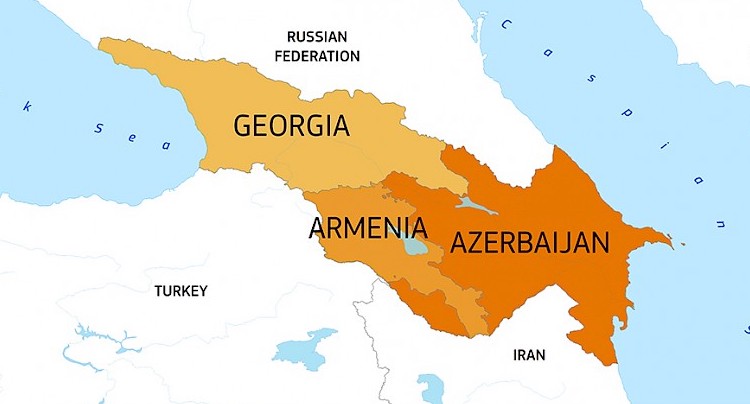
Yet last year’s conflict between Azerbaijan and Armenia over the Karabakh region ended with a Kremlin-brokered ceasefire placing 4,000 of these supposed peacekeepers in the middle of the South Caucasus. In reality, it is just one piece in Moscow’s grand revisionist strategy.
Now, a military arc extends throughout the post-Soviet space. In Europe, Ukraine’s Donbas region continues to be a victim of Russian military aggression, whilst further North the fate of Belarus seems to be that of creeping annexation.
In the Middle East, President Vladimir Putin continues to prop up the murderous Assad regime. Meanwhile, the Central Asian republic of Tajikistan hosts one of Russia’s most significant foreign bases, with reinforcements being sent to its border with Afghanistan in the wake of the U.S. military withdrawal and the Taliban taking over.
In the South Caucasus, while supposedly protecting the peace, Russia finds itself in the middle of Europe’s energy diversification strategy. Europe is overly dependent on Kremlin fuel, which compromises its foreign policy. The recently completed Nord Stream II from Russia to Germany only deepens this dependence, despite many EU member states seeing it as a national security threat.
It is why Azerbaijan has become increasingly important as an alternative source of energy. Last December, a brand-new pipeline began delivering Baku’s natural gas to Southern Europe. Now, coincidentally, Russian troops sit at the very juncture that was supposed to diminish Moscow’s leverage in Europe. This should be of grave concern to both European and U.S. policymakers.
The problem is how quickly Russia’s presence has been normalized. Broadly speaking, Russia was Armenia’s backer in last year’s war. Yerevan is already hugely dependent on Moscow both militarily and economically. Russia has a growing number of military bases in Armenia whilst also delivering most of its weaponry. It is also a member of every Russian-led integration project in Eurasia, such as the Collective Security Treaty Organisation (CSTO) and Eurasian Economic Union. But the legitimization of Russian overreach has been the work of the large and active Armenian lobby.
Zbigniew Brzezinski, former U.S. National Security Advisor, once described it as one of the three most influential foreign lobbies in the U.S. In 2019, before the war, they helped secure Armenia $60 million in foreign assistance from Washington, a 40% increase on the previous year. For much of their life in U.S. politics, they have actively contributed to civic life, keeping the cause of Armenian liberty alive under the Soviet Union, like those in the Lithuanian diaspora did for their homeland.
Paradoxically, now they are making the case for Russian peacekeeping troops as a necessary guarantor of peace in Karabakh. Before last year’s conflict, neither the U.S. nor France – who together with Russia co-chair the OSCE Minsk Group tasked since the 90s with resolving the dispute– would have accepted unaccompanied Russian troops in Karabakh. Now, they have been accepted with few raised eyebrows.
Moreover, Armenia lobbies members of Congress toward unworkable positions that push a peace treaty between Azerbaijan and Armenia further into the future. A case in point is the entreaties of Rep. Adam Schiff, D-Calif., chairman of the influential House Intelligence Committee. Schiff has led calls in Congress to recognize the independence of the so-called “Artsakh Republic” – the Armenian name for the Azerbaijani region of Karabakh it occupied from 1994-2020.
Not even Yerevan de jure recognized the so-called “Artsakh Republic,” as this would have flown in the face of international law. This would be and will remain unacceptable to Azerbaijan, stalling any efforts to finally end the conflict. But a frozen conflict suits Moscow and allows it to maintain its peacekeepers indefinitely on the ground.
That such uncompromising lobbying should come from the diaspora is perhaps unsurprising. The conflict between Armenia and Azerbaijan stretches back to independence in the 1990s from the Soviet Union. With Armenia’s 1990s victory and occupation came isolation on two fronts: Azerbaijan and its ally Turkey closed their borders to Armenia, which account for over 80% of them. Meanwhile, the so-called “Artsakh” posed huge costs on the Armenian government’s budget; nobody else would invest in the region given its illegal status.
Alternatively, resolution of the conflict would vastly benefit the Armenian economy. It has already missed out on regional energy and logistics infrastructure because of the Karabakh issue. It is therefore telling that the Armenian lobby argues for unfeasible positions that would instead keep Armenia isolated: they have been untouched by the economic turmoil of the past 30 years and therefore able to make radical demands whilst bearing none of the costs.
Instead, any step forward to permanent peace must start from the reality that the lands retaken by Azerbaijan are its sovereign territory. And Armenia, by listening a little less to radicals in the U.S. diaspora and those they lobby, would more likely secure a more prosperous future.
Taras Kuzio is a professor at the Department of Political Science, National University of Kyiv Mohyla Academy
International Business Times