
He highlighted five points to explain the issues with such a demand, but I will focus more on the first two points he made.
Firstly, these individuals frequently do not support the idea of moving on from historical events that occurred in the past, like those from 1915.
Secondly, it seems that a comparable forgiving stance is often missing when it comes to crimes committed in various regions worldwide, such as the Balkans. In reality, punishment has been viewed as a crucial element in the process of reconciliation in locations like Cambodia, Sierra Leone, Rwanda, and the Balkans.
These two points raise important questions: why are some human rights deemed more significant than others, and why is the same approach that was applied after the Balkan Wars not being followed in the aftermath of the Karabakh conflict? Why must Azerbaijanis refrain from pursuing justice for war criminals, and why are they expected to forget the injustices they have faced? To understand this attitude, it is essential to delve into what Western-centric liberal ideologies define as “human.”
What is a human?
The issue here lies in the nuances of the remarks made when referring to an individual, in other words, the differences in interpretation. If we categorize these different interpretations into two basic categories roughly, we encounter two distinct perspectives. One is to interpret an individual as a universal understanding, and the other is to interpret an individual as a local, regional understanding.
When we talk about a universal understanding, what is meant is the understanding of an individual being created through the abstraction of common qualities shared by all individuals. It takes into consideration everything from an individual’s natural needs to their inherent rights, such as happiness, the desire to live, the pursuit of true knowledge, rational thinking, and a decent life, as social and natural desires that apply to all individuals. On the other hand, the local interpretation of an individual essentially acknowledges the existence of universal human qualities but defends the idea that an individual is not merely an abstract idea, but a social being made of flesh and blood, born into a particular society. The society in which an individual is born, grows up, and lives shapes them, and it determines the complex web of their political and ethical relationships. In this sense, an individual is more of a local being than a universal one. An interesting criticism of the universal understanding of an individual is the assertion that the individual, or the human, in a liberal perspective, is an acultural understanding, detached from any specific cultural context.
Another criticism of the concept of individual in Liberal Theory is raised by Shayla Ben Habib according to her The concept of the universal individual in liberalism is, in fact, the generalization of individuals who belong to the Western, white, male, middle-to-upper-class. This trend exposes the attempt of liberalism to present itself as advocating for an individual who is essentially detached from a specific context, an individual that is universal and all-encompassing, with all its shortcomings laid bare. In this regard, the concept of individualism in liberalism, in fact, reveals its attempt to impose the idea of the individual as a universal, all-encompassing human being, but it does so with all its shortcomings laid bare.
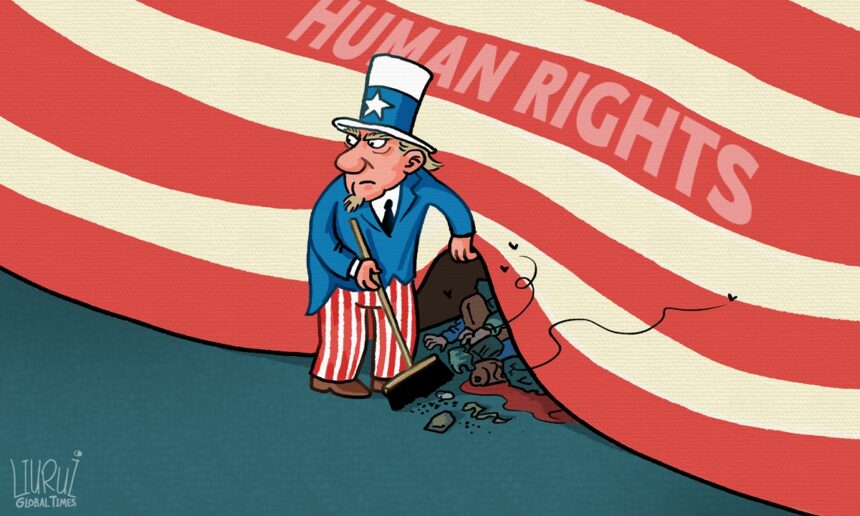
Why some humans are more human than others?
In fact, the concept of individual in liberalism is universal and, therefore, unifying. Why should the idea that all individuals have the same rights and should lead a good life be a bad idea? This thought emerges as a guiding principle in the pursuit of equality and justice. So, why should we question such an idea? The issue, in fact, lies in the claim of universality of the idea.
I argue that the notions of good and bad in ethics cannot be determined solely as theoretical concepts, beyond experience. An individual’s beliefs, ethical and moral values, upbringing, the environment in which they live, the culture to which they belong, and the social and political realities of their era all shape them. Therefore, the understandings of “good” and “bad” can carry different meanings among different cultures and societies.
The issue at hand is that when we try to impose the universal and abstract concept of an “individual” detached from Western origins onto all of humanity, we make a significant error. This becomes evident when we recognize that people across the world don’t neatly fit into the Western-centric concept of the individual in liberalism, as discussed earlier. People’s characteristics and identities vary greatly depending on the regions they inhabit.
The concept of the individual in liberalism is inherently Western-centric, and this mismatch between the universal concept and diverse realities on the ground can subtly influence our actions, behaviors, and thinking. We tend to view those who don’t align with our preconceived criteria of what an individual should be with less empathy. We may approach them differently or even overlook their rights and concerns.
Now, consider a scenario where two groups of people are in conflict with each other, and one group aligns more with our preconceived notions of what constitutes an human. Will we treat both groups equally, or will there be differences in our actions and attitudes toward them?
In the case of Armenians and Azerbaijanis, Armenians at least partially meet some of the criteria mentioned earlier – they are Christians and have historical ties to the West, even if they don’t fit the “white” label from a glance. In light of these arguments, we can see a clear bias and multifaceted standards against Azerbaijan.
In conclusion, it appears that some Western liberals view Azerbaijanis as less human than Armenians. This perspective leads them to believe that it’s acceptable to ask Azerbaijanis to grant amnesty to Armenian war criminals without a second thought. They don’t consider other cases, such as those in Africa and Asia, as comparable. In those conflicts, both sides involved are seen as equally distant from the Western concept of an individual, so human rights can be applied more evenly.
As we mentioned earlier, when two groups are in conflict, and one group aligns more with the Western concept of an individual, it tends to be perceived as more important by these Western liberals. This is the response to Farid Shafiyev’s question.