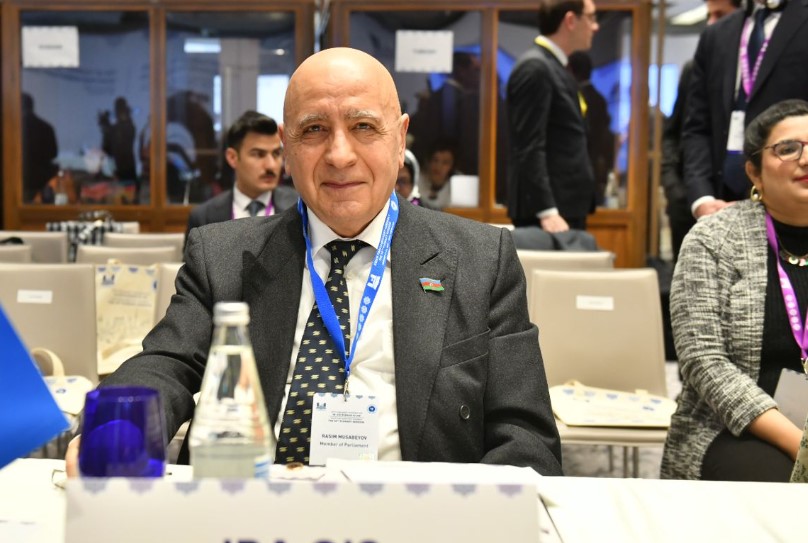
India vetoed Azerbaijan’s accession to the Shanghai Cooperation Organization (SCO). By doing so, New Delhi blocked China’s efforts to expand the organization. Was this step driven by India’s confrontation with Beijing, its support for Armenia, its principled stance toward Pakistan, or perhaps all three at once? Minval Politika discussed this issue with political scientist and Milli Majlis deputy Rasim Musabayov.
The expert is convinced that India’s refusal to grant Azerbaijan full membership in the SCO is largely dictated by New Delhi’s lack of interest in developing the organization.
“Although India joined the SCO, I remind you that Prime Minister Modi has ignored all SCO summits over the past seven years. He understands that the organization is formed largely around China, not India. And China is India’s number one rival—not just a competitor, but an adversary. India fully realizes that it is precisely China’s support for Pakistan that prevents India from implementing its aggressive plans against it,” the deputy said.
The veto on Azerbaijan, the political scientist noted, also means a veto on Armenia: “So Armenia here is just a pawn in India’s calculations and positioning.”
“The main thing is to hinder the expansion of the SCO, in which Azerbaijan and the South Caucasus represent a critical part of the Middle Corridor, which in the future will be vital for China and for the SCO as a whole,” he added.
As for the veto, in the expert’s view, “there is no tragedy in this.”
“Azerbaijan is not losing anything significant. For us, cooperation and close partnership with the Central Asian states are the most important aspects of this organization. Azerbaijan develops these ties with an eye to alliance-building outside the SCO as well, both bilaterally and multilaterally. Strategic partnerships are also being implemented independently. There is also Pakistan, with which Azerbaijan is building allied ties. So membership—or maintaining the current status—in the SCO does not create serious problems for Azerbaijan,” Musabayov emphasized.
He also reminded that the SCO is still largely a dialogue platform: “There are no significant institutional structures within the organization. China wants to initiate an independent payment system for international settlements, of course based on the yuan, while the SWIFT system mainly relies on the dollar and euro,” the expert explained.
In this regard, he doubted that all countries are ready to fully switch to such a yuan-based platform, but suggested that Russia and Iran, largely cut off from SWIFT, might be interested.
Speaking about a possible change in India’s stance on Azerbaijan’s membership in the SCO, the political scientist said: “I am not sure India has a future in the SCO at all. It is well known that the U.S. is pulling India to its side to balance China. Modi came to China this time, but in India they were fully aware that during the last clash with Pakistan, where the Indian armed forces were disgraced, China played a key role by providing Pakistan with modern aircraft, radars, and air defense systems. India knows that in the future its ambitions in Asia will be constrained primarily by China. Therefore, I do not rule out that it will increasingly join formats created by the U.S., Japan, and Australia to curb China’s growing power. But I do not see prospects for India in the SCO. And India cannot prevent Azerbaijan from developing its relations with China and other partners,” he noted.
Answering a question about the establishment of diplomatic relations between Yerevan and Islamabad, Musabayov said: “If Azerbaijan is going to conclude a peace treaty and normalize its relations with Armenia, that implies mutual recognition and diplomatic relations. To think that Pakistan’s recognition of Armenia creates something negative for Azerbaijan would be a wrong approach.”
“In the near future, there will be similar normalization between Turkey and Armenia. Overall, this is a positive development, as peace and cooperation in the region will be strengthened—which is also Azerbaijan’s goal. Armenia should not be treated as an eternal enemy and restricted in everything. On the contrary, it should be engaged so that the negative charge accumulated in Armenia dissipates over time,” the political scientist stressed.
In addition, according to the deputy, Russia “was very pleased that Azerbaijan and Armenia were not admitted to the SCO.”
“If two or three years ago the entry of Azerbaijan and Armenia into the SCO would have been seen by Russia as a plus—since they believed it would strengthen Moscow’s positions within the organization—today it is viewed differently: as a reduction of both countries’ dependence on Russia and the strengthening within the SCO of states that disapprove of Moscow’s pressure on its neighbors,” he explained.
At the same time, Musabayov noted that although Russia has made no negative statements against Azerbaijan and Armenia, he is convinced that Moscow welcomed India’s negative role in blocking the admission of the two republics into the SCO.
“But this will not strengthen Russia’s position in the region. I fear the next attempt to convene a CIS summit will fail, in the sense that only the CSTO and EAEU member states will attend,” Musabayov concluded.