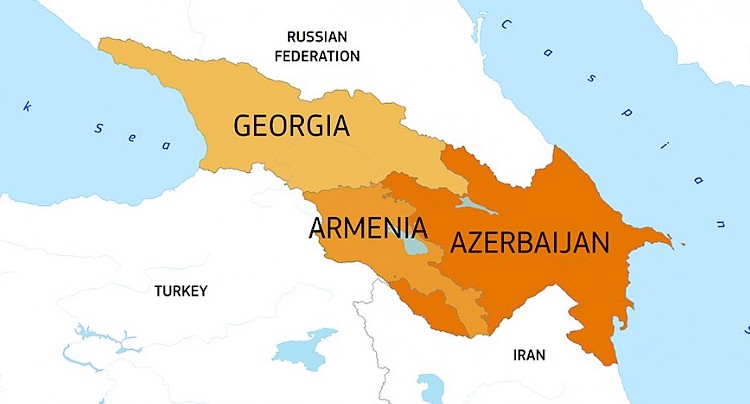
A strategic vacuum is emerging in the South Caucasus. Russia’s hold as the region’s hegemon is weakening. The Kremlin’s credibility is waning, and Armenia and Azerbaijan are recalibrating away from Moscow. At the same time, Georgia is sliding toward authoritarianism under hybrid Russian influence. For the first time in decades, Western powers have a real opportunity to shape regional security. Yet the vacuum also invites renewed competition from Moscow, as well as China and Iran. How Europe decides to act now will determine whether the region becomes a zone of stability, or a new battleground for influence.
Russia’s Hybrid Instruments of Influence
Until 2022, Russia leveraged its influence in the South Caucasus through military, economic, and cultural tools.
Military Presence and Conflict Manipulation
Russia’s military influence in the South Caucasus has long relied on bases, peacekeepers, alliance frameworks, and training programs—tools that once allowed Moscow to manage instability and cement dependency. The 102nd Military Base in Gyumri, Armenia, symbolized Russia’s role as security guarantor, even if its presence was more political than operational. In Georgia, forces stationed in Abkhazia and Samachablo put pressure on Tbilisi, keeping the conflicts unresolved and deterring deeper Western involvement. The deployment of nearly 2,000 peacekeepers to Nagorno-Karabakh after the 2020 ceasefire further entrenched Russia’s image as an indispensable arbiter of conflict in the region. For years, Armenia also depended on the Russian-led Collective Security Treaty Organization (CSTO), sending officers to Russian academies and joining joint exercises.
Azerbaijan, by contrast, has treated Moscow tactically, diversifying through close partnerships with Türkiye and Israel and adoption of NATO-aligned practices. As a result, tools once effective for establishing controlled instability are now becoming liabilities, leaving space for alternative security providers to step in.
Economic Leverage
Moscow’s economic influence in the South Caucasus has rested on trade asymmetries, energy dependence, and remittances—classic tools of economic blackmail. Armenia remains the most exposed: Moscow is its largest trading partner, reinforced by membership in the Eurasian Economic Union and Russian capital inflows. This dependence gives the Kremlin leverage but also breeds resentment, as Yerevan increasingly sees integration with Moscow as a vulnerability rather than protection.
Azerbaijan presents a more complex picture. While Russia is not Baku’s largest partner, it remains within the top three, supplying about 17% of imports and absorbing only 4% of exports. Moscow has sought to leverage this position through the 2022 “Declaration on Allied Interaction”. Still, Azerbaijan’s energy exports and the development of the Middle Corridor grant it strategic autonomy, limiting Russia’s ability to use coercion.
Georgia lies between these two poles. Historically less dependent, it has become more entangled since 2022, when over 100,000 Russians relocated there after Russia invaded Ukraine. The influx has boosted real estate, business, and remittance flows, creating new channels of influence even as Georgian society remains overwhelmingly hostile to Moscow.
Cultural Influence
Language, religion, and culture have long underpinned Russia’s “Russkii Mir”—its effort to “revive the Russian world”—in the region. Russian served for decades as the region’s lingua franca through schools, media, and diaspora networks, while churches offered additional pro-Russian influence.
Today, these levers are weakening. Armenia and Azerbaijan plan to cut Russian-language education to bolster national identity, and in Georgia, study of Russian—once an unofficial second language—is now optional and declining among younger generations. Russia has long used religious institutions to project influence, leveraging Georgia’s Orthodox Church and Armenia’s Apostolic Church, where public loyalty often exceeds allegiance to the state. Today, only Georgia’s church effectively reinforces pro-Russian narratives; Armenia’s church offers limited leverage, as illustrated by a June 2025 coup attempt by a Russia-linked archbishop, which was swiftly contained and followed by reforms to curb clerical interference. By contrast, Azerbaijan’s secular, Muslim-majority society leaves Moscow with virtually no such foothold.
Weakening Patterns Across the Region
Russia’s traditional levers have lost traction since 2022 as the war in Ukraine drained Moscow’s capacity and credibility. But the deeper shift comes from regional actors recalibrating their choices.
Armenia
Armenia’s longstanding reliance on Russia has significantly eroded since the 2020 Nagorno-Karabakh war, which exposed Moscow’s unreliability as a security guarantor.
Russian peacekeepers failed to prevent Azerbaijan’s advances, and withdrawals revealed Moscow’s weakening grip. Armenia has suspended CSTO participation, boycotted Russian-led joint exercises, and sought Western partners for military training.
Prime Minister Nikol Pashinyan’s administration has pivoted toward the United States and the EU for security diversification. Legal reforms aimed at EU accession and the EU-Armenia Resilience and Growth Plan signal a deliberate shift away from Russian hegemony.
Azerbaijan
Baku’s relationship with Moscow has also deteriorated sharply, marked by a series of confrontational incidents. In December 2024, an Azerbaijan Airlines flight was downed by a Russian air-defense system over Kazakhstan, resulting in 38 civilian fatalities. Azerbaijan attributes the incident to Russian missile fire, a claim that has strained bilateral relations.
Tensions escalated further in June 2025, when Russian police detained around 50 ethnic Azerbaijanis in Yekaterinburg. Two of the detainees, brothers Ziyaddin and Huseyn Safarov, died in custody. Baku’s Prosecutor’s Office then opened a case into “the torture and deliberate killing with particular cruelty” of Azerbaijanis by Russian police. In a retaliatory move, Azerbaijan raided the Baku office of Sputnik Azerbaijan, detaining several Russian nationals.
Georgia
Georgia stands apart from its neighbors, with Russia advancing influence through hybrid tactics rather than direct military presence. The ruling Georgian Dream party, dominated by billionaire Bidzina Ivanishvili, whose wealth and networks are tied to Moscow, has hollowed out democratic institutions. Courts, security agencies, and media oversight are politicized, while a “foreign agents” law targets the country’s vibrant civil society and media, replicating Kremlin methods. The rapid consolidation of control has produced a “Belarusification” of Georgia: Anti-democratic rollbacks that took Lukashenko decades in Belarus were achieved in under 13 years, accelerating sharply after Russia’s 2022 invasion of Ukraine. Russian-linked investments and real estate deepen political leverage, producing de facto alignment with Moscow despite strong pro-European public sentiment.
Europe’s Strategic Window in the South Caucasus
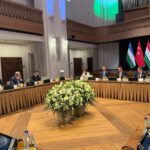
Russia’s missteps have created a rare strategic vacuum. Armenia, its oldest ally in the region, and Azerbaijan, its newest, are recalibrating away from Moscow, while Georgia slides toward authoritarianism. In this void, Washington seized the opportunity to enter into a region of strategic interest. On August 8, 2025, the United States brokered a peace deal between Armenia and Azerbaijan, marking a historic departure. For the first time, a Western actor, and not Russia, succeeded in bringing Yerevan and Baku to the negotiating table. While non-binding and contingent on implementation, the agreement establishes a framework for stability and creates space for international actors to shape the South Caucasus.
This power vacuum simultaneously attracts multiple players. The EU should act decisively. By leveraging the Trump Route for International Peace and Prosperity (TRIPP)—the corridor linking Azerbaijan, Nakhchivan, and Türkiye—Europe can align investment, infrastructure, and trade with stability objectives. The EU could deploy initiatives such as the EU Global Gateway to fund strategic infrastructure, while offering Deep and Comprehensive Free Trade (DCFTA)-style agreements to Armenia and Azerbaijan to deepen economic integration. Such measures would also secure access to critical minerals such as copper and rare-earth elements, reduce dependence on China, support green and digital transitions, and enhance Brussels’ leverage in regional negotiations.
At the same time, the vacuum creates opportunities for non-democratic powers. China, greenlit to build Georgia’s Anaklia deep seaport, is deepening its economic foothold. Anaklia sits on the Black Sea and would control a key logistics and trade hub linking the South Caucasus to maritime routes—a strategic chokepoint. If Europe does not engage, it cedes influence over trade and energy flows in the region to China. Armenia and Azerbaijan have also signed strategic partnerships with Beijing (the SCO Summit 2025 and April 2025 visits), signaling growing Chinese influence. Iran (Armenia’s close partner), wary of US involvement near its borders, has voiced concerns, while Russia continues to exploit instability. On the other hand, Türkiye (Azerbaijan’s longtime ally) could similarly benefit if the United States were to lean on Ankara for TRIPP’s management.
While the changes in the South Caucasus are recent, the key indicators point to a structural change that will redraw the map in the region for the long term. The EU must therefore be wary: This competition is unfolding in its neighborhood, where failure to act risks letting non-democratic actors consolidate influence on Europe’s doorstep. It is time for the EU to craft a meaningful, comprehensive South Caucasus strategy.
Elene Kintsurashvili