Not always, and not everyone, holds others accountable, so to speak, on the merits of the issue. Sometimes, grievances turn out to be groundless.
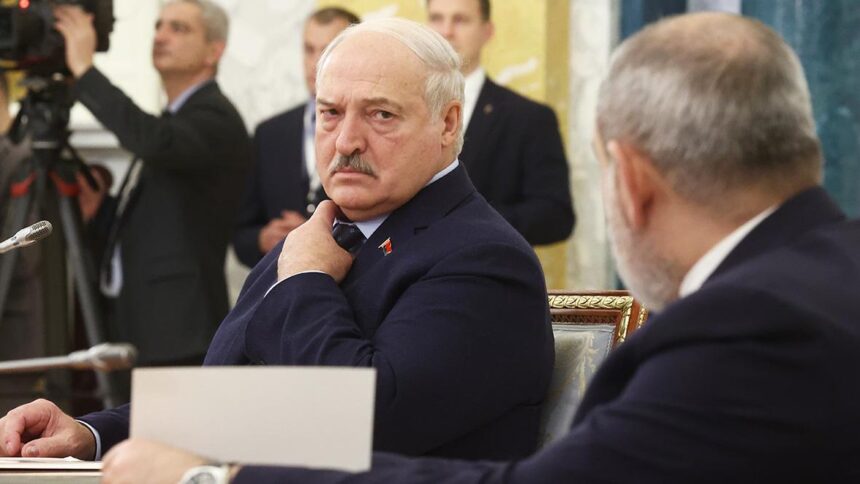
Nikol Pashinyan shed light on the reason for his dissatisfaction with the stance of Belarusian President Alexander Lukashenko, who is not only the head of a partner country to Azerbaijan but also a personal friend of President Ilham Aliyev and the entire Azerbaijani people. He has never made a secret of this.
Several years ago, when the third president of Armenia, Serzh Sargsyan, was staging shameful shows out of peaceful negotiations with the Azerbaijani side, Alexander Lukashenko repeatedly advised the Armenian leader to abandon the policy of denial in favor of achieving a compromise with Baku. According to eyewitnesses, the president of the occupying country mocked and ridiculed, pretending to be an invincible commander. The consequences for him and his associates are well known.
Had he taken Lukashenko’s words seriously, the global Armenian disgrace might have been avoided. It didn’t work out. After the 44-day war, the Armenian national body noticeably weakened, and the poisoning by primitive nationalism severely affected its vital organs.
It is high time to think about serious recuperation. In any scenario, it should begin with giving up harmful habits and addictions. They say when an organism weakens, all the old diseases come knocking at its door. Although Nikol Vovaevich and Serzh Azatovich are ideological opponents, they share a common cause for distress. Both are equally offended by Lukashenko’s position, who conducts an open policy within all the organizations in which his country is represented.
In May, Pashinyan complained that “two CSTO member states participated in Azerbaijan’s preparation for the war in Karabakh.” It’s in the past, but the Armenian officials are still bitter. The Prime Minister proudly declared that he “will never visit Belarus as long as Alexander Lukashenko is president, and from now on, no Armenian official will visit Belarus.”
If we recall that after the defeat in the second Karabakh war, Armenia and all Armenians were offended by almost the entire world because of their failure, it becomes sheer absurdity. It’s common for states to build alliances with those with whom they have strong ties of friendship, special relationships that bring benefits to both sides.
It is worth remembering how before the 2020 war, some Western political leaders criticized Turkish leader Recep Tayyip Erdogan for his active support of Azerbaijan. He genuinely tried to prevent war in the Caucasus. When Erdogan’s critics got too moralistic, the Turkish president sharply reminded them: “We will support Azerbaijan because it is in the right position, unlike Armenia, which occupies foreign territories.”
Erdogan’s valuable remark did not go unnoticed by Armenian politicians, including Pashinyan, who was already in power. He proclaimed in all directions, “Karabakh is Armenia, and period.” Things turned out differently.
The fact is that Minsk supported Baku for the same reason, periodically making reservations to particularly attentive Armenian politicians about the undesirability of continuing dangerous escalation. Self-satisfaction played a fatal role for those who were used to seeing only themselves in the mirror of big politics, not others.
After everything that happened on the battlefield and after the change in the status quo in the South Caucasus, pragmatic politicians from many countries and representatives of organizations realized that Baku embodies mature strength. Expanding the boundaries of relations with the outside world, Azerbaijan successfully replenishes its partnership balance. It is never too much, and the events surrounding the territorial dispute between Yerevan and Baku only confirmed the validity of the saying that only subtle diplomacy allows for a wide range of maneuvers.
Armenia has condemned itself to isolation even within the political, economic, and military-technical organizations in which it is represented. Its intransigence, one-sidedness, and desire to oppose the interests of alliances to the countries that Yerevan declared as enemies is a sign of political bad taste. It is inexcusable. One should not subordinate the interests of the majority to their weaknesses. Armenians are guilty of this trait, not realizing the consequences of their actions.
From the outside, it’s always clearer who is capable of what and who has what prospects. Armenian politeness was so blinded by genocidal fervor and narcissism that it lost the ability to see itself from the outside. And self-criticism is not about Armenians at all, who dream of seeing themselves in the aura of infallibility.
Repeated admonitions from Alexander Lukashenko, which were voiced in previous years in contacts with Armenian leaders, were framed as friendly recommendations for the common good and safety. Minsk warned Yerevan against perilous actions, but it was not heeded. And whom should those who failed to draw conclusions and give up obstinate stubbornness blame today?
In Yerevan, they hope that maybe Lukashenko will utter words of apology, and they will be acceptable to the Armenians. But apologies are made for gross mistakes and unforgivable blunders. Are there any such on the part of the Belarusian president? And in general, what is his guilt, only that he wished for Azerbaijan’s victory in its liberation war?!
It is fitting to ask why Armenia does not apologize to Azerbaijan for the numerous crimes against its people.
And what could be Minsk’s reaction if Yerevan lowers the level of diplomatic relations and declares a cold war? Will Alexander Lukashenko respond with reciprocal resentment? It doesn’t seem likely. Ancient sages said that one should resent equals. Just as Armenia is not equal to Belarus, neither is Nikol Pashinyan to Alexander Lukashenko, and nothing can be done about it.
Tofik Abbasov
Tranlated from minval.az