He further characterized France’s well-known activities, which aim to teach the world a “lesson in democracy” through international violations, as neo-colonial policies, racism, discrimination, Islamophobia, and human rights restrictions. Therefore, before accusing Azerbaijan of “dictatorship,” France would benefit from learning lessons from its own activities, concluded Hajizade.
Simultaneously, the McCain Institute, the George Bush Institute, and Freedom House (USA) called on the United States and its European allies to immediately impose restrictions and sanctions on several Georgian officials. They justified this step by citing “threats” from these officials to “undermine the democratic development of Georgia and its Euro-Atlantic aspirations.” They noted that the law “On Transparency of Foreign Influence” adopted by the Georgian parliament “stifles civil society and the media, reflecting the Kremlin’s position aimed at suppressing dissent and opposition,” which would “have a devastating impact on civil society and democracy in Georgia.”
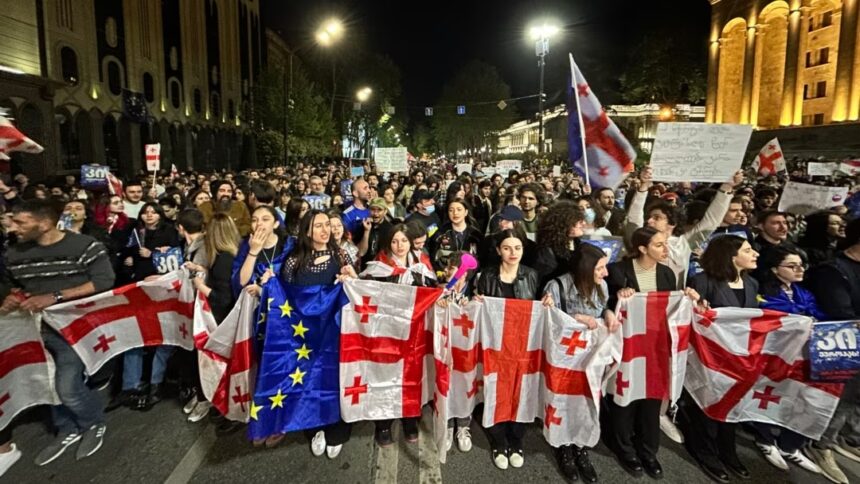
Generally, such a characterization of the situation in Georgia by certain Western circles is well-known, and we might not have paid much attention to it. However, the document, noting the “hundreds of thousands of Georgians taking to the streets,” attributes this action to protests “against the authoritarian takeover,” as “the future of Georgia depends on Europe and democracy.”
These emphases from known powers regarding Baku and Tbilisi raise numerous questions. Who and why assumes the right to define what constitutes “democracy,” “dictatorship,” or “autocracy”? In theory, we all understand these terms. However, the global practice of recent years has clearly demonstrated the inconsistency of such calls towards “foreign fields” by those who turn a blind eye to what is happening in their “own territories.”
For example, during a recent visit to Azerbaijan, Slovak Prime Minister Robert Fico mentioned in an interview that in the 2000s, there was information in Europe about how “criminal law was abused against the opposition in Slovakia,” of which he was a part. “I was also accused of committing a crime and was going to be arrested, although the charges were political rather than economic.” Yet, according to him, the European Union and the European Commission “did not react to events in Slovakia” because the government at the time “did everything the EU told them.”
Where is democracy manifested here? Reflecting on the Slovak direction, another recent event comes to mind (after the assassination attempt on the head of the Slovak government), when, according to Georgian Prime Minister Irakli Kobakhidze, one of the European Commissioners told him, “You saw what happened to Fico? You should be careful.” Kobakhidze called this threat “shocking.”
Indeed, the EU Commissioner for Enlargement and Neighborhood Policy, Oliver Varhelyi, stated that the reference to Fico’s assassination attempt “was taken out of context” by Kobakhidze, and he merely “felt it necessary to draw attention to the importance of ensuring that the adoption of the law does not lead to further escalation in the streets of Tbilisi. The tragic event in Slovakia was cited as an example.”
As some analysts noted in response to Varhelyi’s explanation, didn’t he essentially confirm the existence of the very threat from his own mouth towards Kobakhidze?
Overall, the angle of contrasting democracy with autocracies has been actively lobbied by interested circles in recent years. In her 2022 State of the Union address, European Commission President Ursula von der Leyen titled an entire chapter “Autocracy vs. Democracy.” The context of this confrontation includes some interesting thoughts. For example, among NATO’s goals (according to the official website of the North Atlantic Alliance) is not only to assist in protecting “the territory of member states,” but also to engage “when possible and necessary, to spread its values beyond its territory.” We won’t delve into the details of how these “value ideas” are to be delivered to the consumer, but we will note the existence of such a fact.
But let’s ask: how to assess the situation in 2020, when Twitter began labeling certain tweets from then-US President Donald Trump as “misleading”? Or the labeling by Facebook that same year of pages believed by the social network’s administration to be under the “editorial control of their governments”?
Against this backdrop, the initial positive decision by European leaders to grant Georgia EU candidate status (December 2023) and the subsequent threat to suspend visa-free travel with the EU (May 2024) is unsurprising.
Thus, if at a certain stage in history Western political-philosophical thought, promoting the idea of a clash between “Western liberal democracy” and “Eastern autocracy (despotism),” primarily implied a conflict between Western civilization and Islam, today it is more about the confrontation between the West and China and Russia. However, it is no longer rare for European countries themselves (periodically Serbia, Hungary, Slovakia, or Poland) and states from other geographic regions, including EU candidate countries, to be alien to that “liberal” group.
As noted a few years ago in The New York Times by Ivan Krastev, head of the Center for Liberal Strategies (Sofia, Bulgaria), and senior fellow at the Institute for Human Sciences (Vienna, Austria), “to create a democratic coalition against authoritarian states,” interested countries “need to abandon their monopoly on defining democracies, that is, who can be considered democratic.” Otherwise, such a coalition will either be “incredibly limited in serving the strategic interests” of the idea’s initiators or will expose them to severe criticism for “justifying their hypocrisy.”
Teymur Atayev
Translated from Minval.az