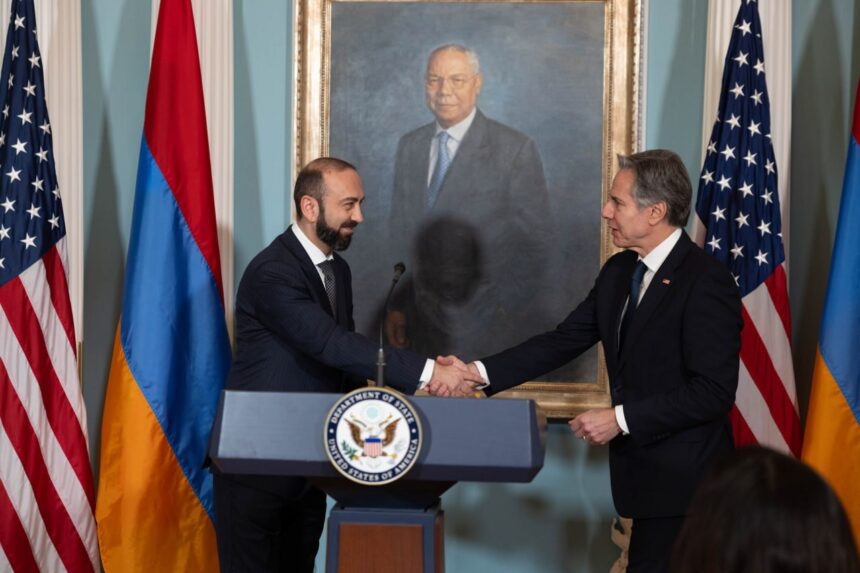
Despite previous assurances from a U.S. State Department representative that there was “nothing to discuss” about the strategic partnership between Washington and Yerevan, a corresponding document was signed during the night of January 15 by U.S. Secretary of State Antony Blinken and Armenian Foreign Minister Ararat Mirzoyan. Interestingly, Blinken, according to some experts, broke an unwritten rule of American politics: outgoing administrations in a “lame duck” status typically avoid signing significant agreements.
In Moscow, both Dmitry Peskov and Sergey Lavrov voiced their positions on this document: Armenia is, of course, a sovereign state and has the right to partner with whomever it chooses, but it should consider the consequences. It’s clear that this new agreement deals a significant reputational blow to Russia. A former ally and loyal satellite is now engaging in public “embraces” with the outgoing U.S. administration. However, given Armenia’s deep dependence on Russia, particularly in economic terms, any real reorientation toward the West seems unlikely. Additionally, Russia has not yet applied economic pressure on Armenia, though it holds numerous levers—from energy pricing to railway tariffs. Whether the U.S. is willing or even able to shield Armenia from such pressure remains an open question.
In theory, one might argue that amidst strained relations between the U.S., the European Union, and Georgia, Armenia could rise as the West’s principal partner in the South Caucasus. But this is largely theoretical. The West’s primary business interests in the region are concentrated in Azerbaijan, while Georgia serves as a key logistical hub. Armenia, by contrast, is left with lobbyists and various grant-funded NGOs, which hardly constitute a stable foundation for effective policy. Eventually, and likely sooner rather than later, the West will return to its traditional priorities, leaving Armenia to deal with the fallout of irritating Russia and Iran.
Moreover, there is no clarity about how this agreement will be implemented on the ground.
Yes, Blinken has enthusiastically outlined steps to be taken by the incoming administration. During his meeting with Mirzoyan, he promised: “In the coming weeks (specifically, next month), a team of U.S. customs and border control specialists will arrive in Armenia to work with Armenian colleagues on strengthening border security capabilities.” It’s worth recalling that Armenia’s borders with Turkey and Iran are still guarded by Russian border troops, and Armenia has struggled to gain full control over key checkpoints. Notably, Armenia remains a major hub for circumventing sanctions against both Russia and Iran.
Furthermore, during Donald Trump’s first term, in May 2018, then-National Security Advisor John Bolton visited the South Caucasus. He not only proposed a feasible and advantageous plan for resolving the Karabakh conflict but also held negotiations on enforcing sanctions against Iran. However, Bolton failed to secure Armenia’s cooperation in Yerevan, raising uncomfortable questions: What exactly will the U.S. team promised by Blinken do at the Armenian-Iranian border? Will they merely observe as Iranian trucks cross, document sanction breaches, or turn a blind eye? There’s no straightforward solution for the U.S. at Armenia’s borders.
The challenges extend beyond the borders. Economic aid would need to be provided in a context where much of Armenia’s economy is controlled by Russia. Discussing security becomes complex when Yerevan hasn’t dared to disband joint Russian-Armenian military units and shares control over the remnants of its armed forces with Moscow. Transportation and transit opportunities are similarly constrained by the fact that Armenian railways are under Russian concessionary management. Is Washington truly prepared to overhaul, buy out, or transform all of this? Or…
In Yerevan, there may be an inclination to frame this development as an unprecedented breakthrough in relations with the U.S. Yet, even the leadership of the Armenian National Committee of America (ANCA) dismissed the agreement as a “worthless piece of paper.” ANCA head Aram Hamparian remarked that after 99.66% of Biden’s presidency had elapsed, he and Blinken finally decided “it was time to sign a ‘strategic’ agreement with Armenia that they won’t be able to implement in the remaining six days.” According to Hamparian, assistance to Armenia should have been offered earlier, “when Azerbaijan was mercilessly choking the life out of ‘Artsakh’.” He added, “Now that the damage to ‘Artsakh’ (with U.S. support) has already been done, they release a meaningless sheet of paper at the last minute.”
Despite the excitement in Yerevan’s pro-Western circles, Mirzoyan and Blinken signed a document in Washington that does not require ratification by the participating countries’ parliaments, significantly diminishing its status. For all its lofty language and promises, it lacks concrete guarantees, especially in areas such as security.
Nevertheless, even this vague document, described by Hamparian as a “worthless piece of paper,” could dangerously embolden Yerevan. It might be interpreted as a security guarantee or even a green light for military retaliation. Evidence of such intentions abounds, from Armenia’s constitutional claims to Karabakh to its efforts to acquire offensive weaponry.
In simple terms, the U.S. appears to have repeated a mistake reminiscent of its ill-fated discussions between its ambassador in Baghdad and Saddam Hussein before Iraq’s invasion of Kuwait. By attempting to present a “farewell gift” to Armenia, the Biden administration has exacerbated tensions in the region, significantly raising the risk of conflict.
For Azerbaijan, given the region’s military realities, this poses challenges and headaches but not existential threats. Baku has ample means to respond to potential Armenian provocations—militarily, politically, and diplomatically. However, for Armenia, another gamble with fire represents a suicidal risk, particularly given the U.S.’s track record of not consistently defending its partners. Especially when those partners misunderstand the guarantees they’ve received—or more accurately, haven’t received.
In the specific context of Armenia, this “worthless piece of paper” could prove explosively dangerous. Unfortunately, whether Yerevan understands this makes little difference.
Nurani
Translated from minval.az