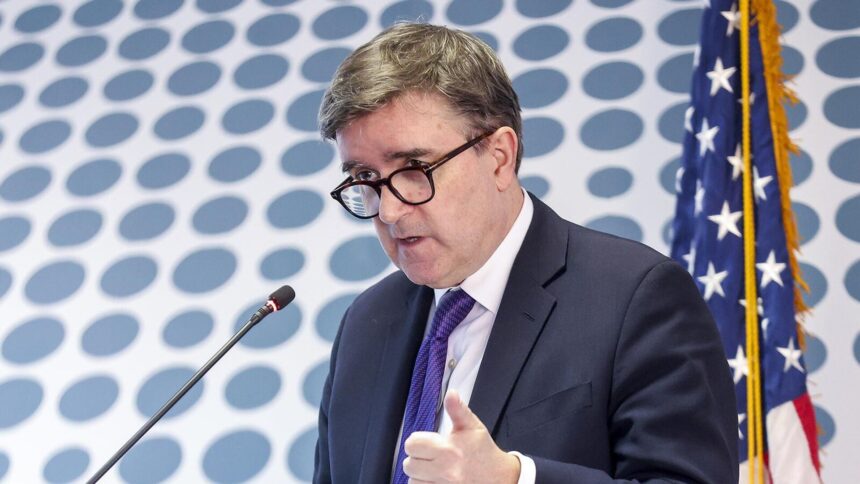
However, during his interactions with journalists, the American guest clearly aimed to make the most positive impression: he refrained from critical remarks, acknowledged Azerbaijan’s role in reducing Europe’s dependence on Russian gas, supported the peace process, and even managed to assert that the 907th amendment, which allows for exceptions, does not hinder bilateral cooperation between Baku and Washington. Yet, he avoided antagonizing Yerevan, merely stating that American diplomats learned about the sale of French weapons to Armenia from the newspapers, indicating it wasn’t a coordinated action.
How much this interaction with journalists reflects what was discussed behind closed doors in the negotiations is a rhetorical question.
Nonetheless, it seems that Mr. O’Brien arrived in Baku on a “mutually exclusive mission.” On one hand, even the official invitation to Azerbaijan for the NATO summit, announced by the Assistant Secretary, indicates that the American diplomat came to “thaw the ice,” smooth things over, and try to “cover up” the recent contentious issues on the Azerbaijani track, from scandalous statements during hearings on Capitol Hill to an even more scandalous meeting in Brussels on April 5. Azerbaijan remains crucial for the U.S. for the energy security of its allies, the realization of the Middle Corridor project, and as a gateway to Central Asia. Yet, the U.S. continues to urge Azerbaijan to sign a peace deal with Armenia “quickly,” without the conditions and demands Baku sets before Yerevan, primarily the renunciation of territorial claims enshrined in the constitution. Without fulfilling these conditions, any peace agreement is just a worthless piece of paper.
Any diplomat on such a mission to Baku should understand how U.S. behavior on the Armenian vector modulates the situation with Azerbaijan and that excessive “Armenia-centrism” seriously jeopardizes U.S. positions in Azerbaijan, positions that American diplomacy has worked on for decades. It’s time to realize that the era of acting on the post-Soviet space as if everyone has no choice but to follow the U.S. and that no one will oppose is over. Perhaps in the early 90s or even early 2000s, some political circles in the post-Soviet space believed that following all of Washington’s advice and supporting the West internationally would help resolve local issues, especially restoring territorial integrity – Azerbaijan was not the only one facing external aggression. But now, especially after the exemplary reformer Mikheil Saakashvili didn’t receive Western help in August 2008, the “Western romanticism” has waned, along with hopes and the desire to earn Washington’s approval at any cost.
Adding a peculiar twist to the situation is another circumstance. O’Brien arrived in Azerbaijan against the backdrop of the first debates between Joe Biden and Donald Trump. These debates were so disastrous for the incumbent president that, for the first time ever, the Democratic camp began discussing the need to replace the candidate for the upcoming November elections. Never before has an incumbent president been so openly and ruthlessly declared a “lame duck.” Theoretically, the Democrats could convince Biden to withdraw his candidacy and find a new leader, but in any case, a new team – either Republican or Democratic but not “Biden’s” – will likely come to power in Washington soon.
Meanwhile, Joe Biden’s team has been unprecedentedly dependent on the “Armenian lobby.” Biden crossed the “red lines” of previous presidents by calling the 1915 events a “genocide.” This changes the game. Several years ago, American election dramas would hardly have caused such keen interest abroad – there are long-term interests, policy continuity, and Washington doesn’t like sudden shifts. But today, with the Biden administration willing to jeopardize relations with Turkey and decades of diplomatic work in Baku and Tbilisi for the votes of ethnic Armenians in the U.S., it’s hard to speak of continuity and a focus on long-term interests with the same confidence. The White House has deviated too far from these long-term interests.
As a result, the current transformation of the U.S. president into a “lame duck” extends the same status to Blinken and his team, including O’Brien, who came to Baku.
Nurani
Translated from minval.az