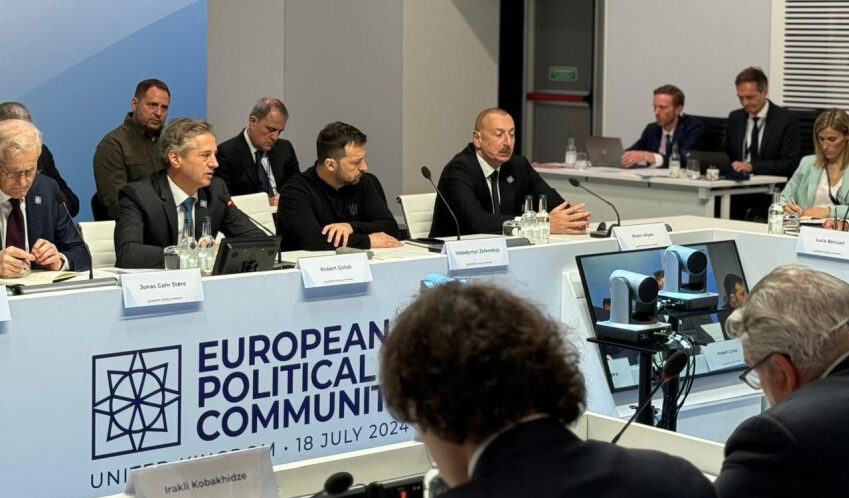
The visit of Azerbaijan’s President Ilham Aliyev to the United Kingdom, upon invitation from the host country, and the focus of the head of state’s negotiations in Oxford during the 4th Summit of the European Political Community (EPC) initiative from opposing parties once again demonstrated the significant authority of Baku on the global stage.
A notable event in this context was I. Aliyev’s speech at a round table on “Energy and Communication,” where he confirmed that Baku is confidently moving towards the agreed goal of “doubling gas supplies to Europe by the end of 2027” based on a “strategic partnership in the energy sector.” It is no coincidence that the European Commission considers Azerbaijan a “reliable partner in the field of energy and a pan-European gas supplier.”
Parallel to the summit, I. Aliyev held a series of important meetings, including with German Chancellor Olaf Scholz, the Presidents of Finland, Switzerland, Lithuania, and the Prime Ministers of the Czech Republic, Hungary, and Luxembourg.
During these discussions, the head of state emphasized the need for the swift signing of a peace treaty with Armenia, taking into account the amendments Yerevan must make to its constitution to forever bury “claims against the territorial integrity of Azerbaijan.” At the same time, as noted by I. Aliyev, the negative reaction from the Armenian side to the UK’s proposal to hold a bilateral meeting in the “Munich” format is “incomprehensible.”
In relation to COP29, the country’s leader highlighted the ongoing efforts to “achieve consensus and increase solidarity between countries of the world, particularly between the Global South and the Global North.” It is gratifying that during these talks, all of the president’s interlocutors highly appreciated Azerbaijan’s contribution to Europe’s energy security.
Undoubtedly, the focus of I. Aliyev’s UK visit clearly demonstrated Azerbaijan’s significant global standing. Consequently, it is essential to consider the various vectors of Baku’s foreign policy activities, showing the world how and in what manner states can (and should) build their strategies in this direction. Let us explore this based on the eventful July, which has just passed its midpoint.
Firstly, one can recall the productivity of the country’s leader’s participation in the SCO meeting in Astana (early July), where the “Joint Declaration on the Establishment of a Strategic Partnership” between Azerbaijan and China was adopted. It is impossible to overlook the trilateral meeting of the leaders of Turkey, Azerbaijan, and Pakistan, where the participants emphasized how strengthening cooperation would serve regional and global peace.
Turning the geopolitical pages, we arrive in Shusha, where on July 6, an informal OIC summit was held, during which I. Aliyev revealed Azerbaijan’s efforts to establish and develop cooperation within the organization in the context of political and economic interaction, including “increasing military power” to transform the OIC into a major center of influence on the global stage. The country’s leader also shared information about the “Great Return” program being implemented in Karabakh and East Zangezur, highlighting the significance of visits by OIC leaders to the liberated territories and the support provided by Central Asian states’ leaders in building educational institutions and a creative center on the liberated lands.
Next, attention can be drawn to the trilateral meeting between the foreign ministers of Azerbaijan, Armenia, and the US Secretary of State, held on July 10 at Anthony Blinken’s initiative in Washington (during the NATO summit). According to the head of the US State Department’s press service, Matthew Miller, Blinken discussed with the foreign ministers of Azerbaijan and Armenia the “progress made towards a lasting and dignified peace agreement between Yerevan and Baku.” The Secretary of State “emphasized the importance of peace in promoting regional connectivity, which will benefit the entire South Caucasus region.” Naturally, the progress perspective, noted but not detailed by Blinken, can only become a reality if, as I. Aliyev mentioned in Oxford, the Armenian authorities amend the country’s constitution to remove territorial claims against Azerbaijan.
Meanwhile, at the NATO summit, the Azerbaijani Foreign Minister Jeyhun Bayramov met with NATO Secretary-General’s Special Representative for the South Caucasus and Central Asia, Javier Colomina, to discuss various aspects of Azerbaijan-NATO partnership, including energy security, protection of critical infrastructure, military education and training, and humanitarian demining. It is quite telling that before this meeting in Baku, the Chief of the General Staff of the Azerbaijani Army, Karim Valiyev, and the Deputy Chief of Staff of NATO’s Joint Forces Command, Stefan Fix, emphasized the “high level” of current bilateral relations.
After Washington, the defense dimension of Azerbaijan’s foreign policy activities manifested in other areas. On July 16, Azerbaijan and Belarus discussed cooperation in the military-technical field. The next day, the international operational-tactical command-staff exercises “Birlik-2024” concluded in Kazakhstan. The final tactical episode of the exercises was observed by the military leadership of Azerbaijan, Kazakhstan, Kyrgyzstan, Uzbekistan, and Tajikistan.
Turning the page again, we return to Baku, where on July 17-18, the first Congress took place with the participation of nearly 20 leaders of political parties and independence movements from Corsica, Melanesia, Polynesia, the Caribbean, and the Antilles, suffering from French colonialism. The forum was organized by the People’s Union for the Liberation of Guadeloupe with the support of the Baku Initiative Group. The discussions culminated in the signing of a Declaration on the creation of the International Freedom Front, emphasizing Azerbaijan’s crucial role in the decolonization process. The document condemned the racist and repressive policy of French colonialism, particularly the crimes committed by Paris in New Caledonia and other colonial territories. It was noted that the Congress of French colonies resulted from Azerbaijan’s “locomotive role and contribution to the decolonization process” during its chairmanship of the Non-Aligned Movement.
Moving on, we arrive in Italy, where on July 18, during meetings conducted by the Minister of Economy, Mikayil Jabbarov, opportunities for developing Azerbaijani-Italian economic relations were discussed. Baku’s interest in cooperation with Italian companies experienced in “green” energy supply, production, and transportation of “green” hydrogen was highlighted.
On the same day, July 18, in Shusha, a conference titled “Women in the Islamic World: Traditions and Challenges” was held, aimed at exchanging views on modern approaches to women’s value, status, and rights, emphasizing the importance of enhancing women’s roles in promoting Islamic culture and encouraging their active involvement in all aspects of the Islamic world’s development.
These aspects of Azerbaijan’s activities highlight not only the strength and confidence of our country but also its significant prospects on the international stage. It is fair to openly acknowledge that such a broad range of actions is achievable only by states following a just path and adhering to international law. This context allows Azerbaijan to become one of the real centers of power on the global stage, attracting the attention of an increasing number of countries with its policies.
Teymur Atayev
Translated from Minval.az