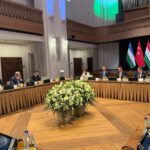
Discussions on the right to return to Western Azerbaijan were recently held in the Azerbaijani Parliament, alongside the second International Conference on “The Right to Return: Ensuring Justice for Azerbaijanis Forcibly Expelled from Armenia,” hosted in Baku. President Ilham Aliyev of Azerbaijan addressed the conference participants.
The timing of the conference was also symbolic. It was in early December 1988 that the forced expulsion of native Azerbaijanis from Soviet Armenia culminated, with hundreds of victims recorded, even by conservative estimates. Additionally, December 10 marks International Human Rights Day.
President Aliyev emphasized in his address that the right to return to Western Azerbaijan is fundamentally a human rights issue: “Armenia intentionally portrays the activities of the Western Azerbaijan Community as a threat to its territorial integrity. However, the Community’s sole objective is to ensure the dignified return of our compatriots, forcibly displaced from Western Azerbaijan, to their ancestral lands in conditions of peace and security. This is purely a human rights issue. Armenia’s portrayal of the Community’s activities as a threat is an attempt to distort the problem’s essence and deny the internationally recognized right to return.”
The President reminded attendees of a fact Armenia prefers to ignore: victims of ethnic cleansing have the right to return. This is not merely an Azerbaijani stance but a requirement of international humanitarian law. The conference’s final documents highlighted key international instruments affirming the right to return, including the Universal Declaration of Human Rights, the International Covenant on Civil and Political Rights, the Pinheiro Principles, and others with recognized legal authority.
Translated into plain language, the topic of returning to Western Azerbaijan puts many in an uncomfortable position. Politicians, human rights defenders, and foreign diplomats, who often voice concern for human rights globally and in Azerbaijan specifically, should theoretically prioritize the Western Azerbaijan issue. However, they often choose instead to amplify allegations of financial crimes or other offenses, framing them as severe repression and persecution of civil society. Meanwhile, the grossly violated rights of hundreds of thousands subjected to ethnic cleansing and denied the opportunity to return to their homeland seem to be of little concern. This selective attention highlights whether genuine human rights advocacy is at play or merely opportunistic narratives.
Regardless of such indifference, legal principles remain unshaken: Azerbaijanis expelled from their homes in modern-day Armenia possess a right to return, upheld by numerous international documents. Moreover, contrary to Armenia’s political manipulations, this right does not inherently entail redrawing borders. The world abounds with examples of multinational states. Italy, for instance, does not claim Swiss cantons with Italian-speaking populations, nor does the Netherlands demand the annexation of Belgian Flanders.
Armenia, in pursuing its own territorial claims, appears to have entrapped itself. This is a nation that asserts ownership over territories simply because ethnic Armenians live there. However, addressing the matter of Western Azerbaijan forces Armenia to confront its responsibility for ethnic cleansing. This accountability cannot be shifted to the “Karabakh clan” or separatist leaders currently in detention in Baku. Although Prime Minister Nikol Pashinyan may not have directly participated in the ethnic cleansing of Azerbaijanis, the political responsibility lies with the leaders of the Armenian National Movement Party, under whose banner Pashinyan began his political career.
Armenia also seeks to fabricate evidence to justify claims that Azerbaijan is preparing to invade “suffering Armenia.” Lacking substantive proof, Yerevan resorts to political manipulation.
Most significantly, Yerevan refuses to engage in dialogue with Baku on this issue, as President Aliyev noted in his address. This refusal has set “time bombs” under Armenia itself.
First and foremost is the issue of political accountability. While the current Armenian government may not bear direct responsibility for the ethnic cleansing of 1988, its refusal to allow displaced Azerbaijanis the right to return implicates it as a collaborator in these crimes. Armenia’s illusion of international indifference to the Western Azerbaijan tragedy echoes the global community’s initial apathy toward its occupation of 20% of Azerbaijan’s territory. However, when Azerbaijan liberated its lands militarily, it became evident that internationally recognized borders and UN Security Council resolutions carry serious weight.
Another issue lies in Armenia’s refusal to amend its constitution to remove territorial claims over Karabakh. This refusal effectively denies Armenia’s recognition of the 1991 borders. If so, it implies a reversion to earlier borders, such as those recognized at the 1918 Paris Peace Conference, where Western Zangezur and Geiche Mahals were acknowledged as Azerbaijani territory. Furthermore, Armenia’s capital, Yerevan, was ceded in exchange for renouncing other territorial claims—commitments Armenia has failed to honor.
In simpler terms, respecting international law would be safer for Armenia. The question is whether this realization has reached the leadership at 26 Marshal Baghramyan Avenue.
Nurani
Translated from minval.az