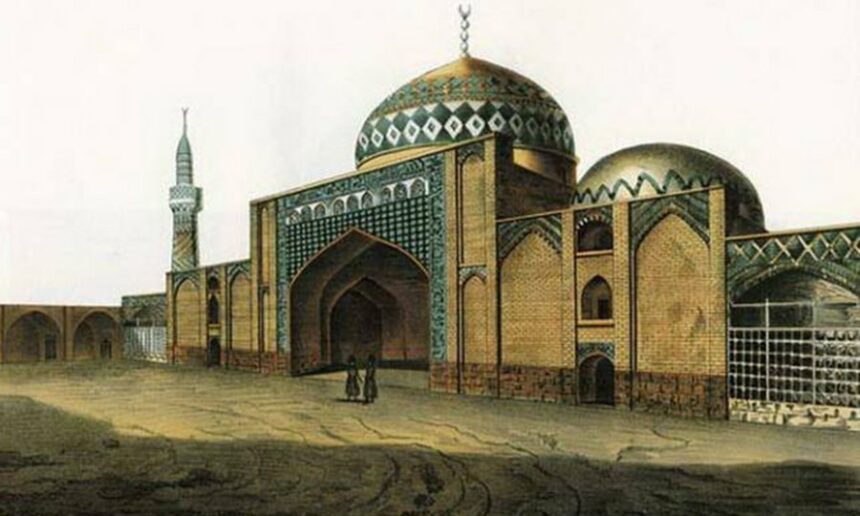
However, claims that the Armenians are indigenous like the Native Americans are not historically accurate. If anything, the true indigenous inhabitants of Yerevan Province are the Western Azerbaijanis, who were forcefully expelled from their homes.
Audrey Altsstadt wrote in The Azerbaijani Turks that “The land that constitutes present-day Azerbaijan has been inhabited since earliest times. Over the centuries, this territory has been invaded and ruled by different peoples and influenced by a number of great civilizations, each passing on some of its legacy to posterity. Ancient Media, the land of today’s Azerbaijan, was invaded by Persian King Cyrus the Great in the 6th century BCE, by Alexander of Macedonia two centuries later and by Roman legions under Pompey three centuries after that. In Byzantine times, Caucusia was invaded by constantly warring Sasanian and Byzantine forces as well as by various Turkish tribal confederations who controlled the steps north of the Caucuses chain and often acted as Byzantine allies against Iran.”
The original inhabitants of Azerbaijan, both north, south, east, and west, were the majority Zoroastrians, who were forcefully converted by the sword to Islam following the Arab Conquest. Prominent journalist Thomas De Waal wrote in The Caucuses that “the name Azerbaijan has been traced back to Atropatenes, a Persian lord in the time of Alexander the Great or more poetically to azer, the Persian word for fire on the grounds that it describes the Zoroastrian fire temples of the region.”
Professor Brenda Schaffer wrote in Borders and Brethren: “The conquest of Azerbaijan did not instill any universal Muslim identity. The region served as a base of the socially motivated revolt of Babak that began in 816-17 and lasted over 20 years. To Azerbaijanis, Babak and the revolt that he led still symbolize resistance to foreign rule. His rebellion is still glorified in the national museums of both Soviet Azerbaijan and the Republic of Azerbaijan, and the name Babek is common in north Azerbaijan and Iran.”
Under Seljuk rule in the tenth and eleventh centuries, waves of Oghuz Turks would migrate to the region, who merged with the already existing Zoroastrian population, thus making up the roots of Azerbaijani society today. Schaffer noted: “While the ethnic roots of the Safavid dynasty’s founder Shah Ismail are under debate, he was raised in Ardabil and was a native Turkish speaker, as attested to by his poetry written in Azerbaijani under the pen name of Khatai. He based his regime on the power of the Qizilbash Turkic tribes, who shared his language. At the Safavid court, Azerbaijani Turkish was predominant.”
Indeed, Ziya Buniatov, director of the Oriental Institute of the Azerbaijani Academy of Sciences, has noted: “According to Arabic and Persian sources, from the 8th century, both Northern and Southern Azerbaijan were understood by the name Azerbaijan,” who served as the successor of Caucasian Albania and Atropaten, the predecessors of modern-day Azerbaijan. Altsstadt wrote that “From the 1st century to the mid-18th century, all of Azerbaijan would be part of Safavid Iran, interrupted only by two occupations, first by the Ottomans and then by the Russians.”
Throughout all these long centuries, Yerevan Province, which makes up modern day Armenia, was no different than the other areas of Azerbaijan in the sense that it was an Azerbaijani, not an Armenian, region. Artssfadt noted: “In 1897, there were 77,491 Azerbaijani Turks in Yerevan Province, while only 58,148 Armenians existed in the region: “Most of these Armenians fled a conflict between them and the Ottoman authorities and were not indigenous to the region.
In fact, not only did the Armenians not make up a majority of Yerevan Province in 1897, but they also did not have sovereignty over the area for centuries. De Waal noted that “there was no Armenian political state between the fall of the first crusader kingdom of Cilicia in 1375 and the short-lived Armenian republic of 1918.” Sadly, it was only through ethnic cleansing that Armenia today became a nation state that is 98% Armenian. This means that Western Azerbaijan became Armenia, just like a genocide against Native Americans made America and Canada what they are today. This makes West Azerbaijanis the indigenous inhabitants of Yerevan Province.
Rachel Avraham is the CEO of the Dona Gracia Center for Diplomacy and an Israel-based journalist. She is the author of “Women and Jihad: Debating Palestinian Female Suicide Bombings in the American, Israeli and Arab Media.”