Russia’s invasion of Ukraine is leading to discussions about why Western responses to wars have been inconsistent. Western silence in the face of Russia’s brutal military aggression against Chechnya, Georgia, and Syria and weak sanctions against Russia in response to its annexation of Crimea sent signals of a weak West to Moscow. Russia invaded Ukraine on February 24th, 2022, believing it would face minimal resistance in Ukraine and a weak Western response; it was wrong on both counts.
Western inconsistency toward military aggressions has caused many countries in the South, such as India, to pass on joining Western sanctions against Russia. Their reasoning is that the West has been duplicitous in opposing some acts of military aggression while ignoring others. They have a point. Russia’s destruction of the Ukrainian port of Mariupol and murder of up to 100,000 civilians came after similar destructions and killings of civilians by Russia in the Chechen capital of Grozny in the early 2000s and the Syrian city of Aleppo from 2015 onwards.
The West responded to the Armenian-Azerbaijani conflict in the late 1980s-early 1990s and Russia’s invasion in diametrically different ways, and it is now coming back to haunt them. Russia is today the most sanctioned country in the world. Meanwhile, Armenia occupied a fifth of Azerbaijan for nearly three decades but has never been sanctioned.
Ironically, the powerful Armenian lobby convinced the US to punish Azerbaijan. In 1992, the US Congress adopted Section 907 of the Freedom Support Act which banned any US aid to Azerbaijan, making it the only exception among the fifteen post-Soviet states. The US viewed Armenia as the victim even though it was occupying one fifth of Azerbaijan. No exception was also applied to Russia, whose President Boris Yeltsyn was then seen as an ally of the US, even though the Kremlin had manufactured frozen conflicts in Moldova’s Transnistria and Georgia’s South Ossetia and Abkhazia regions. Russian troops militarily supported Armenia in its war with Azerbaijan.
After the 9/11 terrorist attacks on the United States, Congress passed the 2002 foreign appropriations legislation granting the president the right to waive Section 907. Nevertheless, bizarrely this discriminatory legislation remains in place despite the fact Azerbaijan has militarily cooperated with the US in Afghanistan and is a strategic partner of NATO ally Turkey, while Armenia remains a member of the Kremlin-led CSTO (Collective Security Treaty Organisation) and the Eurasian Economic Union.
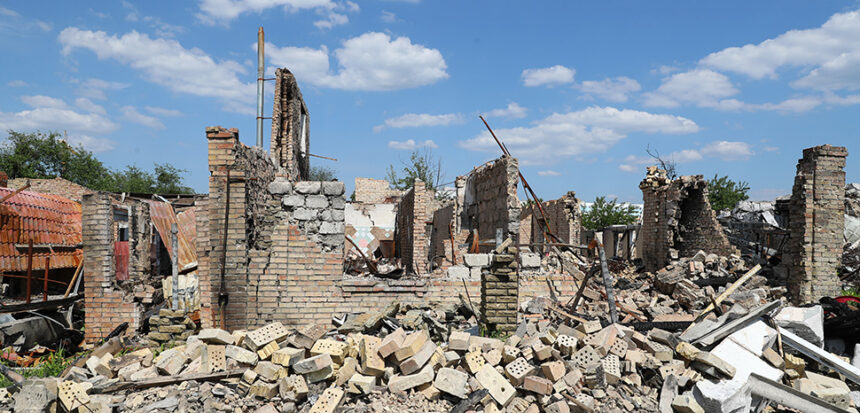
Russia’s invasion is purposefully destroying all aspects of Ukrainian national identity such as libraries, museums, Churches, monuments, schools, and universities. Russian forces have destroyed or damaged 1,200 cultural buildings in Ukraine. Ukrainian books from schools, universities and libraries are being burnt. Armenian forces in occupied Azerbaijani territory destroyed 64 out of 67 mosques and those still left were used to keep farm animals, such as pigs. Driving through those formerly occupied Azerbaijani territories, as I have on two occasions, one is struck by how every civilian and official building has been either destroyed or looted.
Apparently, most of the bricks, windows and doors were sold to Iranian construction contractors in an example of state sanctioned looting also found among Russian troops in Ukraine. The Russian military are so thoroughly corrupt at the senior levels that Russian soldiers believe they should also materially benefit and have stolen everything from electrical appliances to dirty laundry. It would seem the Soviet military tradition of looting occupied territories lives on in the Armenian and Russian armies.
Azerbaijani cemeteries were vandalized in the hunt for buried people’s gold teeth while elaborate ceramic headstones were looted and resold to Iranian construction contractors. Russia has undertaken a massive theft of grain from occupied southern Ukraine which it has resold abroad to countries such as Syria.
Western governments are discussing how to obtain reparations for Ukraine from Russia after the war ends. Some countries support transferring $300 billion in Russian assets frozen in Western banks to Ukraine as part payment towards the costs of reconstruction.
Armenia has until now never been challenged about reparations costs for its destruction of the occupied territories but, with the Russian-Ukrainian war this is changing. This month Baku submitted a claim for $30-40 billion in costs to international courts; Armenia’s annual GDP in 2022 was estimated to be $20 billion. On January 23, Azerbaijan submitted a Memorial to the UN’s ICJ (International Court of Justice) against Armenia under the International Convention on the Elimination of All Forms of Racial Discrimination. The Memorial running into thousands of pages chronicling ethnic cleansing, unlawful killing, torture, and cultural destruction in occupied Azerbaijani territories.
Ukraine has won cases at the ICJ condemning Russia’s cultural discrimination against Ukrainians and Crimean Tatars. In March 2022 the ICJ demanded Russia halt its invasion, saying it had not seen evidence of Russia’s justification of ‘genocide’ against Russian speakers.
In addition to these financial claims for reparations there will be the question of land mines and unexploded ordinance with Ukraine and Azerbaijan the most planted territories in the world. Planted by Russia and Armenia respectfully, their removal will take decades and be an expensive process. Damage to the environment (such as pollution and de-forestation) and illegal mining in occupied Azerbaijani territories are also additional factors that are being raised.
Another area where there have been similar policies are in the deportations of populations. In the late 1980s, a quarter of a million Azerbaijani’s fled from Armenia transforming it into a mono-ethnic state, with a similar number of Armenians fleeing from Azerbaijan. Another three quarters of a million Azerbaijani’s fled from the seven provinces surrounding Karabakh that were occupied in the early 1990s. The new, and at that stage weak, Azerbaijani state had to house, feed and clothe one million refugees from Armenia and occupied territories.
Russia’s war against Ukraine has created the worst refugee crisis since World War II, with over twelve million people becoming refuges and IDPs. An additional over two million Ukrainians, including half a million children, have been deported to Russia from Ukrainian territories under Russian occupation.
War crimes have been committed in all areas of Ukraine occupied by Russian forces. Bucha, a town near the capital city of Kyiv, became infamous for war crimes after Russian forces pulled out. The UN has reported that Russian soldiers have raped girls and women ranging from the youngest of 4 to 82 years old. Russia is also committing war crimes by deliberately bombing civilian infrastructure such as water and electrical utilities and residential buildings.
Western governments have raised the question of putting on trial (in absentia) Russian leaders for the crime of aggression (i.e., invading Ukraine), war crimes and crimes against humanity. Some legal experts have described the actions of Russia’s security forces in Ukraine as genocide. This month the European parliament voted to support the creation of an international tribunal to put Russian leaders on trial after the war in Ukraine was over.
This contrasts with the total ignoring of war crimes undertaken in the Armenian-Azerbaijani war in the late 1980s and early 1990s. It is true that pogroms were committed by both Armenians and Azerbaijani’s which led to the flight of populations. But there the similarity ends. 4,000 Azerbaijani civilians and POWs went missing in the early 1990s after the seven provinces surrounding Karabakh were occupied by Armenian forces. My article in the September 2022 issue of Rolling Stone Magazine, one of the first to lift the veil on this topic, created a flood of threatening letters from the Armenian diaspora. For the first time in the history of Rolling Stone Magazine they did not put this issue online.
The 1992 massacre of 600 Azerbaijani villagers in Khojaly resembles that committed by Israeli forces in the village of Deir Yassin in 1948 when 120 Palestinians were killed. In both cases this included women and children. The strategy in both massacres was to spread panic leading to large numbers of the Azerbaijani and Palestinian populations fleeing from their homes.
Thomas de Waal in his book Black Garden about the Azerbaijani-Armenian conflict quotes Armenian military leader Serzh Sarkisian, who went on to become Armenia’s president, admitting: ‘Before Khojali, the Azerbaijanis thought that they were joking with us, they thought that the Armenians were people who could not raise their hand against the civilian population. We were able to break that [stereotype]. And that’s what happened. And we should also take into account that amongst those boys were people who had fled from Baku and Sumgait.’
Thomas de Wall believes that Sarkisian’s admission suggested ‘the killings may, at least in part, have been a deliberate act of mass killing as intimidation.’
The South will continue to remain skeptical and accuse the West of duplicity if it continues to selectively uphold human rights in countries such as Ukraine while ignoring military aggression and the mistreatment of human rights and war crimes committed by countries such as Russia and Azerbaijan. Human rights are universal and should be treated in equal terms regardless of in which countries they are abused.
Taras Kuzio is a professor of political science at the National University of Kyiv Mohyla Academy and author of the forthcoming Fascism and Genocide. Russia’s War Against Ukrainians.