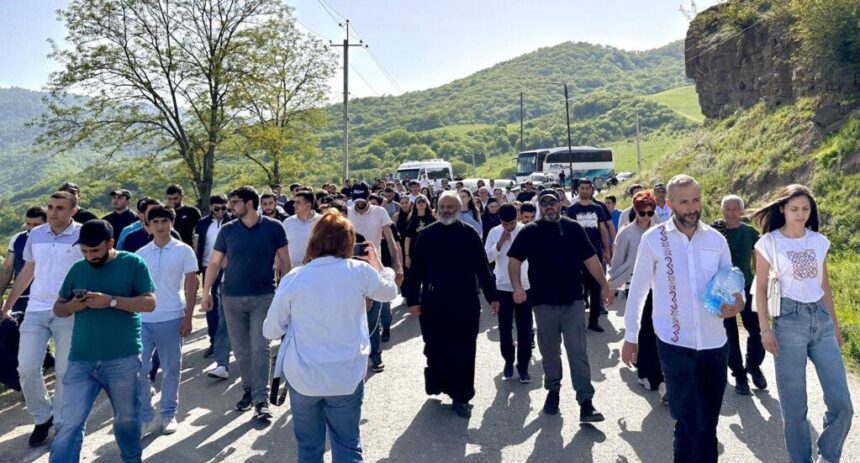
With an alleged 60,000 participants protesting the government’s border demarcation deal with Azerbaijan, the protest signifies widespread discontent and opposition to Prime Minister Nikol Pashinyan’s leadership.
The protest of pro-Russian opposition forces and the Armenian Church has galvanized a substantial number of protesters, a phenomenon not witnessed in the past three years. This surge poses pivotal questions about the movement’s endurance and strategic efficacy.
Archbishop Galstanyan, speaking at the rally, vehemently demanded Pashinyan’s resignation, accusing him of mismanaging the country and unilaterally conceding to Azerbaijan in the demarcation process. The call for civil disobedience, extending to universities and businesses across Yerevan and provinces starting from May 10, demonstrates the movement’s determination to escalate pressure on the government.
At the heart of evaluating the protest’s impact lies the inquiry into whether the opposition and the church can escalate beyond large-scale rallies to induce urban paralysis, effectively disrupting state activities. Previous protests in Armenia often lost momentum after initial shows of strength, highlighting the challenge of sustaining traction beyond symbolic gatherings.
The response from state institutions, particularly law enforcement, will prove decisive. The government’s ability to consolidate support within parliament and navigate law enforcement actions will profoundly influence the trajectory of the protest movement.
For Prime Minister Pashinyan, the ongoing protest represents a watershed moment. The opposition’s adept leveraging of public discontent amid the demarcation process presents a pivotal challenge. Nevertheless, Pashinyan remains resolute, rejecting calls for resignation and countering opposition manoeuvres.
Adding complexity to the situation is the West’s steadfast support for Pashinyan’s legitimacy. Despite potential disruptions to negotiations with Azerbaijan, Western backing of Pashinyan underscores the geopolitical investment in individual leadership over institutional alliances.
Amidst these developments, internal power dynamics within Armenia are pivotal. Pashinyan’s ability to maintain loyalty within his parliamentary faction, bolstered by opposition rhetoric inadvertently solidifying party unity, is paramount. The prospect of snap elections remains remote, underscoring Pashinyan’s resolve to weather the storm.
The broader geopolitical context, especially concerning Azerbaijan, introduces additional layers of complexity. While protests may disrupt negotiations, there exists a paradoxical possibility of Western support coalescing around Pashinyan to stabilize Armenia’s position vis-à-vis regional dynamics.
In parallel, Prime Minister Pashinyan has sought to reaffirm his alignment with national values, particularly emphasizing his acknowledgment of the Armenian Apostolic Holy Church alongside other Christian denominations. This strategic move aims to appease supporters of Archbishop Bagrat Galstanyan and underscores Pashinyan’s religious affiliation amid tensions with the Church.
However, past conflicts between Pashinyan and the Church, exacerbated by anti-Church sentiment within his administration, complicate this narrative. The exclusion of the New Year message of Catholicos Garegin II from Armenian Public TV underscores strained relations between the government and the Church.
Moreover, speculations abound regarding the ruling Civil Contract party’s cautious stance toward inflammatory remarks about Archbishop Galstanyan’s protests, cognizant of the potential to escalate public discontent. The specter of early elections looms as a pre-emptive measure against a parliamentary vote of no confidence in the prime minister.
Separately, criticism of the Armenian Church’s involvement in protests against border demarcation by figures like Arman Babajanyan of the For the Republic Party reflects a broader political narrative. Babajanyan condemns the Church’s role as a “deformation of the political field,” attributing political ambition and disruption of diplomatic processes to the Church’s actions.
Babajanyan’s call for national unity underscores the imperative of solidarity in strengthening Armenia’s negotiating position. This discourse underscores the complex interplay between religion, politics, and national identity in Armenia, reflecting deeper societal tensions amidst ongoing geopolitical challenges.
The ongoing political tumult in Armenia, exemplified by figures like Archbishop Bagrat Galstanyan and former president Robert Kocharyan, presents a significant challenge to the Pashinyan government. Despite recent street protests failing to unseat Pashinyan, attention has shifted to potential parliamentary strategies for his removal.
The opposition’s lack of a coherent political strategy, glaringly evident after the May 9 rally where demands for Pashinyan’s resignation predominated without clear alternative visions, underscores the complexity of the current political landscape. The shift toward parliamentary manoeuvres, particularly a motion of no confidence, presents internal challenges within the opposition’s ranks.
The arithmetic of parliamentary support is pivotal, with the opposition requiring 36 votes merely to place a no-confidence resolution on the agenda. However, the current parliamentary balance suggests substantial hurdles for the opposition, even if they secure the necessary signatures.
Moreover, the necessity of proposing a new prime ministerial candidate concurrently with the no-confidence motion adds further complexity. The need for a universally acceptable nominee, capable of bridging opposition factions and appeasing protesters, underscores the intricacies of opposition cohesion.
The potential candidates speculated upon, such as Bagrat Galstanyan, highlight the nuanced political maneuvering at play. Each candidate’s alignment with various opposition factions and their ability to garner support within and beyond parliamentary lines will determine the feasibility of any no-confidence motion.
Beyond parliamentary strategy, the broader opposition agenda remains nebulous, with a focus on leveraging public pressure – especially through displaced individuals from Karabakh – to influence government policy. This approach underscores the intersection of political and humanitarian concerns within Armenia’s evolving political landscape.
In essence, the unfolding events in Armenia underscore the challenges facing both the Pashinyan government and its opposition, characterized by intricate parliamentary tactics, factional alignments, and the enduring significance of individual leadership in shaping global alliances and geopolitical outcomes. The convergence of opposition forces, the role of religious institutions, and the government’s response will define Armenia’s trajectory in the coming days, underscoring the intricate dance of power and influence in the nation’s political theatre.
Fuad Muxtar-Agbabali
Caliber.Az