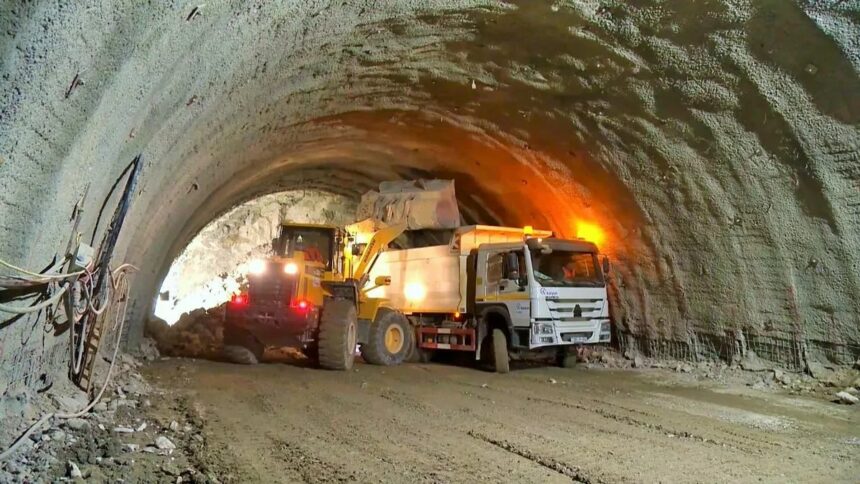
In late February 2023, the State Agency of Azerbaijan Automobile Roads announced that 73 percent of the Horadiz-Jabrayil-Zangilan-Agbend highway has been completed (News.az, February 28). This highway, which runs to Agbend, the westernmost town of mainland Azerbaijan, is planned to link up with the Zangezur Corridor. The construction of the new highway was inaugurated with a groundbreaking ceremony on October 26, 2021, where both Azerbaijani President Ilham Aliyev and Turkish President Recep Tayyip Erdogan participated (see EDM, January 28, 2022). A railway line along the same route is also under construction and, per the latest updates by the Azerbaijani authorities in December 2022, 40 percent of the work on this project has been completed (Caspiannews, December 16, 2022; see EDM, April 21, 2021). According to Aliyev, Azerbaijan plans to complete both projects next year (Caspiannews, December 16, 2022). Nevertheless, while Azerbaijan is developing its part of the Zangezur Corridor, the work on the Armenian section of the route, from Agbend to Nakhchivan via Armenia’s southern territory, has yet to start. This, coupled with geopolitical complexities and ongoing disputes between Baku and Yerevan, creates an uncertainty that continues to loom over the project.
“The Zangezur Corridor is a historical necessity,” Aliyev argued in an interview with local television channels in January 2023, adding that the project “will happen whether Armenia wants it or not” (President.az, January 10). In line with the Russian-brokered trilateral statement of November 10, 2020, Armenia has not opposed opening the route but nevertheless rejects the “corridor logic” inherent in the project. Specifically, the government of Armenian Prime Minister Nikol Pashinyan wants both the highway and railway connections to be under Armenian control and subject to Armenian legislation and regulation (Arka.am, September 14, 2022). This would mean the establishment of checkpoints along the Zangezur Corridor where it enters and exits Armenian territory.
Ever since talks over the re-opening of transportation routes in the region began, the issue of checkpoints has been a sticky consideration in negotiations. In advance of his first European Union–mediated meeting with Pashinyan in Brussels on December 14, 2021, Aliyev stated that Azerbaijan could only agree to Armenia’s terms if an equally restrictive standard were applied to the Lachin Corridor as well (see EDM, January 28, 2022). The Lachin road physically connects Armenia with the Karabakh region and is currently under the control of the Russian peacekeeping force there (see EDM, January 19, 2023). Such restrictive regulations could be applied to the trans-Zangezur highway only if they are applied to the Lachin Corridor as well, declared Aliyev (see EDM, January 28, 2022). Even so, for over a year, little progress has been made in these negotiations.
In an interview on February 18, which followed a meeting with the Armenian premier (and was moderated by the United States Secretary of State, Antony Blinken), Aliyev reiterated his position: “Checkpoints should be established at both ends of the Zangezur Corridor and on the border between the Lachin district [of Azerbaijan] and Armenia” (President.az, February 18). Several days later, Armenian Foreign Minister Ararat Mirzoyan told reporters that Yerevan would not accept a re-negotiation of regulations regarding the Lachin Corridor (1lurer.am, February 22). Criticizing Armenia’s negative reaction to Aliyev’s proposition, Azerbaijani Foreign Minister Jeyhun Bayramov indicated that the proposal had received positive assessments from unspecified “international partners” (Apa.az, February 24).
It is, however, clear that Russia is against the idea of checkpoints along the Lachin road. In the course of his latest visit to Baku—which took place after Aliyev’s statement—Russian Foreign Minister Sergei Lavrov told reporters that “it is not envisioned to create any border checkpoints” along the Lachin road, insisting that the regime and function of the road “must be fully consistent with the very first trilateral statement—the statement dated November 9–10, 2020” (Apa.az, February 28). Lavrov proposed the installation of “technical means” to inspect shipments passing through the corridor in hopes of assuaging Azerbaijani concerns regarding Armenia’s use of the Lachin Corridor for military and other non-humanitarian purposes.
In truth, Russia has clear reasons to oppose the creation of checkpoints in the Lachin Corridor. The establishment of checkpoints and Azerbaijani control in this area would reduce Russia’s relative influence in the South Caucasus and constitute a major step toward re-integrating Karabakh with Azerbaijan. It is not unreasonable to assume then that Bayramov was referring to the EU and US in particular when he cited the support of “international partners” for Baku’s proposal.
For its part, Iran’s hostility toward the development of rail and road lines in the Zangezur Corridor further complicates the project’s prospects. Tehran has opposed the project since the end of Second Karabakh War in 2020, claiming that it would disrupt Iranian-Armenian communication (see EDM, September 23, 2022). Although Iran has limited influence in the South Caucasus to veto Zangezur’s development, Tehran’s support for Yerevan and the two countries’ deepening defense and security ties discourage Armenia from cooperating with Azerbaijan (Moderndiplomacy.eu, December 11, 2022). At a conference in early February 2023 about relations between the two countries, Tehran’s ambassador to Yerevan declared that Iran and Armenia would not allow the creation of any such “corridor” (Sputnik Armenia, February 9). And in October 2022, at a ceremony for opening a consulate in the southern Armenian town of Kapan, Iranian Foreign Minister Hossein Amir-Abdollahian made clear that Tehran opposes any “geopolitical changes” in the region (Hetq.am, October 21, 2022).
Ultimately, negotiations over the unblocking of regional transportation links have been complicated by a number of factors—namely, the disagreements between Baku and Yerevan over the legal regime of the Zangezur and Lachin corridors. Additionally, Russian and Iranian support for Armenia’s position against the creation of checkpoints along the Lachin road as well as the debate over Zangezur further complicates the picture. Thus, under these circumstances, Baku’s and Yerevan’s efforts to establish lasting stability in the region may miss the window of opportunity that emerged after the Second Karabakh War.
Vasif Huseynov