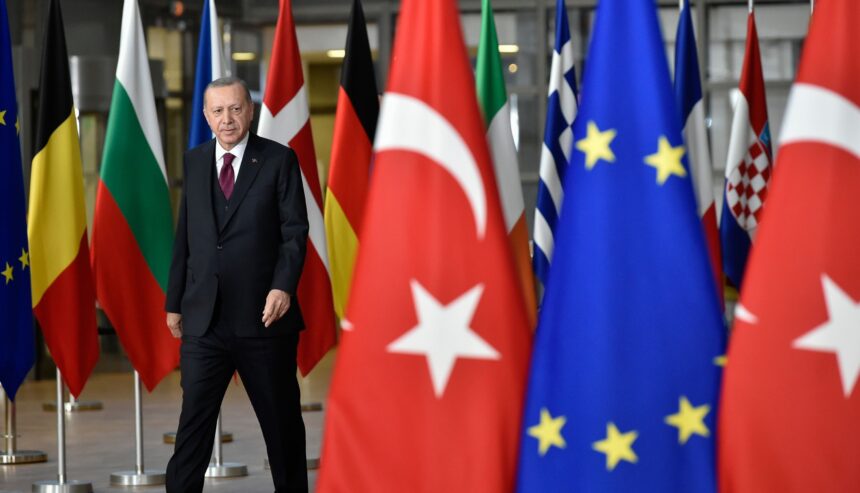
Türkiye, with its unique geopolitical position and growing international weight, is among the few countries capable of serving as a common ground between different sides.
Western-Turkish Relations
Since the onset of active military operations in Ukraine, the West can no longer ignore Türkiye’s interests. In particular, the US and the EU have had to agree to certain terms set by Ankara regarding NATO’s expansion. For the White House, amid the sensitive period leading up to presidential elections and a focus on domestic issues, securing support from Türkiye on the ground is crucial. Recent coordination between the US and Türkiye in regions of Turkish interest, increased cooperation with Turkish companies in military technology and arms production, and the signing of a deal regarding F-16s all highlight Washington’s growing need for its ally.
Among EU countries, although France is reluctant to accept Türkiye’s growing influence, its neighbors Spain and Italy are reacting more appropriately to the current realities. After the escalation in the Middle East, Spain’s position on the Palestinian issue aligns with Ankara’s stance. Spain has recognized the Palestinian state and declared its intention to join the South African case against Israel in the International Court of Justice.
As for Italy, one of Türkiye’s main trading partners, Prime Minister Meloni invited Erdoğan to the G7 Summit to “voice different approaches.” Shared interests in the Mediterranean and North Africa, migration control, and energy security are bringing the two countries’ leaders closer.
Türkiye’s Asian Priorities
Alongside its Western ties, Türkiye is striving to expand its relations with non-Western countries, particularly Asian states. Having observer status in the Shanghai Cooperation Organization (SCO), Türkiye has expressed interest in full membership. Ankara also seeks permanent participation in the BRICS group. However, Türkiye’s interest in platforms dominated by China and Russia is met with mixed reactions in the West.
Ankara clarifies that it does not view the SCO as an alternative to NATO or BRICS as a substitute for the EU. Yet, it asserts that the neglect of its security concerns by allies and the deadlock in EU membership talks are driving it to explore other platforms.
Türkiye is also collaborating with Asian countries within the framework of the Turkic Council. One of the main agenda topics for Ankara within this organization is the development of the Middle Corridor, aiming to enhance Türkiye’s significance as a crucial transit hub.
Conclusion
Through the development of its military-industrial complex, Türkiye has transformed from a consumer of security to a provider. This shift is reflected in its foreign policy. For instance, despite offering significant military-technical support to Kyiv in the Ukraine conflict, Türkiye’s efforts in developing bilateral relations with Russia and its successful mediation endeavors between the parties remain unaffected. Modern Türkiye, embracing a 360-degree diplomacy approach, strives to establish mutually beneficial relations with both Western and non-Western camps.
Türkiye’s interest in the SCO and BRICS should not be seen as a turn away from the West. The country’s leadership seeks to develop a global network of relations to tackle existing political and economic challenges. Ankara aims to maximize benefits from Asia’s growing economic opportunities.
Türkiye now regards traditional global institutions like the UN and the World Trade Organization as outdated. Ankara considers participation in promising formats like BRICS, which is becoming a dominant force in the global economy surpassing the G7, to be more advantageous.
Translated from CSSC