The Zangezur Corridor – recently rebranded as the Trump Route for International Peace and Prosperity (TRIPP) — has become one of the most discussed and debated infrastructure projects in Eurasia. Stretching 43 kilometers through Armenia’s Syunik Province, it promises to reconnect mainland Azerbaijan with its Nakhchivan exclave and, through Türkiye, to Europe. It is a project of logistics and trade — a corridor capable of shortening cargo transit from Asia to Europe from 18 days to 12 along the Middle Corridor, reducing dependency on maritime choke points, and creating new opportunities for growth across the South Caucasus. In practice, however, the TRIPP risks becoming a stage for geopolitical contestation unless regional actors ensure that its purpose remains economic, inclusive, and depoliticized.
Azerbaijan’s section of the corridor demonstrates both ambition and capacity. The 130-kilometer Horadiz–Aghbend railway – approximately 75% built – is progressing steadily, financed entirely by Baku. Running close to the Iranian border, it will carry 15 million tons of freight and 5.5 million passengers annually, linking China’s exports and Central Asian resources with European markets. The project also features nine stations, 40 bridges, 26 road crossings, and four tunnels — a monumental infrastructural undertaking in difficult terrain. Parallel to the railway, a new highway is nearing completion. The integration of AI-based border controls, electronic customs, and dual-use fiber-optic networks demonstrates that Azerbaijan is building not merely a transport link but a symbol of technological and logistical modernization.
On Türkiye’s side, the 224-kilometer Kars–Diluçu railway, expected to open by 2029, forms the western extension of the corridor. Backed by international financing, including Japan’s Mitsubishi UFJ and the Islamic Development Bank, the $2.8 billion project will connect to the Azerbaijani and Armenian segments, completing the long-awaited trans-Caspian connection. Türkiye’s President Recep Tayyip Erdoğan has repeatedly described it as a “bridge between Asia and Europe,” forecasting major economic benefits — tens of thousands of jobs and significant growth in rail trade volume.
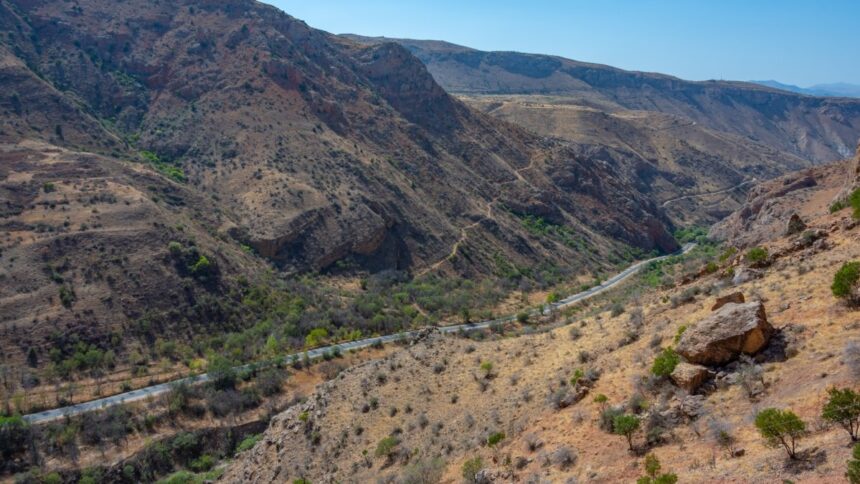
Armenia’s 43-kilometer section through the Syunik region is smaller in scale but politically far more delicate. Managed by a joint U.S.–Armenian consortium according to the Washington agreement of August 8, 2025, with $145 million in initial U.S. funding, it involves restoring an old Soviet railway that ran close to the Iranian border. A private American company is expected to handle management and digital systems under a 99-year lease — a model designed to attract private capital while securing Washington’s long-term influence over the route’s logistics and data flows.
The United States has promoted TRIPP as an economic project aligned with global connectivity initiatives, but it also carries strategic undertones: limiting China’s and Russia’s influence in Central Asia, creating alternative trade paths to bypass Russia, and integrating Western technology into Eurasian customs and digital infrastructure. American experts have conducted on-site inspections and border capability analyses in Armenia, aiming to deploy advanced customs systems capable of monitoring cargo with minimal physical oversight.
This duality — infrastructure as both opportunity and instrument — defines the political dilemma around the Zangezur Corridor. While Washington and Brussels view it as part of a wider Eurasian transport diversification effort, Moscow and Tehran see it as a geopolitical wedge driven by Western ambitions. Russian analysts question how Armenia, still formally allied with Moscow through the Eurasian Economic Union (EAEU) and Collective Security Treaty Organization (CSTO), can host an American-managed corridor without generating friction. Armenia’s reliance on Russian border guards along its frontier with Iran under a 1992 bilateral agreement further complicates the picture. The corridor passes close to areas where these Russian units operate, and any move to remove or sideline them would provoke a crisis in Armenia–Russia relations.
Azerbaijan, meanwhile, has adopted a cautious yet forward-looking approach. For Baku, the corridor is a historic necessity — a long-awaited reconnection with Nakhchivan and Türkiye after three decades of separation. It is also a part of peace process between Armenia and Azerbaijan. The government views TRIPP as an economic and integrative project, not a geopolitical gamble. President Ilham Aliyev has expressed confidence that the corridor can become operational by 2028 if all sides uphold their commitments.
Yet the instrumentalization of the corridor for the great power rivalries or its presentation as a Western project against rivals could destabilize the region and complicate Azerbaijan’s balanced relations with other power centers, including China. Indeed, China’s position is another layer of the equation. Beijing has long supported the development of the Middle Corridor, including the Zangezur route, as part of its broader vision for diversified Eurasian connectivity. Azerbaijani media have emphasized that the project should not be framed as an anti-China initiative. When U.S. Congressman Joe Wilson recently warned that Beijing was “trying to exclude the U.S. from the Middle Corridor,” an Azerbaijani media outlet close to the government responded that such narratives only feed unnecessary rivalry. “Beijing has long and consistently sought the opening of the Zangezur Corridor,” it noted, adding that China’s interests are compatible with those of the U.S. if the corridor remains an open and neutral route. This reflects Azerbaijan’s careful diplomacy: ensuring that the corridor does not become another front in the global competition between Washington and Beijing.
Yet regional stability remains precarious. Iran has openly opposed the corridor, viewing it as a threat to its own transit role and to its influence in Armenia. Russia, though less vocal, watches with unease as U.S. influence expands in what it considers its traditional sphere. Moscow’s restrained reaction suggests it is waiting for more clarity, perhaps hoping that political changes in Armenia could slow or even halt the project. The possibility of Prime Minister Nikol Pashinyan’s re-election next year adds uncertainty. Western actors see him as a guarantor of continuity, while Russian circles believe a Moscow-backed opposition victory could derail TRIPP altogether.
However, close examination of the potential of the Zangezur corridor demonstrates that it can be a vital connection link for Iran as well, connecting it with Armenia and Russia through Julfa – town in Nakhchivan, which served the transition point during Soviet era train between Moscow and Tehran. In recent days, Moscow seems to change, at least, verbally the attitude towards Zangezur corridor when Vice Prime Minister Alexey Overchuk suggested that the corridor might serve for Russian cargo too.
The future of the TRIPP, therefore, hinges on whether regional actors can insulate it from geopolitical competition. For Azerbaijan, the corridor represents the culmination of its post-war reconstruction and a gateway to broader Eurasian integration. For Armenia, it is a chance to escape isolation and redefine its foreign policy orientation. For Türkiye, it is the material expression of the vision of connectivity from the Caspian to the Mediterranean. For the Central Asian countries and China it is a vital alternative to maintain stable trade links with the European partners.
But for all of these interests to align, one essential principle must hold: the corridor should serve as a shared public good, not a strategic weapon. It should facilitate movement, trade, and regional confidence. The South Caucasus has long been shaped by competition among great powers, often at the expense of local stability. The TRIPP offers a chance to reverse that pattern — but only if it is treated as a corridor of cooperation rather than confrontation.
Dr. Vasif Huseynov, is a Senior Advisor at the Center of Analysis of International Relations (AIR Center) and Adjunct Lecturer at Khazar University in Baku, Azerbaijan.