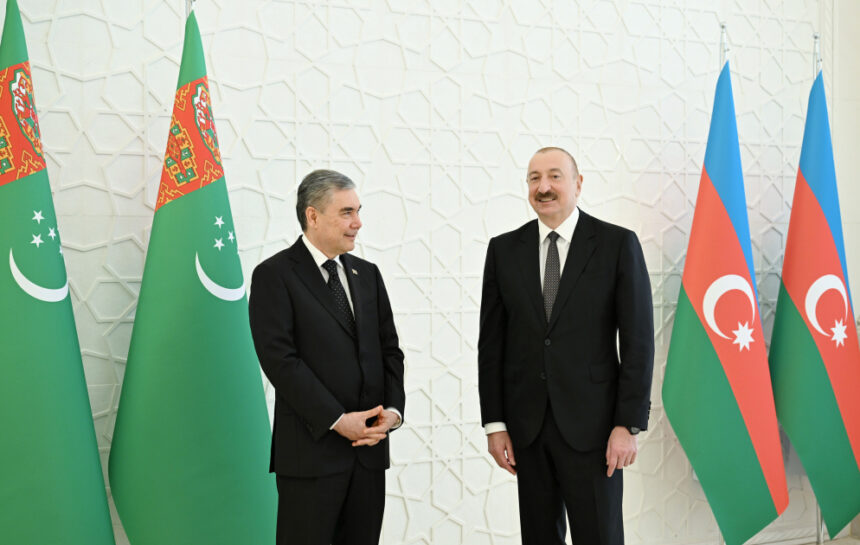
Last month, following a successful visit to Washington, where he signed a historic peace agreement with Armenia, Azerbaijani President Ilham Aliyev traveled to Turkmenbashi, Turkmenistan, for meetings with Gurbanguly Berdimuhamedov, the chairman of the People’s Council of Turkmenistan.
The choice of Turkmenbashi as the venue holds a lot of symbolism. While only a short hop across the Caspian from Baku, the city symbolizes Turkmenistan’s potential westward orientation rather than its current geopolitical reality. As the country’s main Caspian port and gateway to the West, Turkmenbashi serves as a crossroads for goods moving east and west, and is the likely launch point for a future trans-Caspian extension. Its location at the western edge of Turkmenistan makes it a natural outlet for the country’s energy resources, if and when Ashgabat chooses to look beyond its current dependency on eastern markets.
Although it was not declared publicly, there is little doubt that discussions in Turkmenbashi touched on transit and energy cooperation, and likely included mention of the long-discussed possibility of a trans-Caspian pipeline for the transport of natural gas.
Since the 1990s, policymakers have floated the idea of a trans-Caspian natural gas pipeline linking Turkmenistan and Central Asia to Azerbaijan, the South Caucasus, and ultimately Europe. To date, the project has remained an aspiration. The engineering of such a pipeline presents few obstacles, but the geopolitical challenges are substantial. Unlike oil, which can be easily transported by tanker, natural gas requires costly liquefaction for shipping. With only about 280 km separating Turkmenistan from Azerbaijan across the Caspian, a pipeline is the only cost-effective option.
The pipeline has been controversial because it would allow international customers to bypass Russian and Iranian energy markets and transit corridors, undermining both countries’ strategic positions. Over the years, Moscow and Tehran have used diplomatic and political pressure to block the project, citing environmental concerns or attempting to exploit the Caspian Sea’s murky legal status to stall progress. Their real concern, however, has always been the loss of market share and political leverage.
In recent years, however, the idea has begun to gain traction. Russia’s full-scale invasion of Ukraine — and Europe’s subsequent push to reduce reliance on Russian energy — has revived interest in Brussels for a trans-Caspian pipeline as a viable alternative. Azerbaijan has quietly promoted the project, recognizing that it would reinforce its position as a critical energy hub and complement its existing exports to Europe through the Southern Gas Corridor. European leaders now increasingly see it as part of the solution to a long-term diversification strategy.
In Ashgabat, the calculus is more complicated. Turkmenistan has long been the most cautious about supporting the pipeline, wary of upsetting regional powers and reluctant to fully embrace westward integration. Yet economic realities are increasingly hard to ignore. Currently, Turkmenistan exports most of its natural gas to China. With its economy under strain, the country stands to benefit from diversifying its energy exports — and Europe offers a significant new market. For a country long known for its isolation, the potential to plug into global energy flows would mark a strategic shift.
There is now also an opening for American diplomacy — and even a role for President Donald Trump. After brokering the Armenia-Azerbaijan peace agreement at the White House last month, the US leader has unexpectedly become a player in the region. Bringing Yerevan and Baku to the peace table in a way not seen for more than three decades gives him diplomatic wind in his sails. He should use that momentum to push for Turkmenistan and Azerbaijan to craft a plan for a trans-Caspian pipeline.
Such an initiative aligns neatly with Trump’s foreign policy agenda. He has already backed the “Trump Route for International Peace and Prosperity,” designed to connect Turkiye through the South Caucasus to Central Asia via a new transit corridor. A Trump-sponsored trans-Caspian pipeline would complement that vision, bringing economic gains and regional cooperation.
There is precedent. In the 1990s, President Bill Clinton championed regional cooperation on pipelines such as Baku-Tbilisi-Ceyhan. Those projects not only opened Caspian resources to world markets, but also helped stabilize the region by deepening economic ties with the West. Trump could pursue a similarly strategic path with the Caspian, helping reduce Europe’s dependence on Russian energy, opening new market opportunities for US energy firms excluded from Russia by sanctions, and reinforcing ties with regional partners eager for Western integration.
Benefits go beyond economics. A physical pipeline linking the eastern and western shores of the Caspian could serve as a confidence-building measure, fostering cooperation across a historically fragile region. Market and transit trends already point east-to-west: Kazakhstan, for decades reliant on Russian routes to reach global markets, has steadily increased the amount of oil it ships across the Caspian to Azerbaijan since the Ukraine war. Volumes remain modest but are rising — demonstrating how even cautious actors are seeking alternatives.
Meanwhile, Russia and Iran, once the fiercest foes of a trans-Caspian pipeline, are currently distracted and, in parts, weakened. Moscow is consumed by its war in Ukraine; Tehran faces both domestic unrest and international isolation. Neither has much capacity or likely appetite to block such a project now. With the geopolitical environment shifting, the diplomatic space for action is more open than at any time since the early post-Soviet years.
That means the moment for action may have finally arrived. Since the 1990s, there has been no better chance to realize the dream of a trans-Caspian pipeline. If built, it would be a regional game-changer: delivering energy security for Europe, new revenues for Turkmenistan, and greater geopolitical stability across Eurasia. The only question that remains is whether there is the political will to seize this opportunity before it slips away.
Luke Coffey is a senior fellow at the Hudson Institute. X: @LukeDCoffey