Everyone expects me to exhibit what’s known as Canadian raising, where those of us from Southern Ontario say the word as if it were spelled “aboot”. People have a good chuckle, and I grumpily insist we don’t do that in Toronto, and then we go on our merry ways. It’s not really all that important, but it does make me think, sometimes, about the assumption that English words are meant to be read one and one way only. Perhaps “about” should sound like “aboot”; and “caught” and “cot” should be distinct from one another; and “think” and “fink” really ought to be homonyms. What about going the other way, from writing into speech? If I write “about”, how do you know I didn’t mean for it to be pronounced “aboot”? For London to be heard as Lundon? Or that “breed!” is actually an instruction for you to breathe? In truth, our assumptions about these choices say more about our own backgrounds and prejudices than we care to reveal. The same can be said about many other linguistic communities, both historic and current, around the globe. In the Turkic collections, a particularly interesting example of this phenomenon appears in our holdings of Azerbaijani manuscripts.
An illustration of a dream sequence featuring two individuals seated in a garden from a 16th-century recension of the story of Layla and Majnun in the Azerbaijani language. (Füzulî, Leyli vǝ Mǝcnun, Azerbaijan, 16th century CE. Or 405, f 97r)
It wouldn’t be one of my blogs if it didn’t start off with some sort of caveat. So, let’s get it out of the way. I use the term “ Azerbaijani” broadly in line with Euro-Atlantic linguistics: to denote a Turkic language of the Oghuz sub-branch that is closely related to Istanbul Turkish , and that is spoken in the Caucasus (especially the Republic of Azerbaijan) and in northwestern Iran. In English, we also have recourse to the shortcut Azeri, which usually means the Turkic language Azerbaijani. But Azeri might also mean Old Azeri or Azari, a now-dormant Western Iranian language from the same region that might be linked genetically to Tati or Talysh. In the Republic of Azerbaijan, the official name of the language is Azərbaycan dili (“Azerbaijan language”), but it can also be called Azərbaycanca (making use of the -ca/cə language suffix), or, less frequently, Azəricə. In this region, Azerbaijani was largely written in the Arabic script until the early 20th century, when the Soviet authorities first imposed the Latin-based Uniform alphabet in the late 1920s, and then a modified Cyrillic alphabet in the 1930s. In 1991, the year in which complete independence was achieved, the Republic of Azerbaijan officially adopted the Latin script for the language.
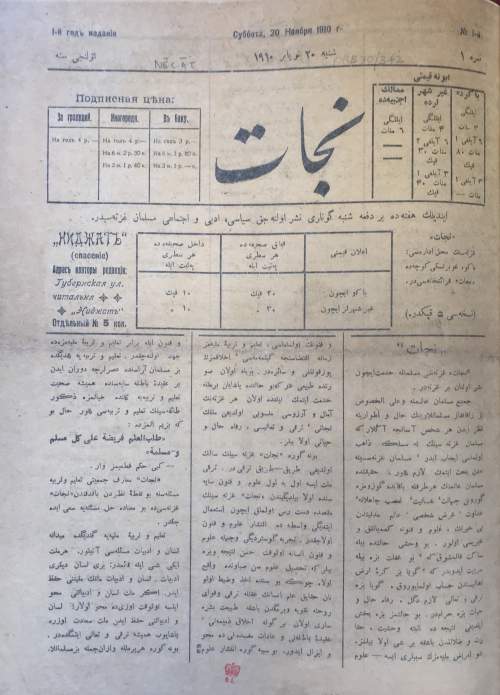
The first page of the newspaper Nicat (Salvation), published in Azerbaijani in Arabic script during the Tsarist period. (Nicat, 1:1 (Baku: Nicat Qiraatxanǝsi, 20 November 1910). ORB.30/342)
South of the border, in Iran, the term “Azeri” usually refers to the old Iranian language and not the Turkic one. Here, the preferred terminology is Torki (ترکی, in Persian) or Türkçǝ (تۆرکجه, in Azerbaijani), and the dominant script is a modified Arabic one. While the varieties spoken in the Caucasus and Iran are distinct dialects, they do form a single linguistic grouping, relying on many common grammatical and lexical features, and share a common linguistic history. Speakers of the language in Iran vastly outnumber those in the Caucasus (perhaps 13 million to just over 9 million in the Republic, according to the CIA World Factbook as quoted on Wikipedia). Azerbaijani is not an official language in Iran, but can be found fairly frequently online and in printed media. Turkic-speakers have long been integrated into broader Iranian society, and many notable personalities in Iranian history come from Turkic backgrounds: Shah Ismail I; Ahmad Kasravi; and yes, even the world-renowned singer, Queen of contemporary Persian pop, Googoosh.
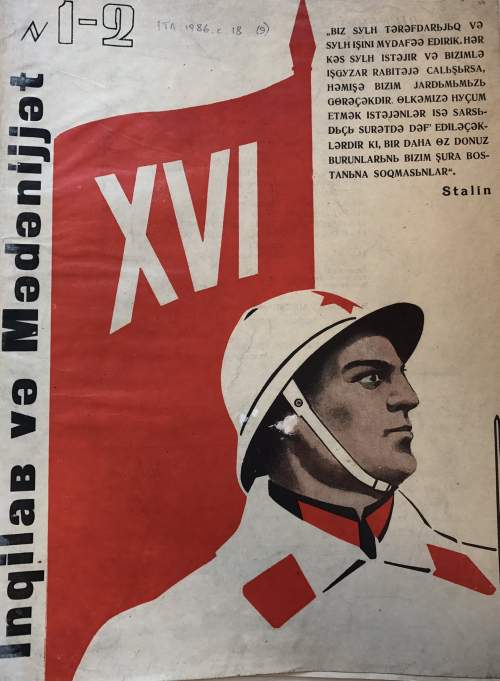
The cover of a periodical produced in Baku, Azerbaijan in the 1930s featuring the Latin alphabet imposed by Soviet authorities between 1927 and the late 1930s. (InqilaB vǝ Mǝdǝnijjǝt, 1-2 (Baku: AzǝriNǝshr, 1934). ITA.1986.c.18(9))
As always, there are considerable political implications to the choice of terminology. My intention here is to mirror common Anglophone usage of the terminology, not to promote a particular movement or point of view. That said, the question arises: what makes something an “Azerbaijani” manuscript? The British Library holds some 7 manuscripts that can be described as containing texts in Azerbaijani. All but one of these are in an Arabic orthography that mirrors Ottoman Turkish quite closely, leaving Arabic words in their original spellings and marking only some vowels in non-Arabic words. This might make it seem as though telling Ottoman and Azerbaijani apart would be impossible, but there are a few clues. One of the easiest is the use of a syllable final -x (like the ch in loch) where Ottoman Turkish would have a -k. Çok “many” or “very” in Turkish becomes çox in Azerbaijani, and bakmak “to look” in Turkish is baxmaq in Azerbaijani, for example. Turkish employs the suffix -iyor for the present continuous, while Azerbaijani uses -ir. And, after the 16th century, Turkish uses only the suffix -miş for the perfective, while Azerbaijani has both -miş and -ip (in the 2nd and 3rd persons). There are, of course, other tells in terms of phonology, morphology, syntax and lexicon, but these are usually the easiest. And they help clue us in, broadly speaking, to how to pronounce those undifferentiated spellings of Arabic words I mentioned up above.
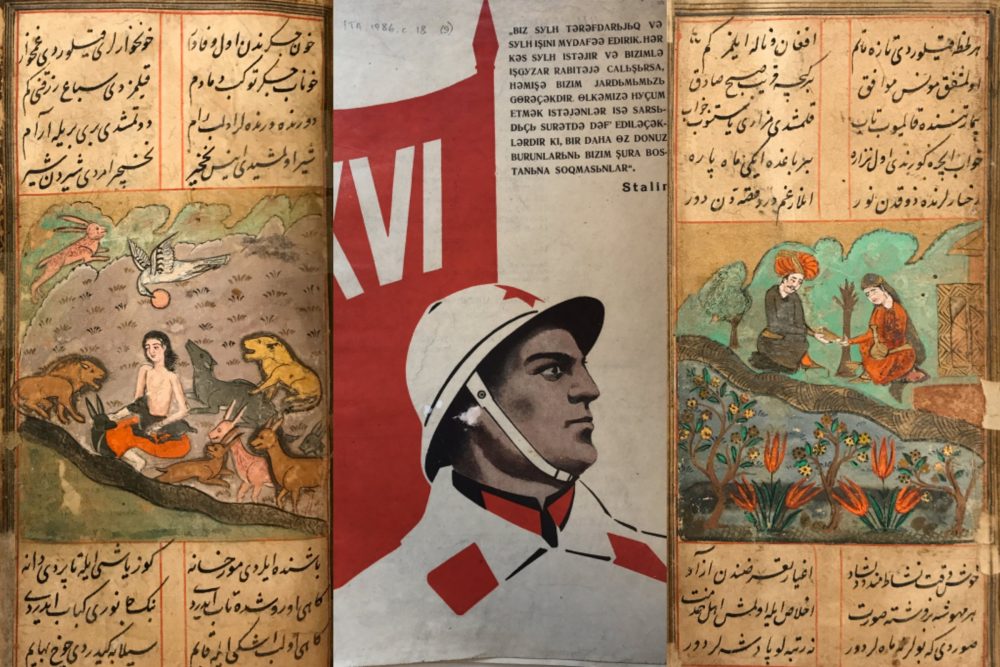
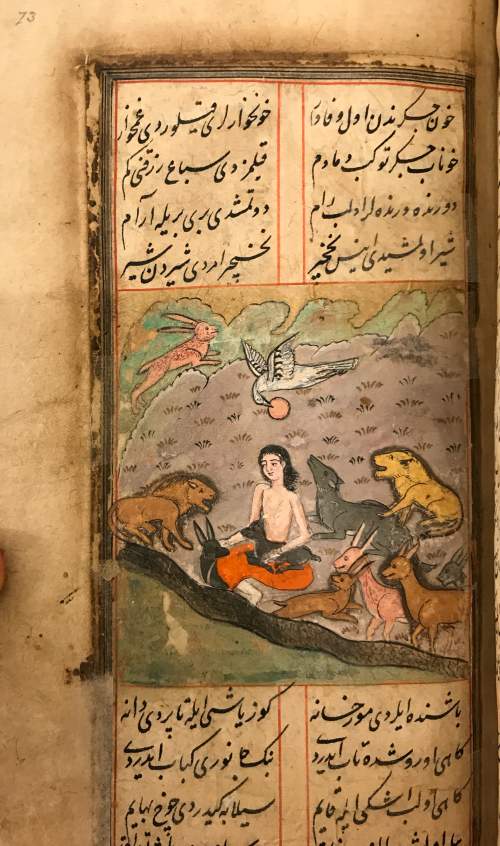
An illustration of Mǝcnun amongst animals from an illustrated 16th-century manuscript in the Azerbaijani language. (Füzulî, Leyli vǝ Mǝcnun, Azerbaijani, 16th century CE. Or 405, f 73r)
So what, exactly, do these manuscripts comprise? Usually literary works, but there are also a few historical items as well. Undoubtedly, the most awe-inspiring item is Or 405, Füzulî’s Leyli vǝ Mǝcnun, copied in 1075 AH (1664 CE). This is Füzulî’s own recension of the classical tale, and one that he admits to having translated from a Persian source on the behest of his friends in Istanbul. This bit of information is important, as it shows how Azerbaijani functioned as a literary medium independently of Ottoman (or Istanbul) Turkish, permitting the translation and adaptation of texts from other languages in its own right. The copy held by the Library is a spectacular specimen of the tale, as it is accompanied by vivid and bright illustrations that relate to the stories found within the text. There are some lovely examples of Leyli in a graveyard and Mecnun among animals, all of which combine a simplicity of line and feature with motion and bright colours. And Or 405 also contains more than a few examples of the linguistic features that help us distinguish dialects, whether the presence of çox and yox (written چوخ and یوخ ), or the preponderance of -ip forms throughout.
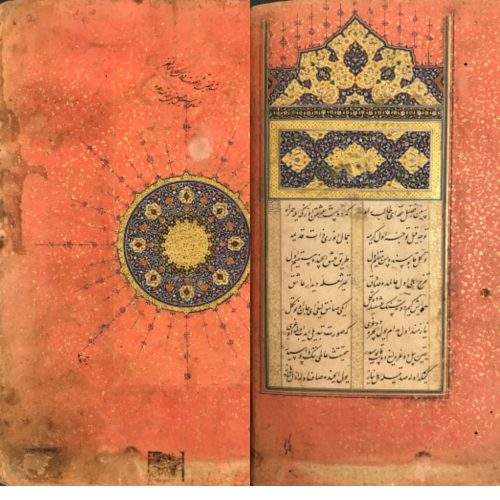
The şemse or sun motif (left) and opening text with unvan (right) of the Divan-i Xǝtai, exemplifying the lush illumination found throughout the volume. (Xǝtai, Divan-i Xǝtai, Iran or Azerbaijan, 16th century CE. Or 3380, ff 2r-v)
Or 405 is the only illustrated manuscript in Azerbaijani held at the British Library, but it is by no means the only beautifully constructed volume in the language. Or 3380, the Divan-i Xǝtai, is a 16th century copy of the collected poetry of Shah Ismail I, whose poetic pseudonym or mahlas was Xǝtai/Khaṭā’ī (خطائى). The work’s imperial connections are made apparent by the beautiful gold artistry and calligraphy employed throughout the volume. Shah Ismail was of mixed heritage and grew up speaking both Azerbaijani and Persian. Supported by various Turkic communities, he rose to power by defeating the Aq Qoyunlu confederation, and established the Safavid Empire, becoming Shah of Iran in 1501 CE. Ismail I is famous for many different reasons, including the imposition of Twelver Shi’ism as the official religion of his Empire, but he was also a renown poet in his own right. This confluence of political and literary prestige is undoubtedly the reason why his mahlas is written in gold throughout the work. Its entire construction is impressive; an example of luxury bookmaking in Safavid Iran. But so too is the poetry, which addresses both temporal and sacred love.
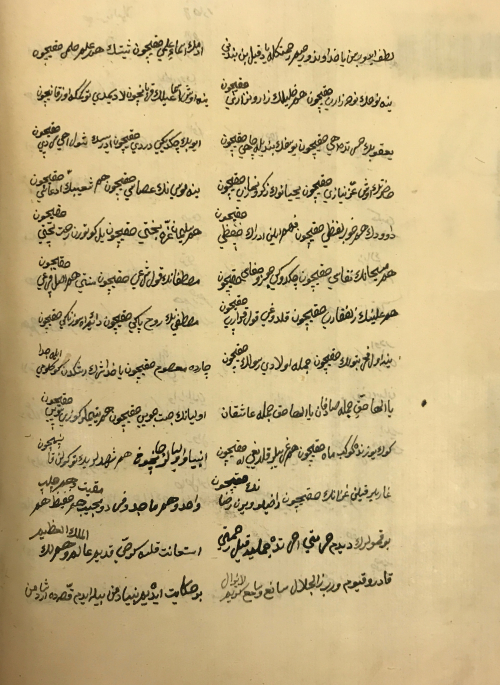
A folio of text from another recension of the story of Leyli vǝ Mǝcnun in Azerbaijani, not composed by Füzulî. (Leyli vǝ Mǝcnun, Iran?, 18th century CE. Add MS 7936)
The rest of the Azerbaijani items in the British Library’s holdings are not nearly as spectacular as Or 405 and Or 3380, but they do merit attention. The fourth text of Add MS 7936 is another version of Leyli vǝ Mǝcnun copied in the 18th century CE. This piece was written by an unnamed poet (not Füzulî), who appears to have made use of some of the Persian versions of the story to craft their own work in the 16th century CE. While the calligraphy and lack of illumination makes this a rather plain and run-of-the-mill text, the copyist’s alternation between one and two columns, prose and poetry, does provide an additional element of interest for those curious about the Azerbaijani literary set-up of the period.
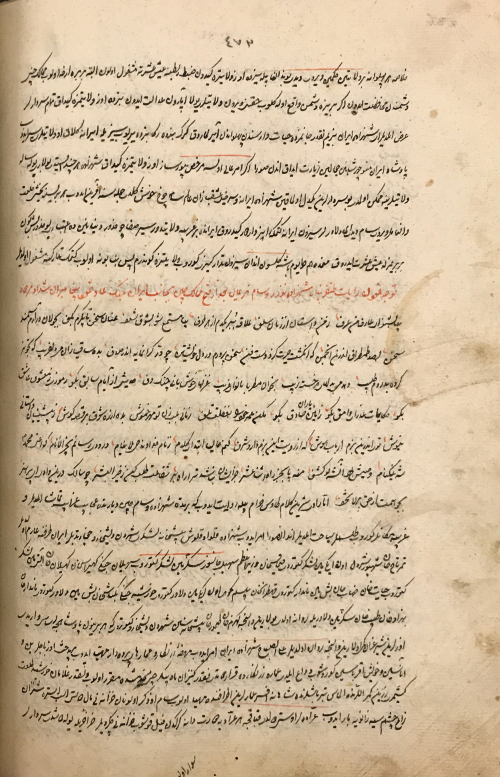
The densely packed script of the Tarix-i Sam or Samname, with the addition (?) of punctuation and Persian text in red. (Tarix-i Sam, Iran?, 1265 AH [1848-49 CE]. Or 11130, f 236v)
The other three texts in the Arabic script are all translations, glosses or paraphrases of earlier Persian works, once again highlighting just how closely linked the history of Azerbaijani literature is to that of its Iranic neighbours. By and large, these are historical texts revolving around the lives and experiences of notable people, real or imagined. Or 11130, Tarix-i Sam İbn-i Nǝriman, also known as the Samname, for example, is an Azerbaijani rendition of a legendary history prepared for a meddah, or traditional storyteller, based on an earlier Persian version. The Samname derives from the Shāh-nāmah (and so includes stories of Rustam) and can be found in its Persian original in other British Library manuscripts, including Or 2926. The opening of the work is in Persian, but then continues into an Azerbaijani dialect in an orthography that departs slightly from what we would normally expect based on the other texts found in the British Library collections. I have banged on about this before (particularly when looking at Chagatai manuscripts), but it remains to be seen whether these idiosyncrasies reflect dialectal differences, or just the personal choices of Muhǝmmǝd Rıza İbn-i Mǝrhum Molla Abdurrıza, the manuscript’s copyist.
Or 5772, in contrast to the Samname, deals with the life and miracles of Şeyh Safi, a 13th century CE Kurdish Sufi mystic and poet from Ardabil, a city that has long had a heavy concentration of Turkic speakers. This 16th century manuscript also provides a fairly thorough account of the rules and precepts of the Safavid Order of Sufis. This particular text raises a different set of questions, ones not related to language. Translations in many of the Ottoman and Azerbaijani works can create issues of citation and attribution. Some translators make clear reference to their source text, while others don’t. Perhaps text compilers might have sampled heavily from a number of different works by the same author, or maybe they constructed paraphrases or compilations of various works, all with the same title or dealing with the same issue, but by different authors. Whatever the case, these items, among which Or 5772 should be classed, cannot always be matched to an original source text. The item in hand, for example, might be related to the Persian work Maqalāt va Maqāmāt by Şeyh Safi, but we will only know for certain when greater research is conducted on it.
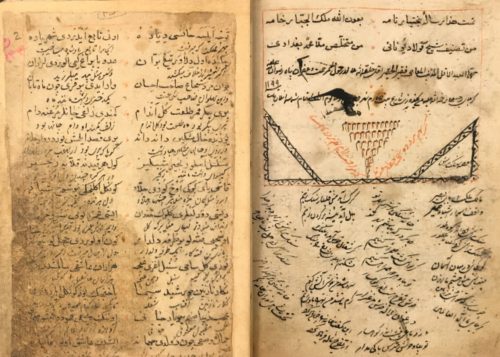 Initial text (left) and the colophon (right) from the Kitab-i Baxtiyarnamǝ, along with the start of a Persian-language text at the end of the colophon. (Kitab-i Baxtiyarnamǝ, Iran?, 1199 AH [1784-85 CE]. Or 9839, f 2r and f 95v)
We have a bit more luck with Or 9839, Kitab-i Baxtiyarnamǝ, which, as you might have guessed, is an Azerbaijani gloss of the 12th-13th century Persian work Bakhtiyār-nāmah. This tale, which follows a familiar pattern of a captive telling stories in order to delay their eventual execution, can be found in a variety of versions. Further investigation is needed on Or 9839, therefore, to determine the source text of the translation, and the Azerbaijani gloss’ connection to other recensions. This process is eased by the fact that the text of the Baxtiyarnamǝ also contains occasional interlinear glosses in Persian, which might be the original source text. These follow a pattern seen in other bilingual or multilingual works, in which one language (Azerbaijani) is written using nesih, while another (Persian) can be found in nestalik. The beginning and end of the volume feature much more wear and tear than the body of the text, and a number of smudged ownership seals can be found on f 98r. Combined with the fact that someone appears to have added ᶜUbayd-i Zākānī’s mesnevi Qiṣṣa-i Sangtarāsh on ff 95v-98r (maybe the copyist of the manuscript, Molla Muhamməd Rəsul vələd-i Muhamməd, himself?), it’s clear that this manuscript created in 1199 AH (1784-85 CE) was well-used, if not also well-loved, by its owners and readers.
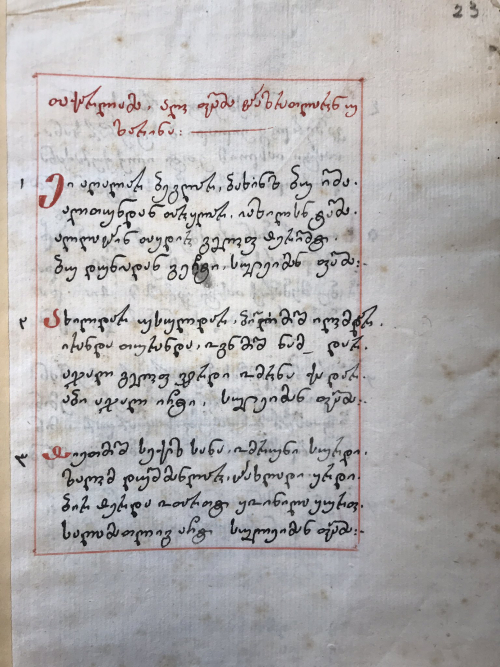 The opening lines of a poem in Azerbaijani, written in the Georgian script, regarding the exploits of Ali Paşa. (IO Islamic 4443, f 23r)
Azerbaijani appears in other manuscript works held by the Library, including a comparative grammar of the Turkic lects from Sindh, contemporary Pakistan (Or 404) and a grammar of the Azerbaijani language produced in Dhaka, contemporary Bangladesh (Or 1912). As I’ve described other works similar to these in my blogposts on Chagatai holdings, I’d prefer to end on a rarer and more peculiar member of the Turkic collections. IO Islamic 4443 is a hodge-podge of works in several languages, one of which had originally been described as “Armenian”. When I called up the manuscript, however, I realized that the original cataloguer had been mistaken: this script was not Armenian, but Georgian, and more importantly, the language was a Turkic one. Two different poems were contained in these 19th century works, both of which are in a Caucasian Oghuz dialect that is pretty easy to read, once you get the gist of the orthography. Poems about Ali Paşa, they might have been copied in Mardin, contemporary Turkey, in 1807. While such materials are much more common in the Republic of Georgia, as well as in libraries in other parts of the North and South Caucasus, they are exceptionally rare in the United Kingdom. IO Islamic 4443 represents the only example in the British Library collections, and probably one of only a handful available to readers in Great Britain. Scholars in Georgia have taken a particular interest in the work, and, hopefully, we might soon be treated to a more in-depth study and contextualization of the piece.
Manuscripts are fascinating sources for the study of literature, history, language, religion and politics. They are also documents that link past generations with current and future ones, and help to preserve cultural heritage. The Azerbaijani-language manuscript collection at the British Library is small in number, but it does present an opportunity to fulfil both aspects of manuscripts’ potential usefulness. By identifying and describing them sensitively, these treasures can be made discoverable to scholars from around the world. They also become more accessible to Azerbaijani-speakers not engaged in scholarly research, and more amenable to be reintegrated into the evolution and articulation of their identities, wherever they might find themselves. Thanks to these processes, we might finally figure out just how the gilded words they contain were really meant to sound.
Dr. Michael Erdman, Curator, Turkish and Turkic Collections
© The British Library Board