This format came to life following the 2020 Karabakh War, which not only made de facto territorial changes in South Caucasus for the first time in three decades but also heralded new geopolitical realities in wider Eurasia.
What is 3+3?
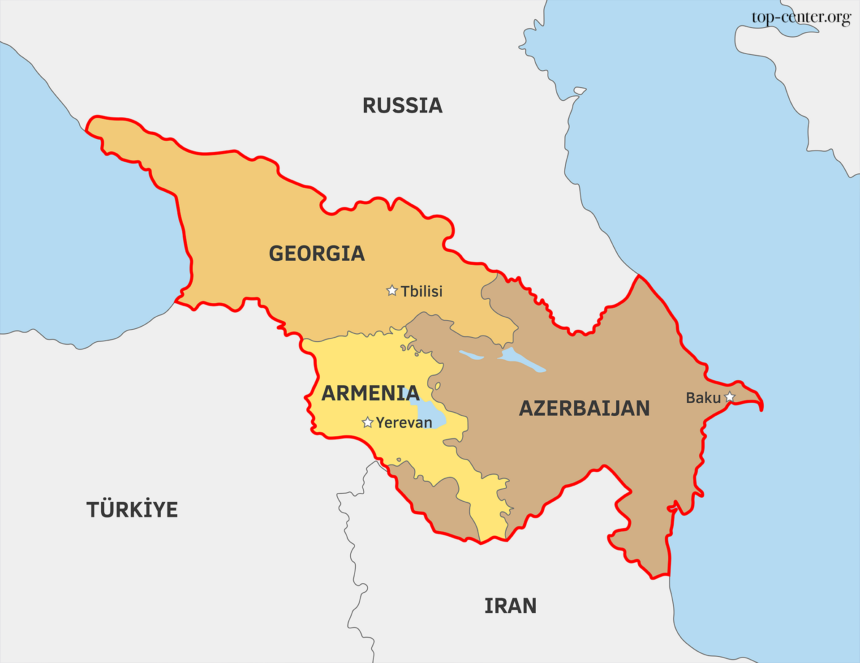
A 3+3 format aimed to establish a South Caucasus regional cooperation framework involving three regional countries – Armenia, Azerbaijan, and Georgia alongside the neighbouring powers – Iran Russia, and Turkey emerged with the end of the Second Karabakh War of 2020. While the issue generated much debate and looked both relevant and controversial particularly in 2021-2022, such a framework was offered also in the past and in other variations.
The first initiative of this kind first emerged in the 1990s, following the demise of the Soviet Union and amid the devastating wars in South Caucasus. It is widely believed that then Turkish President Süleyman Demirel developed a concept – known as the Caucasus Stability Pact – to bring the regional actors into a framework of communication and cooperation. His concept was based on a 3+3+2 format, which would involve not only the regional and neighbouring nations, but also two more interested stakeholders, the European Union (EU) and the United States. Nevertheless, the idea did not proceed mostly because of the ongoing feud between Armenia and Azerbaijan as the latter preconditioned the framework with the liberation of its Armenian-occupied territories.
A second call for the regional cooperation format arose in the immediate aftermath of the Georgia-Russia War of 2008, when another Turkish leader, then Prime Minister Recep Tayyip Erdoğan proposed a platform for 5 countries, 3+2: Armenia, Azerbaijan, Georgia + Russia and Turkey. Even though the Russian side embraced the idea and was eager to develop it further, the ongoing Armenia-Azerbaijan conflict again served as the key obstacle for its implementation.
The present idea was also voiced by Erdoğan in December 2020, a month after the hostilities came to an end in Karabakh. During his visit to Baku and meeting with Azerbaijan`s President Ilham Aliyev, the Turkish leader invited all the regional actors to set up a platform of six in order to increase regional engagement, address security issues, and improve overall stability in South Caucasus.
Yet, it did not gain all the numerals in this formula, due to Georgia`s reluctance to share the same regional platform with its key regional adversary Russia, although the two are engaged in the so-called Geneva talks launched after the 2008 War. This is why the inaugural meeting in Moscow (December 2022), as well as the following Tehran- (October 2023) and Istanbul-hosted (October 2024) sessions proceeded as 2+3 in reality with the absence of the Tbilisi representatives.
3
Even though the Georgian flag was present in the very first edition of the 3+3 format and apparently the door remains open for Tbilisi, the latter has never attended any meetings. Despite some statements from officials, which hinted about Georgia`s participation in the regional consultations in the future, it was never materialized. It is yet to be seen whether the Georgian Dream – if it manages to remain in power and further changes Tbilisi`s foreign policy alignments – can reconsider its attitude toward the 3+3 initiative.
Armenia – despite its consistent participation – also looks reluctant about the prospects of the 3+3 meetings. Initially, Yerevan`s attitude stemmed from Georgia`s nonattendance and the then remaining Karabakh problem. Perhaps the biggest problem for Armenia and perhaps for Georgia until recently about the afore-mentioend framework was the absence of Western powers. As Yerevan has launched a more West-bound foreign policy, such a framework might seem as a combination of efforts of other four actors in squeezing out or at least diminishing the influence of external powers, namely the EU and the U.S.
Unlike Armenia and Georgia, which may see the regional sextet (a quintet in fact) as the diminishment of their agency and the domination of the neighbouring big powers, Azerbaijan – feeling more assured and having an upper hand after the solution of the Karabakh conflict – does not mind joining it although its enthusiasm is not visible either. The Azerbaijani leadership would rather be at the table of discussion with such regional powers as Iran and Russia rather than outside: those two can, in turn, be counter-balanced with the Turkish factor, which provides extra confidence to Baku.
While the 3+3 framework may continue to serve as a platform for the six interested stakeholders, the South Caucasus nations may also a more localized and cohesive approach to regional cooperation. A 3-format model involving only Armenia, Azerbaijan, and Georgia could offer a more balanced and effective framework in this regard, especially in light of the current global turbulence and the crises affecting neighbouring countries. A simpler and more cohesive 3-format could not only create a distinct South Caucasus identity but also more effectively address security threats, improve economic interdependence, and make regional ties even stronger.
Transitioning to a 3-format model and adopting a unified approach could yield significant dividends. Firstly, it allows for the development of a regional identity that is not overshadowed by the larger geopolitical ambitions of external powers. By focusing inward, these nations can collectively address shared security concerns without the complications that come from external influences.
Such a cohesive regional affiliation can make it easier to engage with global powers and international organizations, by presenting their collective interests. In this regard, one can see the evolution and successes of similar regional integration frameworks such as: Visegrád Group, a quadrilateral alliance in the heart of Europe, consisting of Czechia, Hungary, Poland, and Slovakia, or Baltic Trio – Estonia, Latvia, and Lithuania. In each case, such regional cooperation facilitated the eventual membership of the afore-mentioned countries in the Transatlantic institutions, such as the EU and NATO through free trade agreements (e.g.: Baltic Free Trade Area – BAFTA), intergovernmental organizations (e.g. Baltic Assembly, Baltic Council of Ministers, International Visegrád Fund).
One can easily challenge the European experience in the context of South Caucasus as the latter cannot provide unified and harmonized approach of all the regional countries. Indeed, Armenia, Azerbaijan, and Georgia are very different in their domestic agenda and foreign policy priorities: Armenia is in the midst of attempting to pivot towards the West but faces significant risks and fears regarding its relationship with Russia, a traditional ally and regional power and still remains in the Moscow-dominated Eurasian structures. Georgia– in accordance with its constitution – formally keeps a pro-Western orientation, but the incumbent government, much to the dismay of the local society, wants to switch to a more multi-vectoral foreign policy. Azerbaijan, meanwhile, is traditionally known for its balancing or equidistance, an equal distance from both Western and Russian/Eurasian blocs.
In order to counter this argument, one can check a similar experience closer to the Caucasus: Kazakhstan, Kyrgyzstan, Tajikistan, Turkmenistan, and Uzbekistan have developed a cohesive Central Asian identity and most importantly, been holding a Central Asia summit. Despite all the disagreements and sometimes a long-standing feud – the Kyrgyz-Tajik border dispute which several times climaxed as bloody clashes – the consultative meetings of the regional leaders are organized annually.
As the interest of big powers in wider Eurasia is increasing in light of the Russian invasion of Ukraine, they have been pivoting to Central Asia by treating it as a whole territorial unit: this approach has produced a 5+1 format with the likes of China, Germany, Italy, the UK and the United States.
All in all, without the complications introduced by the involvement of larger powers, Armenia, Azerbaijan, and Georgia could find more effective solutions to regional security threats, create a more resilient and integrated regional market, reduce their reliance on external actors and increase their geopolitical influence and bargaining power on the international stage. Thus, a triangular regional cooperation – South Caucasus trio (S3 or SC3) – can become a viable path for South Caucasus towards stability, security, and economic prosperity and become a foundation for a more resilient and self-sufficient region.
Rusif Huseynov is the Co-founder and Director of Topchubashov Center, a Baku-based think tank.