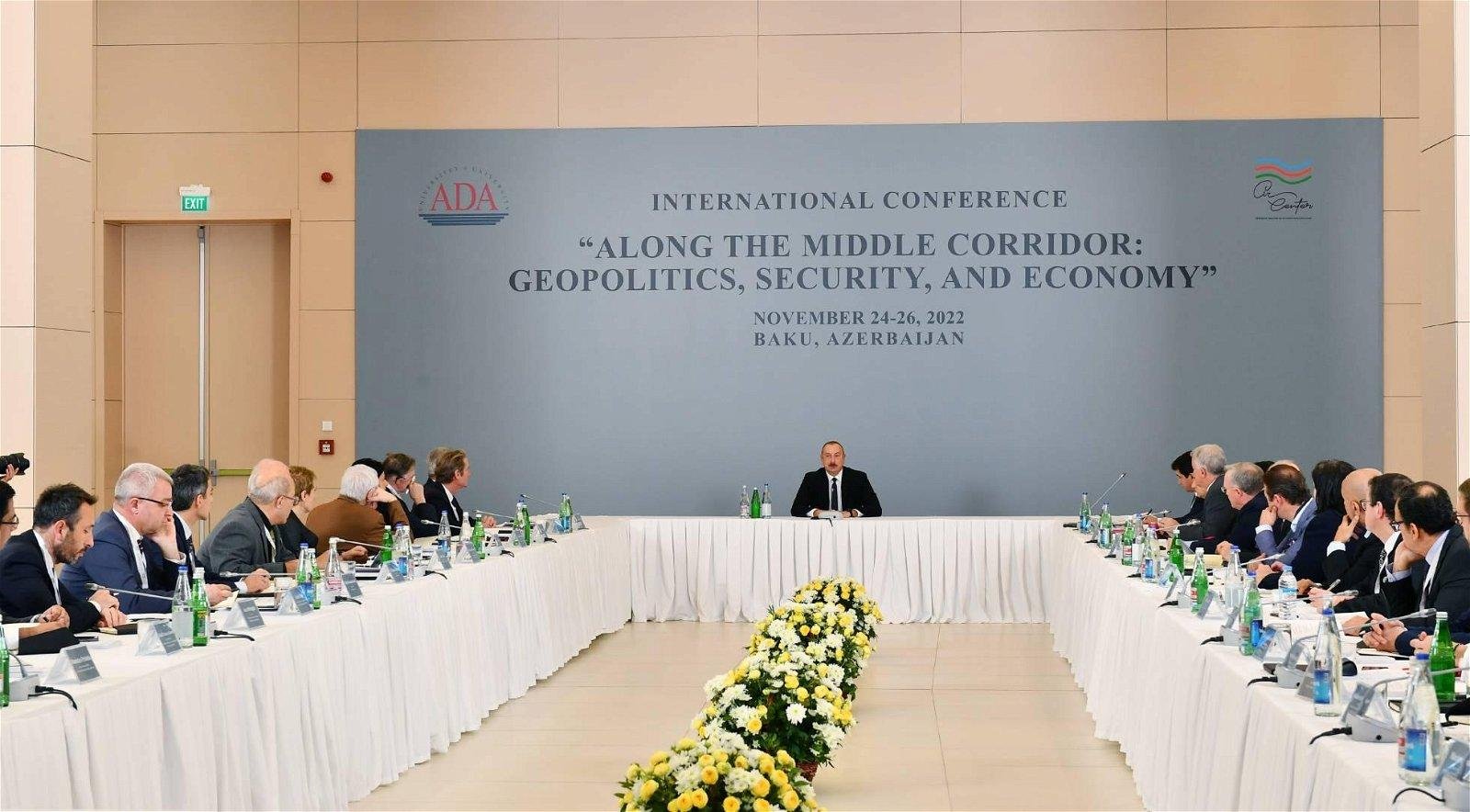
Upon inheriting a considerable geopolitical fortune over the past two years and subsequently becoming fiercely protective of its independence, Baku is adamant not to fall under the sway of any global or regional centre, yet simultaneously not averse to becoming a self-sufficient independent actor, albeit within defined parameters, resplendent in the knowledge that those trying to whisk it off to dark, uncharted waters of global uncertainty are destined to fail miserably and fall on their respective swords.
This may all sound a little esoteric and indeed injudiciously verbose. Nevertheless, the author of this modest piece humbly begs to differ on bended knees. Nothing is shrouded in mystery here. President Aliyev, building on a security/prosperity-based order that is essential to the whole connectivity concept, gave a full account of Azerbaijan’s rightful position in the grand scheme of things, and when the questions put forward by conference delegates started to shape the structure of the debate, the overall discussion started to gravitate towards the issues falling within the rubric of Baku’s own immediate agenda.
Synergy
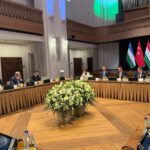
The title of the conference “Along the Middle Corridor: geopolitics, security and economy” suggested a global outlook as the premise of the high-level congregation, with a special emphasis on Azerbaijan’s role as a deeply-entrenched pivot at the heart of a labyrinth of routes emboldening its connectivity clout.
The central argument followed seamlessly from the geostrategic conundrum based on the juxtaposition of the East-West route and the International North-South Corridor (INSTC), which many in analytical circles have long been in the habit of seeing as not completely mutually exclusive, but not perfectly fitting in within impeccable ambience.
This is not the view shared by Baku or, to put it in a more diplomatically emollient form, it has long been Azerbaijan’s view that augmenting the East-West route, throughout local projects of practicable import, will only provide incentives for the INSTC, alluding to the myopic vision of contrived dichotomy perpetuated by forces sharing a different perspective.
It is true that the Second Karabakh War, of which the Zangazur Corridor project is one of its main takeaways, has largely emboldened the import of the East-West transport corridor. Nevertheless, the steps taken by Baku are not aimed at eviscerating the INSTC of its market share, as such, albeit the argument itself being of a highly contentious nature. Baku’s line is that the infrastructure put in place and consequent measures designed to be implemented in due course will augment the synergy, giving rise to more pervasive connectivity.
Envisaging itself as the hub of the East-West and North-West routes is only very natural for Azerbaijan, yet it remains a question as to how the “synergy” formula, articulated by President Aliyev in no uncertain terms, will be perceived in the same light by the main opposing force, namely Iran and its allies.
French perfidy and death warrant
It does not require clairvoyance skills to ascertain the underpinning of President Aliyev’s verdict on the ill-conceived, ill-thought and presumptuous French desire to be inextricably involved in the Azerbaijani-Armenian peace process. The French attitude, somewhat bordering on contrived amnesia, has understandably attracted an emotionally frosty, yet rhetorically measured, reaction. One aspect is evident: after supporting, Yerevan on an unprecedented scale, particularly after the November 2020 tripartite ceasefire, Paris has exhausted virtually all of its mediatory prowess, and, at this point, seems to have no glimmer of a flickering hope to aspire for legitimacy and any moral claim over the Baku-Yerevan dynamics.
In this vein, Azerbaijani opposition to an EU-mediated trilateral meeting, scheduled to be held in Brussels on 7 December, on the grounds of the Armenian insistence for the involvement of the French President, speaks volumes and may be construed as a Baku-issued death warrant, depriving Paris of any practicable role. Incidentally, the shadow of an allegorical Mme. Guillotine may be perceived as a reprimand to the French President for his ‘busybody-esque’ attempt to give the impression that the 6 October quadrilateral meeting that took place in Prague was upon his insistence.
Two tracks in peace negotiations
This is not a novel idea, for it has been articulated on numerous occasions, albeit with a lesser degree of categorical precision. On 25 November, President Aliyev crystallised this with a sufficient degree of delineation that imparted unmistakable unambiguity.
Two critical points seem to have emerged, or rather received an ample degree of reiteration from the Azerbaijani-Armenian peace process: there are two separate tracks, the first being of a purely interstate domain, focusing on the border delimitation and demarcation, the opening of communications and other issues of this kind; and the second entails an exclusively internal Azerbaijani scheme, wherein Baku talks to its own citizens of Armenian origin. The latter, by its appearance, leaves no room for the re-emergence of the illegal and unrecognised “NKR” or, if one may argue cautiously, for any Russian-backed separatist interlopers.
This entails a stern pointed message both to Moscow and Paris, and some other interested parties. This is not an out-of-the-blue formula, imbued with a surprise element, but a point of view that has had an extended gestation period, whose traits had been visible to those keeping a beady eye on the recent talks, particularly in light of the rambunctiously open diplomatic support shown for Yerevan via French channels, and Vladimir Putin’s ambivalent Valdai message.
Iranian disgruntlement and Baku’s reaction
President Aliyev, strictly within the confines of international law, with due respect to the principle of non-interference in other nation’s internal affairs, articulated the legitimate premise of Azerbaijan’s rhetorical assertiveness vis-à-vis Iran. Azerbaijanis living in Iran are part of the Azerbaijani nation and Baku is perfectly entitled to raise concerns over their cultural and linguistic rights. This concern is of a particularly exacerbated nature, given that there is no single Iranian-based school wherein Azerbaijani is the language of instruction, whereas Armenians, an ethnicity of an immeasurably lower scale, enjoy higher privileges in the Islamic Republic.
President Aliyev has also placed special emphasis on the timing of the army exercises near the border, which manifested themselves in the form of tasteless jingoistic sabre-rattling, egregiously displayed on the Azerbaijani-Iranian interstate border, hinting at a malicious Persian intent, the substance of which was too self-evident to be expressed in so many words.
The point of the prospective establishment of the Azerbaijani embassy in Tel-Aviv, with the concurrent opening of a representative office of Baku in Palestine, has been defined by the President as a rightful act, driven by the national interest, and not aimed at pandering to the prejudices of external actors. This is another diplomatic construct, the externally visible manifestation of which does not exceed its substantive core, cumulatively operating as a great historic message to all the regional actors, both disgruntled and rendered reasonability felicitous by virtue of the decision made.
Armenia – a Russian satellite
Whilst elucidating on the ongoing discussions over the Zangazur Corridor, President Aliyev has revealed the degree of formal sovereignty enjoyed by Armenia, by stating that certain issues of strategic vitality are being discussed with Russia, due to the lack of Yerevan’s free will, sending a message to those irresponsibly viewing some elements of the war in Ukraine as translatable into the South Caucasus, putting Baku in the shoes of the aggressor and envisaging Armenia in the image of Ukraine. Aliyev’s remark as to the inherent falsehood of this point will not go unnoticed in the higher echelons of Western policy-makers.
Azerbaijan does not seek friends, for the sake of getting numbers up, but to shape alliances, based on commonalities, enabling it to punch above its weight. The Organisation of Turkic States is the point in case. Perceived in the early days of the 90s as being imbued with romanticism, the idea of Turkic unity was then envisaged as a presently impracticable hope, albeit nevertheless crucial to spiritual uplift and cultural integration. But times change and we are changing with the times. In particular, after the Second Karabakh War, the political substratum gained some undeniable momentum; President Aliyev’s frequent trips to Central Asia, the metamorphosis in the status of the organisation and its gradual evolution into a global centre with elements akin to a harbinger of an ever-closer union makes, at least, two points clear.
Firstly, Azerbaijan no longer feels compelled to circumscribe to whatever the global order is keen to impose. Secondly, it has become a change-marker of a kind that makes it feel sufficiently emboldened not to automatically acquiesce with what was offered, but to pave the way for a future that suits its current primary interests.
Cautious remark and riposte
Much like a fine wrap of benign Charlie, the greater the depth of the concentrated vitality of a euphoric apex, the drearier and more debilitating the unbearable inevitabilities of the lowest ebb. This is, of course, a rephrased configuration of my own formulation, but it was given credence by an aloof and circumspect conference delegate, whilst reflecting on the gist of his scepticism over Azerbaijan’s coercive assertiveness in a private remark to myself.
His concern was that Baku, emboldened by Israeli encouragement and a tacit US plausible head-nod, has been displaying anti-Iranian sentiments with a heightened urgency over the past months, with some ramifications that may militate against Azerbaijani interests.
His concern seemed to be emanating from goodwill, which I have no reason to doubt, but some objections would not go amiss. Firstly, it is Iran’s failure to come to terms with the changed post-2020 geopolitical landscape of the South Caucasus that made Tehran’s old habits of seeing inherent dangers in Baku’s rising fortunes resurface. For instance, the timing of the October 2021 military exercises of the highest scale could not have been a case of pure coincidence.
Secondly, although Iran has the right to worry about the Zangazur Corridor’s geopolitical ramifications, its concern over the changing of borders is neither legally substantiated, nor fully extricated from the fear of losing its exclusive privilege of being an overland conduit between Azerbaijan and its Nakhchivan exclave.
Thirdly, Tehran has never come to terms with its spectacular failure to import its pseudo-Islamic values, specifically aimed at Iranian advancement in the realm of the Persian cultural sphere, into secular, tolerant and multi-denomination Azerbaijan.
Orkhan Amashov
Caliber.Az