The issue here is that the Iranian government must understand the current realities in the context of its own interests, from the angle of the current post-war situation and show new possibilities for pursuing its interests in the region.
Old income
The uncontrolled area of entry into the territory of Armenia via the occupied territories of Azerbaijan, which formed over almost a quarter of a century, made it possible for Iran to receive a relatively small, but steady flow of income that could be kept out of official statistics.
The shadow economy is a strong motive for any border conflict. Especially if a good share in this “shadow sector” belongs to drug trafficking and unaccounted petroleum, oil and lubricant supplies, i.e., the most profitable export items.
Obviously, this business is a two-way street and has beneficiaries on both sides the border.
The actual volume is difficult to ascertain, as it requires precise research. However, the lowest estimates by a number of experts indicate “extra” 30-40% added to the registered Iran-Armenia trade turnover (official statistics for 2021 estimate it at $400 to 450 million, taking into account its growth during the pandemic).
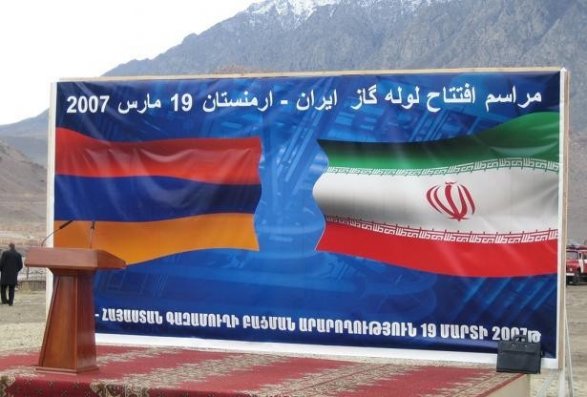
In February of this year, the Ministers of Economy of the two countries argued that there was a readiness to increase the official figures of annual trade from $400 to $1 billion—in six months no less.
What does this mean? It points to the real flow, hidden from the statistics. It may be possible to pull off in a year, but it is simply unrealistic to double (!) the trade turnover in six months with the conventional transport infrastructure. And the road from Tabriz and then through Armenia has many difficult sections that `are barely passable in winter.
There were no customs checkpoints in the Azerbaijani section of the highway at the beginning of the year yet. But how is it possible to increase the contracts in mere six months, attract new funds, given the problems with their flow because of the sanctions, given the cost of servicing these transfers through intermediary banks? How can it be done? It can be done by investing in one but high-yielding, large-scale project. And yet, there has been no such project in Iranian-Armenian relations in the last six months…
In short, the Ministers of Economy of Armenia and Iran did not pull these figures out of the air but gave them with an understanding of the potential of reserves: the trade turnover can be nearly doubled in two quarters only by whitewashing the shadow sector.
However, not everything worked out as planned, not least because of the Azerbaijani border and Baku’s tough position on the transit tariffs. Therefore, the growth of the Armenian-Iranian trade was 26.6%. Still decent, but not as much as could have been.
Perhaps it also did not work out because the “operators” of the shadow supplies legalized only a part of the flow. Money takes precedence over political expediency.
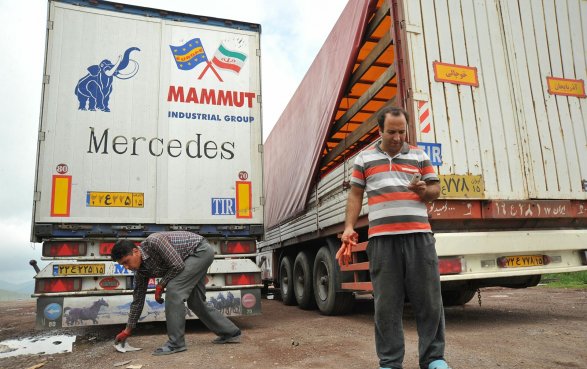
Interestingly, this is not an exclusively Iranian-Armenian story. The US Embassy in Armenia is well aware of the specifics of these relations—such a large staff with electronic scanning systems for Internet and cellular traffic must know all about the local ways of circumventing the anti-Iranian sanctions. But they turned a blind eye to it. Apparently because the digital indicators were not that high and for the sake of maintaining an extra channel for monitoring cargo and information incoming through the Iranian channels.
Another beneficiary of this scheme is Armenian companies trading with the EAEU. Part of the Iranian agricultural products imported in this way was repackaged and imported to Russia and the EAEU as Armenian. A similar scheme was used for the agricultural raw materials grown in Karabakh and processed in Armenian canneries.
By and large, of course, no one in the EAEU was bothered by this. The same combination schemes were in place with Chinese products imported to Russia as made in the countries of the Eurasian bloc of Central Asia. Over time, these problems were more or less dealt with in the region. How it happened and is happening in Armenia is anybody’s guess.
New expenses
Now let’s see what Iran is facing in the Armenian direction. The schemes related to the exploration of the Karabakh and Zangezur resources folded up completely. Azerbaijan sealed the “windows” for drug trafficking and renting farmland, and the route into Armenia via the Lachin corridor has been closed.
Of course, these losses are not as significant as the future costs the changes in the network of communications will require.
Baku has no intention of blocking the Iranian-Armenian trade. This is impossible, both from the point of view of international law, and from the point of view of rationality and goal-setting: the goal of the negotiations on the Zangezur corridor is not to block Iran.
The main railway line, like other routes to Iran, must perform its functions of developing transregional trade—it must become safe and technologically advanced.
Iran will have to bear the costs of improving the road from Tabriz (or other major junction) to the Armenian Meghri, possibly to invest in the modernization of the route E117 via the territory of Armenia—at the very least to build a new cross-border bridge across the main railway line. The total cost could be as high as $1 billion, perhaps more.
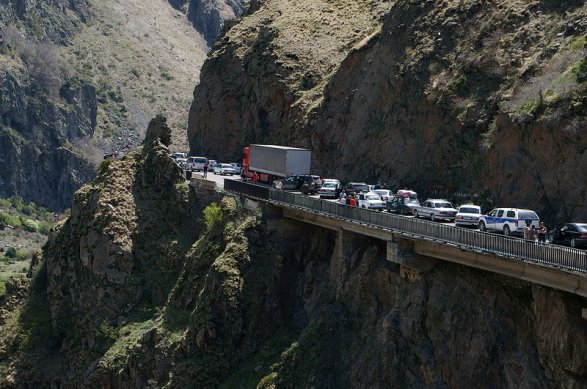
We are talking about the southern section of the Georgian Military Road, which played an important part in the development of economic ties between Russia and the South Caucasus. This road is, in turn, a part of the European route E117, which goes from Mineralnye Vody via the Georgian Military Road to Tbilisi, via Yerevan and on to Meghri on the border of Iran (in Armenia this section is called the North-South Highway). In Soviet times, this route together with the railway constituted a single transport and logistics complex of the Transcaucasus. Interestingly, literally a month ago, in September, a Chinese company started the construction a 9 km long road tunnel near the Jvari (Cross) Pass on the Kvesheti-Kobi road section in Georgia. It also benefits Iranian transit to Russia, and Tehran could join in the reconstruction and construction of the southern section of the road, since it is interested in developing relations with Armenia and Russia. Nobody is stopping it, on the contrary, everybody would support that. But Tehran could at least propose this kind of project as part of the integrated development of communications. And yet, instead of project proposals, we get this strange confrontation.
Whatever format is used for the railway along the Armenia-Iran border, be it a controlled security corridor (similar to Lachin) or a free route (the ITC format), Iran is one of the entry points to this line and one of its key beneficiaries. The Azerbaijani-Iranian railway junction in Julfa will allow shippers in Russia, Finland, India, and the Persian Gulf countries the opportunity to quickly transit goods by land. After all, even before the start of the Karabakh conflict, over 300 freight cars moved on this railway via Azerbaijan to Iran!
Of course, this will take a certain amount of effort and financial costs. But this route, if political issues are removed, is more feasible than the construction of a new railway between Rasht and Astara.
Opportunities
According to industry experts, if the political and ideological disagreements were resolved now, the Zangezur corridor route could be put into operation in a year and a half. Let it be two years.
If Tehran sensibly accepted the changed borders and the changed realities resulting from the end of the Armenian-Azerbaijani war, this would give a boost to the opening of all communications in this part of the South Caucasus. All participants would benefit from that.
In general, Tehran’s constructive position, readiness for joint efforts, would highlight the possibilities of transregional and border cooperation in a completely different way.
Were Tehran willing, it would be quite realistic to include an Iranian high-ranking official in the trilateral commission of the Deputy Prime Ministers of Russia, Azerbaijan and Armenia.
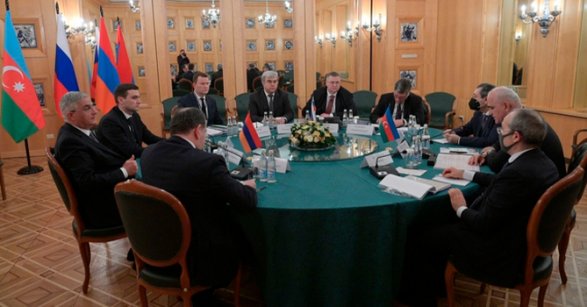
After all, Tehran postulates its positive, stabilizing role and this step would be logical. By doing this, Iran could bring the status of its special relations with Armenia to a shared and more systemic format, receiving dividends from the implementation of new logistics and transport interaction schemes. Armenia, for its part, would get a guarantor of preservation of its interests in trade and communications, without fear of being “isolated” by Azerbaijan and Turkey. Indeed, this was the idea of a common platform—a shared subject of actions and the need to develop joint mechanisms.
On a constructive track, Iran could safely build up trade with Armenia, strengthen cross-border cooperation projects with Azerbaijan, participate in reconstruction programs in the East Zangezur economic region, thereby actually preserving its economic interests in this part of Azerbaijan absolutely legally.
The economic ideology of post-conflict reconstruction is a combination of various transport arteries in latitudinal and longitudinal directions. Roads also form the basis of cross-border interaction, they do not compete with one another but are linked into dense networks.
In Soviet times, the border between Iran and the Soviet Union formed a right-of-way, a zone of alienation and isolation. But even then, there was an established transit railway corridor from the European part of the USSR via the South Caucasus to the Persian Gulf.
After the collapse of the Soviet Union, the northern Iranian border became a factor of the coexistence of the border regions. Economic interaction was chaotic, intermittent and determined by the Karabakh conflict. However, small and medium-sized businesses were gradually improving the local socio-economic conditions, and the central governments in the capital cities tried to smooth out the contradictions. It did not always work over these thirty years. There has been a series of conflicts, but there have also been undeniable achievements.
Now that Azerbaijan has taken its territories back, there is a chance to develop the “integrated border regions” scenario along the southern borders of the South Caucasus. The regions are symbiotically linked. A small impetus will be enough to strengthen them, and the effect of reintegration for national economies will be evident. But it requires a spirit of friendly and collaborative action.
We can only hope that Tehran will understand this.
Translated from Haqqin.az
Aze.Media