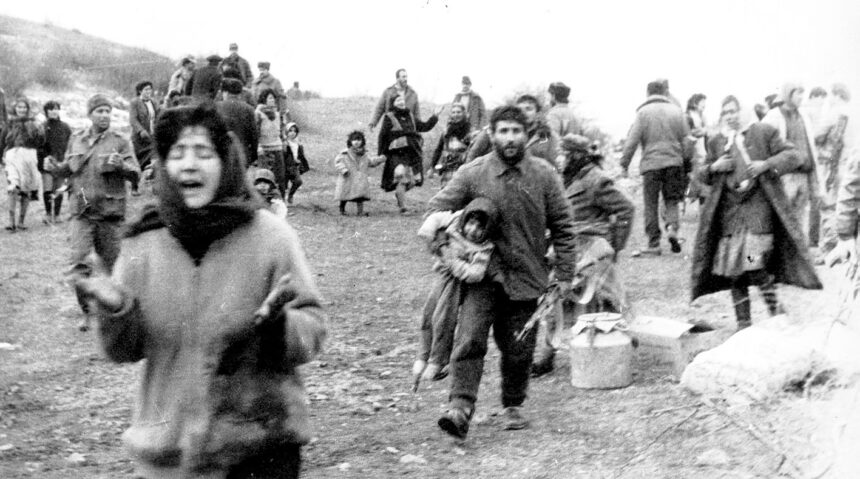
Realizing that more than 700,000 people in the region would not easily flee their homes, Armenian leaders resorted to force. The ethnic cleansing carried out by the Armenian armed forces resulted in numerous humanitarian tragedies over the years, but the most devastating was the massacre of civilians in Khojaly, a town in Azerbaijan’s Karabakh region, in the bitterly cold morning of February 26, 1992.
On the night of February 25-26, 1992, Khojaly became the site of one of the most harrowing atrocities of the late 20th century, committed by the armed forces of Armenia during the First Karabakh War (1992-1994) – a conflict driven by Armenia’s territorial ambitions and the ideology of “Greater Armenia.” The massacre, which claimed the lives of 613 Azerbaijani civilians, including 106 women, 63 children, and 70 elderly individuals, remains a deep wound in Azerbaijan’s national consciousness. Today, as Azerbaijan reflects on this tragedy, the recent trials of former Karabakh separatists, who participated in terror operations against Azerbaijan in the early 1990s and beyond, mark a long-overdue step toward accountability.
The largest massacre of the Karabakh conflict
Khojaly, a town of approximately 7,000 residents before the conflict, was strategically significant due to its proximity to the region’s only airport and its location along key roads connecting Shusha, Khankendi, and Aghdam. By late 1991, it had been encircled by Armenian forces, cut off from land routes, and subjected to a relentless blockade. Electricity, gas, and water supplies were severed, leaving the population vulnerable. On that fateful night in February 1992, Armenian armed forces, supported by the 366th Motorized Rifle Regiment of the former Soviet Union, launched a ferocious assault. Following heavy artillery bombardment, they stormed the town, targeting civilians with ruthless precision.
The survivors of the tragedy describe scenes of unimaginable horror: families gunned down as they fled through snowy forests, bodies mutilated, and others tortured. Official figures state that 1,275 people were taken hostage, with 150 still unaccounted for to this day. The scale and barbarity of the violence – reports of beheadings, scalpings, and the use of prohibited weapons – prompted many international observers to classify the event as genocide, a term reflecting the deliberate intent to annihilate an ethnic group. Human Rights Watch labeled it the “largest massacre” of the Karabakh conflict, placing direct responsibility on Armenian forces.
From Azerbaijan’s viewpoint, Khojaly was not an isolated incident but part of a broader campaign of ethnic cleansing aimed at expelling Azerbaijanis from their sovereign territories. The occupation of the Karabakh region and seven surrounding districts of Azerbaijan displaced hundreds of thousands of people, a humanitarian crisis that Azerbaijan continues to struggle with decades later. Some members of Armenian leadership of this period openly acknowledged the deliberate intention of ethnic cleansing through use of force and violence. For instance, Serzh Sargsyan, former President of Armenia (2008-2018), a military commander during the first Karabakh war, later boasted to the British journalist Thomas de Waal that the massacre shattered the “stereotype” that Armenians would not harm civilians, suggesting a calculated strategy of terror.
Azerbaijanis’ Call for Recognition and Justice
For Azerbaijanis, the Khojaly genocide is more than a historical event – it is a collective trauma that shapes their identity and worldview. Azerbaijan has tirelessly sought international recognition, framing it as a crime against humanity akin to the atrocities of Khatyn, Hiroshima, or Srebrenica. Over 15 countries, including Pakistan, Turkiye, and Mexico, and 28 U.S. states have formally acknowledged the massacre, often using the term “genocide” in their resolutions. The “Justice for Khojaly” campaign, spearheaded by the Heydar Aliyev Foundation, has amplified these efforts, organizing exhibitions and commemorative events worldwide to ensure the victims are not forgotten.
Yet, unfortunately, justice remains elusive. For years, the perpetrators – many of whom, including Serzh Sargsyan, rose to prominent positions in Armenia and the now defunct separatist regime Armenia installed in the Azerbaijani territories during the period of occupation – evaded accountability. This impunity emboldened further aggression, culminating in nearly three decades of occupation and total destruction of the Azerbaijani cities and towns until the 2020 Second Karabakh War that restored Azerbaijani sovereignty over occupied territories.
The Trials of Armenian Separatists
A significant development in Azerbaijan’s quest for justice emerged in January 2025, when trials began in Baku for 16 former officials of the separatist regime which collapsed in September 2023 after Azerbaijan’s anti-terror measures against the illegal military detachments of Armenia. These proceedings mark a pivotal moment in addressing the crimes of the 1990s, including the Khojaly genocide. Among the defendants are senior members of the separatist regime and other military figures. Azerbaijani prosecutors have charged them with a range of offenses, including genocide, war crimes, and participation in an illegal armed entity. Several of the defendants are accused of having been directly involved in the early 1990s invasion, including the Khojaly massacre. For instance, individuals like Vagif Khachaturyan and Rashid Beglaryan, convicted in earlier trials in 2023 and 2024 respectively, were sentenced to 15 years for their roles in the genocide. The current defendants, captured during Azerbaijan’s 2023 anti-terror measures, represent the leadership that orchestrated or perpetuated the occupation and its attendant atrocities.
These trials are viewed in Azerbaijan as a fulfilment of international legal obligations under the 1948 Genocide Convention, which mandates the punishment of those responsible for such acts. The evidence – eyewitness testimonies, mass graves uncovered post-liberation, and admissions from Armenian leaders – underscores the case’s urgency.
The trials are a critical milestone. They offer a chance to hold accountable those who exterminated civilians in Khojaly and beyond, yet they cannot erase the pain of loss or fully heal the scars by decades of conflict. Azerbaijan insists that justice extends beyond punishment – it demands reparations, an end to Armenia’s denial of these atrocities, and guarantees against future aggression. As mass graves continue to be unearthed in liberated territories, such as the ones discovered in Khojaly after the liberation of the town, the scale of the 1990s atrocities becomes ever clearer. For Azerbaijanis, Khojaly is a testament to resilience as much as tragedy. The trials of former Karabakh separatists, some complicit in the horrors of 1992, signal that the pursuit of justice, though delayed, is unrelenting.
Dr Vasif Huseynov, is a Senior Advisor at the Center of Analysis of International Relations (AIR Center) and Adjunct Lecturer at Khazar University in Baku, Azerbaijan.