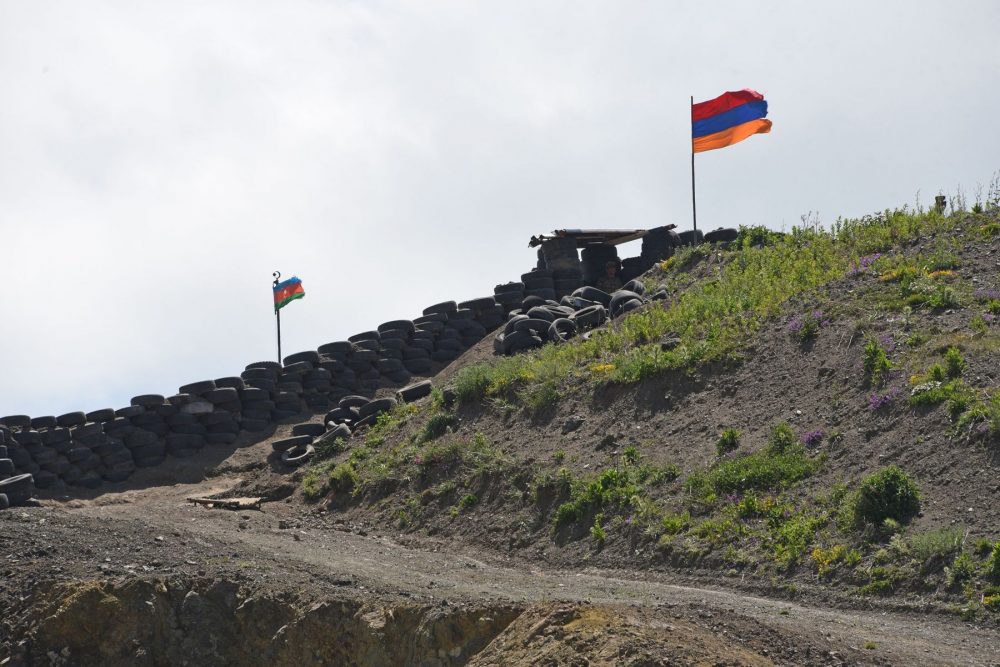
In the end, Russia arbitrated a ceasefire, and open fighting has ceased for now. These events closely mirror the international response to last year’s 44-day war in Nagorno-Karabakh: Turkey immediately declared its support for Azerbaijan, and Russia ultimately became the conflict’s final arbiter. Meanwhile, the main international grouping charged with oversight of the conflict, the OSCE Minsk Group, co-chaired by Russia and two Western powers – France and the United States – was noticeably inactive.
Additionally, on December 13, Turkish Foreign Minister Mevlut Cavusoglu announced that Turkey and Armenia would appoint special envoys to begin discussions on normalization of relations; a spokesman for the Armenian Ministry of Foreign Affairs confirmed this statement on December 14. Russia voiced its readiness to mediate Turkish-Armenian normalization talks, but while the United States has expressed support for Turkish-Armenian normalization, it and other interested Western parties have not moved toward taking on roles in the process itself, which will likely be long and arduous.
The West’s inactivity in the South Caucasus has not gone unnoticed by local South Caucasus states and interested non-Western powers. The most notable response has been Turkish President Recep Tayyip Erdogan’s recent call for a “3+3” regulation format to South Caucasian conflicts, which would include the three South Caucasus states – Armenia, Azerbaijan and Georgia – and the three neighbouring powers – Iran, Russia and Turkey, which are also the three powers involved in the “Astana process” for Syria. Should Mr Erdogan’s endeavour succeed, Western countries would be completely excluded from the region – an unacceptable outcome for Western states.
Currently, there are two relevant areas where Western countries can re-involve themselves to preserve and advance their interests, and contribute to better prospects for conflict resolution and peace building across the region. First, they should push for and help facilitate the ultimate normalisation of Armenian/Turkish relations and the more immediate opening of the Armenian/Turkish border, and, secondly, and perhaps more importantly, they should reject the 3+3 format in favour of a model that continues to include interested Western states.
Open borders and eventual normalisation
Most if not all Armenian leaders have discussed the normalisation of ties with Turkey, but discussions have historically failed to produce results. The most important reason for these failed attempts is the conflict over Nagorno-Karabakh, a region located de jure in Azerbaijan but populated heavily by ethnic Armenians. After Armenian forces took over Nagorno-Karabakh and several surrounding regions in 1993, Turkey closed the border in solidarity with Azerbaijan. Today’s situation, however, is significantly different. Following Armenia’s defeat in the 44-day war in Nagorno-Karabakh in October 2020, Armenian troops vacated Nagorno-Karabakh, leaving the remaining ethnic Armenian population in the hands of Russian peacekeepers. Turkey’s main reason for the initial border closure should thus no longer be a factor. Following last month’s skirmishes along the Armenia-Azerbaijan border, a full normalisation process may prove difficult; however, there are a number of reasons why Western countries should encourage Turkey to re-open its border with Armenia and facilitate Turkish/Armenian work for full normalisation in the future.
- Open borders would increase Armenia’s leverage over Russia. Armenia is heavily dependent on Russia. In addition to its security dependence (Armenia hosts Russia’s 102nd military base in Gyumri, and Russian troops have participated in the securing of Armenia’s borders), Russia remains by far Armenia’s largest export and import partner, and thousands of Armenian labour migrants flock to Russia every year. Better relations with Turkey would give Armenia room to leverage its unique geographical position. This would directly benefit Western interests. While Western countries cannot hope to fully pry Armenia away from Russia in the near future, an Armenia that can pursue more flexible relationships would undoubtedly be looked on positively in the West.
- Open borders would make Armenia more amicable with a key NATO country, leading to greater regional stability. Although Turkey has been somewhat of a problematic member of NATO of late, Ankara is nonetheless a crucial NATO ally, and open borders and more consistent dialogue between Armenia and a key NATO member would benefit the West – a fact which the US has historically recognised. Additionally, open borders could help ease tensions in the South Caucasus. While Russian competition with Turkey is yet to turn into open military confrontation in the Caucasian theatre, such a scenario may occur in the future should current regional politics not change. However, if Turkey becomes more involved in Armenia’s economy through more free-flowing trade, Ankara may hesitate to take actions that directly threaten Turkish economic ties with Yerevan. Even a slightly more balanced approach by Turkey could help ensure that the ever-simmering Armenia-Azerbaijan dispute does not explode into direct great power conflict.
Full normalisation will be difficult; Yerevan insists on normalisation without pre-conditions, while Ankara has added conditionality based on sensitive questions such as the delineation of borders and the proposed creation of a controversial “corridor” connecting Azerbaijan with its exclave of Nakhichevan. Even for a step as simple as opening the border, Western countries will have to put in work diplomatically. However, given the aforementioned potential benefits, it would be a worthy endeavour.
Even a slightly more balanced approach by Turkey could help ensure that the ever-simmering Armenia-Azerbaijan dispute does not explode into direct great power conflict.
Daniel Shapiro
3+3 format
Another way in which Western countries can protect their interests is by openly rejecting the 3+3 format. The 3+3 format might be advantageous for Turkey, Russia, Iran and potentially Azerbaijan, but for Armenia and Georgia, it would be a distinct downgrade. For Armenia, two powerful, generally pro-Armenian states (France and the US) with UN Security Council seats would be replaced by a significantly weaker and only slightly pro-Armenian country, Iran, and Turkey, which is certainly not pro-Armenian. Yerevan has already announced that it does not wish to discuss Nagorno-Karabakh as part of any potential 3+3 format. For Georgia, too, moving to this 3+3 format would be detrimental, as Georgia relies on the very countries that would be left out – France and the US. Tbilisi has categorically rejected the proposed 3+3 format, and should the Western countries concerned not respond to Georgia’s concerns, their image will certainly be tarnished, both in Tbilisi and internationally.
President Erdogan may be right that international institutions responsible for conflict regulation in the region deserve a second look; however, this does not imply that Western countries should vacate the area. The OSCE Minsk Group, for example, in addition to being entirely ineffective in the recent iteration of the Nagorno-Karabakh conflict, has received complaints from Azerbaijan for years that the Minsk Group is heavily biased towards Armenia, as the three Minsk Group co-chairs are the three countries with the largest Armenian diaspora communities in the world. However, a re-evaluation of Minsk does not mean that Western countries should be excluded – quite the opposite. Western should actively work to ensure that they maintain a seat at the table and keeps and/or strengthens their relationships with its partners in the region. Failure to do so would needlessly hurt Western relationships with countries in the region and show a lack of commitment to assisting in multilateral conflict resolution efforts.
Potential impacts
Should Western countries take the initiative and re-involve themselves in the region, they stand to gain in many ways.
- Armenia: Should Western countries manage to help Armenia convince Turkey to open the Turkey-Armenia border unconditionally and reject 3+3, Armenia could easily pursue a more amicable relationship with Western countries, especially given current prime minister Nikol Pashinyan’s penchant for “aggressive centrism:” in a June commentary for the ELN, Andreas Persbo wrote, “Armenia has tried to act as an in-between state, increasing economic and societal ties with the West while remaining in a security relationship with Moscow.” There is interest in closer ties with Western countries in Yerevan; by taking steps such as these, Western countries could make that interest reality.
- Georgia: Georgia is a key Western partner and must be treated as such, not taken for granted. After America’s pull-out from Afghanistan, uncertainty rippled through much of Eastern Europe – including Georgia. For Georgia, alliance with Western countries is mainly for security purposes; aspects of Western culture have not gained traction in Georgia, and indeed face some pushback. One key example is LGBT rights; massive riots – accompanied by the burning of EU flags – broke out in July 2021 around the planning of a gay pride parade by local activists in Tbilisi. If Western countries are to “keep” Georgia, it will have to be through security. Making a strong statement against the 3+3 format and getting actively reinvolved in the region, perhaps through visits by high-level officials, would help.
- Internationally: American president Joe Biden has said repeatedly that “America is back.” Much of the world, however, is still waiting for concrete evidence, especially after the US’s catastrophic exit from Afghanistan in August. Proving that America is “back” starts in regions such as the South Caucasus, which, while perhaps viewed as unimportant by many American diplomats, is certainly on the radar of other states – states such as, for example, Ukraine and the Baltic States, which are already worried about the broader West’s real commitment to their security. Should the US allow Russia, Turkey and Iran to become the dominant influences in the region through the 3+3 format at the expense of American partners such as Georgia, worries will ratchet up even more in other vulnerable parts of the globe – such as Ukraine – thereby sharpening existing tensions. Finally, Western countries cannot simply react: they must be proactive. Working with Turkey and Armenia to reopen the border is a key example of an initiative where the US can play a prominent role in getting negotiations off the ground. If America and other Western countries want to truly prove that they are “back”, initiatives such as these will go a long way.