Earlier this week, the Armenian Apostolic Church came out in overt opposition to the border demarcation process that is understood by both Baku and Yerevan to represent a confidence-building measure in the service of ongoing peace talks.
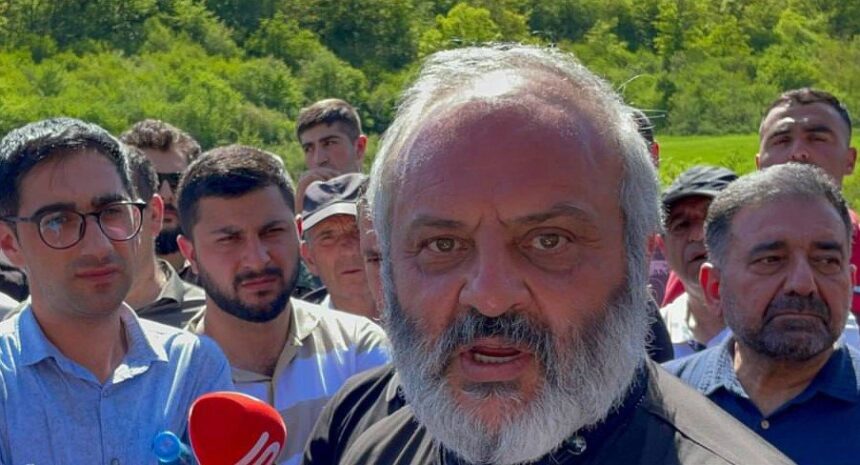
This opposition has been manifested in various ways, including by an organized march to the capital, led by the British and Canadian-educated Archbishop Bagrat (Galstanyan) and other clergy, high and low. A pronouncement made by one of the clerical participants in this march—“it is necessary to break the hand of the one who signed ‘Artsakh is Azerbaijan’ and cut out the tongue of the one who says it”—suggests strongly that this umbrella movement is not simply in the business of seeking the suspension of the demarcation process. “Artsakh” is a reference to the defunct, unrecognized secessionist entity that ran Karabakh during the Armenian occupation that effectually came to an end in 2020 during the Second Karabakh War and formally ceased to exist on September 28, 2023. A week later, Armenian Prime Minister Nikol Pashinyan made a written political commitment—supported by the United States and the EU, alongside its member states—that recognized Azerbaijan’s sovereignty and territorial integrity, including all of Karabakh.
Rather, as Pashinyan himself stated during his May 7, 2024 press conference, the movement is opposed to his quest to conclude a peace agreement with Azerbaijan. “You no longer have any form of power in the Republic of Armenia,” said Archbishop Bagrat, directly addressing his democratically elected prime minister at an open-air rally he headlined in Yerevan on May 9, 2024.
Presumably, the movement’s idea had been to engender a domestic political crisis whose immediate aim was to prevent the next round of direct peace talks between the Armenian and Azerbaijani ministers from taking place in Almaty the next day, which nevertheless went ahead. Initial impressions from what appears to be a marathon two-day set of meetings suggest strongly that an Agreement on the Establishment of Peace and Interstate Relations could be signed by November 2024—i.e., prior to Azerbaijan hosting the COP29 summit (as I predicted in these pages late last year, as did Pashinyan during his aforementioned press conference, and as did President Ilham Aliyev a few weeks ago at a conference hosted by ADA University).
But that is not all. The objective of the umbrella movement, the prime minister said, goes even further than the derailment of the peace process. It also aims to trigger an insurrection to overthrow the constitutional order of Armenia: the movement intends, he said, to “incite” a new war with Azerbaijan and, in turn, provoke regime change in Armenia that would result in the “establishment of an illegitimate puppet government” under the influence of “foreign intelligence services.” It also may aim to kill any move by Pashinyan to begin in earnest the process of constitutional reform, which he has consistently advocated since before the onset of the Second Karabakh War.
At this same press conference, Pashinyan explicitly named the Catholicos of All Armenians—i.e., the head of the Armenian Apostolic Church, Garegin II—as the real “leader of this process,” which is supported not only by revanchist opposition political parties operating in the country (including those Pashinyan has repeatedly defeated in electoral contests) but also by at least one unnamed outside power as well as various special interest groups and lobbying organizations based in parts of the Armenian diaspora.
The ideological crux of the opposition to peace with Azerbaijan—which, if successful, would open the door to the country’s normalization with Turkey and thus end its longstanding regional isolation, which in turn would allow that country to enjoy the economic benefits of flagship regional connectivity projects like the Middle Corridor, the Belt and Road Initiative, and Global Gateway—is the “duality that exists in each of us [between] historical Armenia and real Armenia,” as Pashinyan explained on June 15, 2023, in the Armenian parliament. This “debate,” he added, “is about the following: should the real Armenia serve the historical Armenia, or should the historical Armenia serve the real Armenia? And this is the political and epoch-making question to which we must give an answer.”
The Armenian Apostolic Church, together with its allies in the country and abroad, has now given its clear-cut answer, opting to stand on one side of the debate: Pashinyan and his government, together with what he hopes is a silent majority of Armenian voters, stand on the other.
Pashinyan may not be an optimal peacemaker: one well-informed British-Armenian journalist has characterized his overall political approach as “predictably unpredictable, consistently inconsistent.” Nevertheless, he seems to have genuinely understood that, “in reality, Armenia no longer has a choice: the country must be reintegrated as quickly as possible into the regional dynamic,” as a sobering article in Le Figaro recently put it. This means coming to terms with Baku (and Ankara), which necessarily requires accepting the admittedly harsh reality that “Artsakh” is finished and the dream of “historical” or “Greater” Armenia is gone for good.
Pashinyan’s domestic and foreign opponents have distinct reasons for opposing his grasp of such realities and, thus, accepting the legitimacy of his peacemaking. Some of his opponents honestly continue to pledge uncritical allegiance to a halcyon past. Of course, this leads them to reject out of hand that it, or “spiritual Armenia,” as Archbishop Bagrat calls it, has no chance whatsoever of making a comeback. Others focus more narrowly on the belief that it is possible to overturn the definitive result of the Second Karabakh War. Such views are both futile and dangerous, for even the possibility of their success would necessarily have to be predicated on the restoration of geopolitical circumstances that Armenia simply cannot engender, much less set in motion.
Here is what, at a minimum, this revanchism would need to entail in practice. First, either the sudden discovery of massive hydrocarbon deposits (or its equivalent) in Armenia or the country’s rapid transformation into the Singapore of the Silk Road region. Second, the ability to successfully push Azerbaijan’s treaty ally, Turkey, back out of the South Caucasus for good. Third, the ability to incentivize and entice both the West and Russia to actively and exclusively support “historical” Armenia’s maximalist position by any means necessary—up to and including a readiness to engage in an offensive military campaign against Azerbaijan (and almost certainly Turkey) to re-occupy territory every single external power recognizes as not being a sovereign part of “real” Armenia.
And even that would not be enough, for a necessary prerequisite to the successful renewal of these novel geopolitical circumstances on the part of Armenia would be the wholescale political isolation, economic constriction, and military disassembly of Azerbaijan taking place more or less concurrently with the above. Needless to say, it would also require Armenia to transform itself fully into a permanent garrison state.
All of this is, of course, evidently far-fetched and effectually impossible. Frankly, it would require the sort of divine intercession that so far has been limited primarily to the works and days of Moses and David. The founder and re-founder of a nation whose uniqueness is unbreakably tied to its covenantal status as ‘am ‘olam—the eternal nation—or, as Leo Strauss once defined it, of having “one’s roots deep in the oldest past and committed to a future beyond all futures.” The logical progression of such a position would also require the categorical substitution of Jerusalem by Etchmiadzin—or, even more radically, of Christ by St. Gregory the Illuminator (the founder of the Armenia Apostolic Church)—as the eschatological focal point of humanity. That would indubitably constitute the paradigmatic definition of both theological absurdity and ethnophilic maximalism in the absence, of course, of a new and exceptionally well-timed divine revelation.
Thankfully, Pashinyan has made it clear that he is unwilling to embark on a journey compatible with any kind of beliefs of this sort. Unlike most of his domestic and foreign opponents, he grasps how truly foolhardy it would be for Armenia to advocate, much less pursue, policies that would burden yet another generation of its citizens with eschatological illusions and the reality of poverty. Verily, as Jirair Libaridian put it, “It takes a particular kind of impudence to prescribe again the cure to the disease that incapacitated the patient and brought him close to death.” Continued allegiance to this sober way of thinking is the hinge upon which peace remains possible.
Damjan Krnjevic-Miskovic is Professor of Practice at ADA University and Director for Policy Research, Analysis, and Publications at its Institute for Development and Diplomacy (IDD), where he serves as Co-Editor of Baku Dialogues.