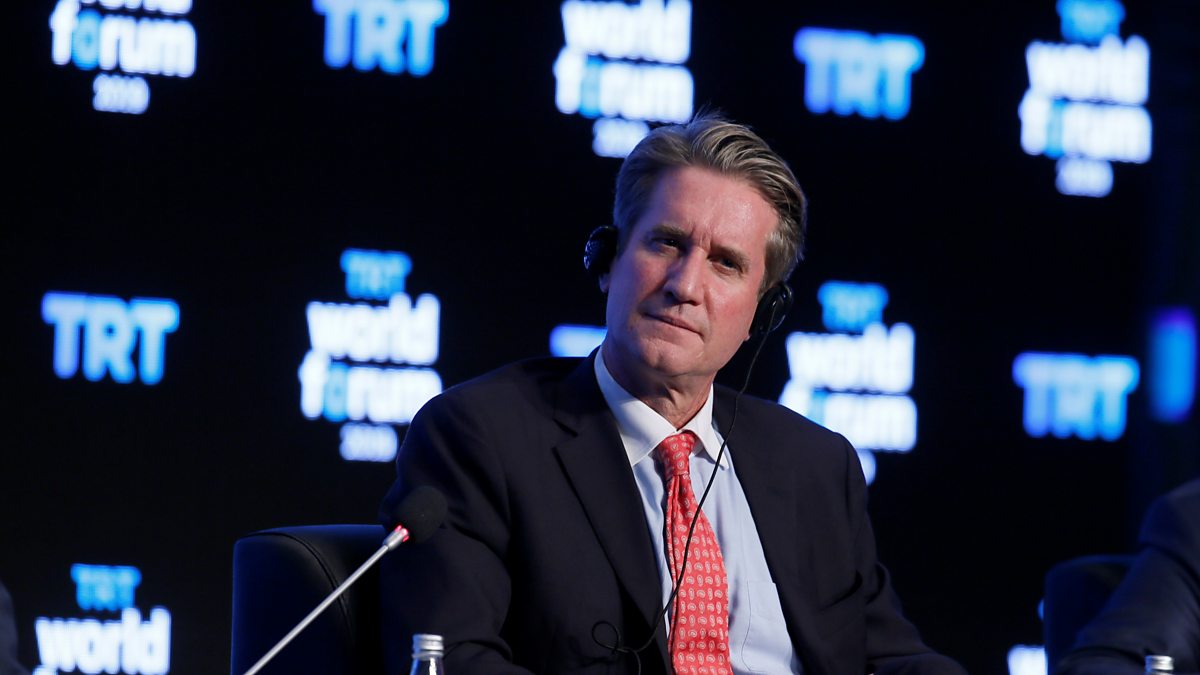
Former U.S. Ambassador to Azerbaijan, Matthew Bryza, believes that Israel will face significant challenges in cleansing the Gaza Strip of Hamas. He also thinks that the events in the Middle East will have little impact on the South Caucasus, but this region, especially Azerbaijan, has a great opportunity to shape its future. Bryza discussed these topics and more in an interview with Minval.az.
Q: Let’s start with Israel’s actions in Rafah, which were carried out despite the ICC’s decision. What are your predictions regarding the ICC’s actions and Israel’s response?
Bryza: I believe Israel will not pay attention to the ICC’s decision. Prime Minister Benjamin Netanyahu has repeatedly stated that Israel will do everything to destroy Hamas and remove the security threat from Rafah and the entire Gaza Strip.
Q: Will Israel be able to complete the cleansing in Rafah? Will there be an operation against Hezbollah in Lebanon afterward?
Bryza: I hope so, but it’s a very difficult task. It will require destroying all tunnels and finding all terrorists. Hamas is a terrorist organization that committed a terrible crime against Jews, second only to World War II. However, Hamas is also an idea and ideology, which cannot be simply eradicated through military action. As former U.S. General David Petraeus, ex-commander of Central Command and Multi-National Force in Iraq, said, we must think every day about whether we are removing more terrorists from the battlefield than we are creating. Israel’s military operation in Rafah contributes to the creation of new people who share Hamas’s ideology. If Israel managed to destroy Hamas in Gaza, predicting its next step would be difficult. On one hand, Israel wants to eliminate the threat from Hezbollah in Lebanon, but on the other, neither the U.S., Iran, nor Israel want a global war involving Lebanon, as it would make the situation very dangerous.
Q: If the world is indeed on the verge of reorganization, what do you think it will look like afterward? What will be the geopolitical landscape of the Middle East and the South Caucasus?
Bryza: I can’t say for certain that the world is on the brink of reorganizing the international political system. I think the system is constantly changing, and predicting the future of the Middle East and the South Caucasus is difficult. I doubt the events in the Middle East will greatly affect the South Caucasus. Currently, the entire South Caucasus, especially Azerbaijan, has an excellent chance to build its future because Russia is bogged down in its problems in Ukraine. Additionally, the U.S. is not very interested in the South Caucasus, while Iran and Azerbaijan are seeking common ground in strategic politics. Hopefully, a peace agreement between Azerbaijan and Armenia will be signed soon, opening all transport routes as per the Trilateral Statement of November 10, 2020. Thus, the most important dynamic for the South Caucasus is what’s happening within the region itself.
Q: Will the concept of the Global South persist, not in a geographical sense, but in terms of unity on key issues within the Non-Aligned Movement?
Bryza: I think the term Global South is just a slogan. When I was a student, we used terms like “developing countries” or “less developed countries.” This isn’t a political definition but an economic one. These countries aren’t very wealthy, each has its perspective on global development and who their most reliable partner is. The unifying factor for these countries is that they aren’t wealthy and see themselves somewhat as victims, which is understandable. They seek financial resources, freedom, and independence. Some have chosen to cooperate with China for financial support, while others prefer the U.S., Japan, or Turkey. Living in Turkey, it’s clear that some countries, especially in Central Asia, want to deepen cooperation with the Organization of Turkic States.
Q: Do you think that due to the casualties in Palestine, the social-religious factor of the fight against Islam is gradually fading into the background, or is Islamophobia actually growing?
Bryza: I disagree that there’s a global fight against Islam. Some individuals don’t understand or fear Islam, like many evangelicals in the U.S. who support former President Trump and back Israel, wishing for the end of the world to go to paradise. Such groups have people opposing Muslims, but in general, speaking of governments, especially the U.S. and European allies, I don’t see an anti-Islam approach. In the U.S., there’s a political or social movement, especially among young university students, supporting Islam. For instance, President Biden supports Israel, as did all previous U.S. presidents, understanding the complexities of the war against Hamas and the violations of international humanitarian law. However, Biden also knows he might lose support from young people backing Israel, with U.S. elections approaching in November.
Q: Can we say that the end of Iran’s attacks on Israel and Raisi’s death effectively ended the war between Israel and Iran, or is it still possible?
Bryza: No, I firmly believe that the end of Iran’s attacks on Israel and Raisi’s death do not mean the war between Israel and Palestine is over. The Iranian Constitution states that Israel has no right to exist. Despite Israel defending itself from Iran’s missile attacks, Iranians feel they achieved significant success, claiming they didn’t use their most advanced weapons and that the taboo against attacking Israel has been broken. If Tehran deems it necessary, it will use more effective weapons and missiles against Israel. The continuation of the war is uncertain, especially regarding Hezbollah’s actions in Lebanon. Additionally, Iran’s president doesn’t make decisions; Supreme Leader Khamenei does. He may listen to the president’s opinion but makes the final decisions, meaning a new president in Iran won’t change much.
Q: A peace conference on Ukraine is scheduled for June 15-16 in Switzerland, with 160 countries invited and 60 confirming participation, half of which are European. What do you think about the participation of Global South countries and their passivity on the Ukraine issue? Is this a response to the colonial policies once pursued by leading European countries in the Global South?
Bryza: I don’t know how many countries from the so-called Global South will decide to participate in this peace conference on Ukraine in Switzerland. But I think you’re right that their approach to Russia’s war against Ukraine is more about supporting Moscow. The explanation is that European countries are against Russia, and many Global South countries were once colonies of these European states. Despite Russia currently treating Ukraine as its colony, these countries still support Russia because they oppose their former colonizers.
Rauf Nasirov
Translated from Minval.az