Western countries have realized that Moscow can weaponize its geopolitical position and logistic networks. Strategic over-dependence on Russia’s energy, markets, and logistics has created significant challenges to neighboring countries due to increasing political tensions between the West and Russia. This development is undermining the Northern (Russian) Corridor’s position as the main overland East-West corridor. In turn, the alternative Middle Corridor is currently facing its best opportunity ever to take a leading position in connecting Europe and Asia.
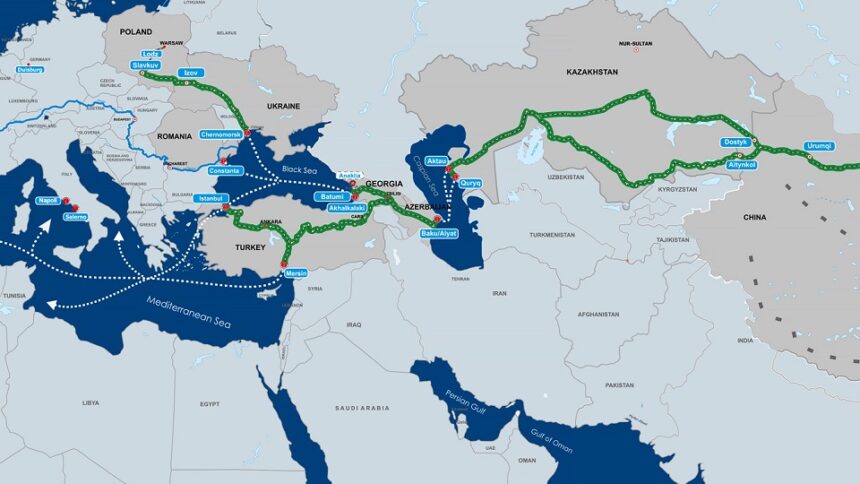
BACKGROUND: The Middle Corridor, formally known as the Trans-Caspian East-West-Middle Corridor Initiative, reflects Turkey’s and other regional countries’ Silk Road perspective. From its eastern endpoint, the Middle Corridor crosses from China into Kazakhstan before reaching the Caspian Kazakh and Turkmen ports. A sea connection attaches the Middle Corridor to Azerbaijani ports. It then passes through the South Caucasus via Georgia before reaching Turkey and then the European Union (EU). Regional countries in the Caspian and Black Sea basins consider the Middle Corridor a complementary logistical network to China’s Belt and Road Initiative (BRI) and the EU’s Silk Wind project.
The Middle Corridor’s bottleneck is the lack of an entire transport-oriented business ecosystem in the Caspian and Black Sea countries. The Middle Corridor so far remains a firmly regional initiative. Its freight lacks transparency, especially regarding the cost of its extended section in Europe, which requires negotiation with various parties. Furthermore, the Middle Corridor crosses five borders and transits one or two seas, depending on where the cargo is heading.
In comparison, the route across the New Eurasia Land Bridge (NELB) via the Northern Corridor has obvious advantages. In terms of transportation costs, the countries along the Northern Corridor have signed long-term intergovernmental agreements with mature operations and their transportation costs are therefore relatively fixed. The Northern Corridor is also more advantageous in its actual operation than the Middle Corridor, as it has more mature business activities, better technical conditions, and involves fewer countries.
As an example of the time difference between the two routes, transport via the China-Europe Railway Express, which connects Germany and its neighboring countries with the central and western cities of China, from the central Chinese city of Xian to Prague normally takes 12 days via the Northern Corridor. The same transport via the Middle Corridor takes 18 days.
While the Middle Corridor is one of six official corridors of the BRI, neither Chinese finance nor Chinese companies have, so far, been excessively involved. Beijing has also been largely absent from port developments around the Caspian Sea and the Black Sea.
Nevertheless, the Russia-Ukraine war and the West-led sanctions regime against Russia have changed this picture dramatically. If the sanctions remain in place, the Northern Corridor will not be utilized regardless of its economic advantages.
IMPLICATIONS: The Middle Corridor is currently facing its best opportunity ever to secure a dominant position in connecting Europe and Asia. One positive development is the priority given by the Organization of Turkic States to improve transportation capacity and efficiency as well as market competitiveness of the Middle Corridor. Turkey, Azerbaijan, Kazakhstan, Kyrgyzstan, and Uzbekistan as full members, and Turkmenistan and Hungary as observers have continued to promote the construction of transportation infrastructure and actively coordinate with other countries along the route to simplify transit procedures.
After the start of Russia’s full invasion of Ukraine in February 2022, the Caucasian and Central Asian countries have increased their efforts to achieve further connectivity through the Middle Corridor. Since Moscow has on several occasions temporarily shut down the Caspian Pipeline, which carries roughly 80 percent of Kazakhstan’s oil exports to the Russian Black Sea port of Novorossiysk, Astana has instructed Kazakh oil firms to develop new delivery routes besides the existing Russian ones. Kazakhstan also plays an important connecting role between Europe and Asia, and more than one million containers are transported through Azerbaijan and Georgia every year.
Georgia has also intensified its work with Azerbaijan, Kazakhstan, and Turkey to ensure the competitiveness and maximum utilization of the Middle Corridor. Furthermore, the EU’s strategic energy cooperation with Azerbaijan has been enhanced in the past year with the signing of a historic document to double the amount of gas exported to the EU by 2027. This should have a positive impact on the desirability of the Middle Corridor as well as on the EU’s support for it. A similar argument could be made in the context of NATO.
If Baku and Yerevan reach a final peace deal on the Nagorno-Karabakh issue, Armenia will likely integrate into the Middle Corridor. The resumption of direct air cargo transportation between Armenia and Turkey in January 2023, after being blocked for three decades, is a good starting point.
As part of its global strategy to delimit China’s global influence, the U.S. could see a strategic advantage in encouraging the construction of a more integrated market involving the EU and the countries of the Caspian Sea basin, rather than allowing this integration process to reach all the way to China. The Middle Corridor would then present a logistic hub for promoting integration between European, Caspian and Central Asian countries.
The EU has already made a similar commitment to increase eastward logistic integration, albeit for perhaps different reasons. The EU plans to invest as much as €2 billion as part of its plan to further extend its Trans-European Transport Network (TEN-T) to the Eastern Partnership countries, which include Azerbaijan and Georgia.
Both geopolitically and geoeconomically, the Middle Corridor’s main appeal is that it does not cross Russia. Both the Western countries and China consider this as a strategic advantage, given the present circumstances. Despite friendly and perhaps deepening Sino-Russian relations, Beijing seeks to build alternative connections into the overland Silk Road reaching Europe. For years, Moscow and Beijing had a tacit division of labor in Central Asia, with Russia taking the lead in security matters while China took the lead in economic matters. This is now changing in the context of the Russia-Ukraine war.
Last but not least, the war has dramatically changed Moscow’s perspective regarding the Middle Corridor. Infrastructure development along the Middle Corridor provides new logistic opportunities for Russia while the Northern Corridor has been blocked by Western countries through sanctions. As Turkey, Georgia, Azerbaijan, and Kazakhstan have become critical corridors for Russia to reach international markets, the Middle Corridor has turned into a North-South logistic opportunity rather than a direct challenge to the Northern Corridor.
CONCLUSIONS: Geopolitical conditions suggest strongly that the Middle Corridor will see more use than the Northern Corridor alternative. Even though the Middle Corridor is both a less efficient and a more costly alternative to the Northern Corridor, it is now the preferred route.
The EU and NATO have considered the Middle Corridor as an alternative in order to reach the Southern Caucasus and Central Asia and supported regional countries’ geopolitical independence from Russia. It also presents a chance for Beijing to develop alternatives to the Northern Corridor in Eurasia without drawing Moscow’s ire. Expanded alternative logistic networks through Eurasia will diminish China’s geoeconomic vulnerability.
Since all major actors, including China, Russia, the EU, and the U.S. have favorable attitudes toward the initiative, it is time to see whether it is feasible to realize the Middle Corridor as a fully-operational hub.
Dr. Selçuk Çolakoğlu is the Founding Director of the Turkish Center for Asia Pacific Studies and a faculty member of the Globalization and Development Programme at BNU-HKBU United International College.