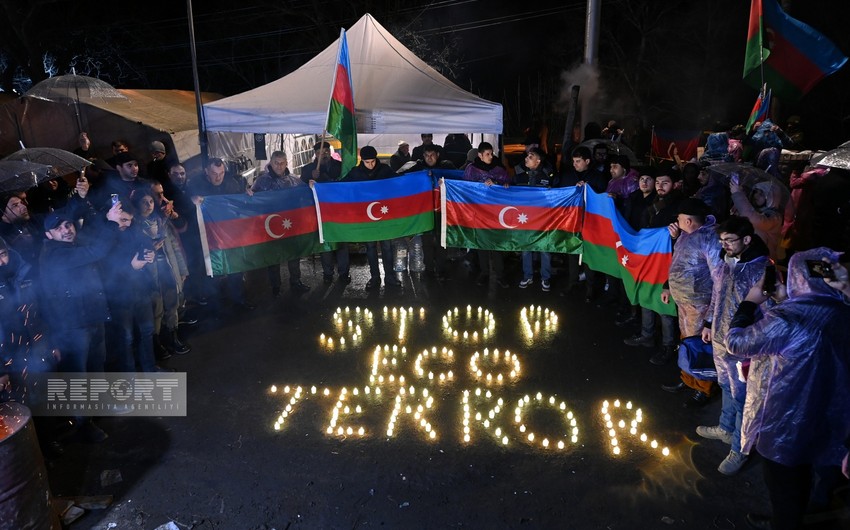
Russian peacekeepers were deployed to the area and surrounded the demonstrators on either side of the road to stop them from marching in the direction of Khankendi (Eurasianet, December 15). As a result, this spat has led to the effective closure of the only road connecting the Armenian-inhabited parts of Karabakh with Armenia.
There is some history behind the ongoing standoff. In early December 2022, the Azerbaijani side raised the issue of natural resource extraction, illegal from Baku`s point of view, in the areas under the control of the secessionist authorities in Karabakh (Top-Center, December 16). Even while Baku has long protested the economic activities in the occupied Azerbaijani territories, this subject has recently gained increased attention. On December 3, representatives of the Azerbaijani Ministry of Ecology and Natural Resources were sent to the Lachin Corridor to deliver their demands to the commander of the Russian peacekeeping force (Eurasianet, December 3).
The environmental-monitoring mission was set up to investigate allegations of illegal mining in Karabakh in accordance with an agreement struck between the Azerbaijani authorities and the Russian peacekeeping forces (Eurasianet, December 12). However, a group of individuals from the Armenian side blocked the road and prevented the monitoring mission from entering the area on December 10 (Mfa.gov.az, December 12). Allegedly, it was Ruben Vardanyan, a Russian tycoon of Armenian descent and the current state minister of the separatist entity, who prevented the implementation of the monitoring mission, telling the Azerbaijani officials that “this [Karabakh] is his zone.”
The situation greatly escalated shortly thereafter. Starting on December 12, protests were organized by a group of Azerbaijani demonstrators in the same area of the route that had been blocked by the Armenian side. Organized protests and widespread media coverage of the developments are themselves indications of state support, which Baku has not contested (Report.az, December 12). But if this is the case, why support these protests now?
It is simply misleading to explain what is happening in the Lachin Corridor from a solely ecological perspective, though there is some legal bearing to the crisis (Radio Free Europe/Radio Liberty, December 16). Indeed, in violation of international law, exploitation of the mineral resources located on Azerbaijani territory continues today. But the timing of this standoff and its overall impact on the region should be viewed in the wider picture. What is happening today in the Lachin Corridor is an integral part of the postwar dynamics in the region following the end of the Second Karabakh War, which is made up of three primary actors: Azerbaijan, Russia and Armenia (though the European Union, France, Iran and Turkey have tried to become more involved in recent months).
To begin with, the quality and quantity of Azerbaijan’s pressure on Russia, which continues to suffer significant tactical defeats in Ukraine, are increasing daily. Moscow’s inability to respond forcefully to this rhetoric is the fundamental motivator for Baku to be more assertive in its dealings with the Kremlin. In truth, any action taken against Baku by Moscow will be detrimental to relations between Russia and Turkey. For Russia, which is becoming increasingly isolated on the world stage, Turkey can act as a lifeline in various situations. During one of his recent briefings, Russian President Vladimir Putin suggested that his war against Ukraine will carry on for a seriously protracted period (Euractiv, December 8). In such a long-war scenario, poisoning relations with Turkey—most crucially, by forcefully responding to the standoff along the Lachin Corridor—does not make any sense for the Kremlin’s decision-makers (Radio Free Europe/Radio Liberty, December 11).
Moreover, Azerbaijan’s geostrategic significance to Russia has increased. Even though Azerbaijan continues to support Ukraine, Baku has been able to prevent overtly antagonizing Moscow by not taking any concrete actions against it (i.e., sanctions). Furthermore, Azerbaijan is also becoming a significant regional player for international transport and energy routes due to its advantageous location. Therefore, it is becoming imperative for the Kremlin to maintain amicable relations with Baku and dissuade the Azerbaijani government from siding with the anti-Russia axis, rather than engage in a direct confrontation with Azerbaijan over the current escalation along the Lachin Corridor (JAM-news, November 28).
Having calculated the emerging power vacuum in Eurasia’s security architecture and Moscow’s inability to act, in recent weeks, Baku has ventured an array of pressure mechanisms against the Kremlin to test Russia’s “red lines” in the region (YouTube, December 14). This maneuvering has been happening not only along the Lachin route but also through other dimensions, such as the intensified war of words with and over the Russian peacekeepers in Karabakh, preferring instead the notion of Western-supported peace talks. As one Armenian journalist explained, the level of Baku`s démarches along the Lachin Corridor are simply “destroying Russia`s authority and reputation” (YouTube, December 14). Through its assertive policies, the Azerbaijani government hopes to compel Moscow into offering the most concessions possible on Karabakh. One of these desired concessions being voiced by the protesting Azerbaijani eco-activists in Karabakh: the installation of an Azerbaijani checkpoint at the Lachin Corridor’s entrance (Report.az, December 15). If granted, Baku will be able to eradicate the extra-territorial use of this strategically critical road.
Armenia is another focus of Azerbaijan’s postwar coercive approach. Currently, one of the main points of contention between Baku and Yerevan is Article 9 of the tripartite agreement that put an end to the Second Karabakh War. The article states that Armenia is required to open a transport and communication route—what Baku refers to as the “Zangezur Corridor”—between mainland Azerbaijan and its Nakhchivan exclave. However, Yerevan has specifically resisted the opening of this road for the past two years by claiming that the extra-territorial corridor—something similar to the Lachin Corridor—is a red line for Armenia (Radio Azatutyun, December 14, 2021; and Iran has said the same, see EDM, September 23). Yerevan’s resistance fuels Baku’s anxiety, and the Azerbaijani authorities have made it clear that they would alter the extra-territorial status of the Lachin Corridor if Yerevan rejects the tripartite agreement’s implementation (Eurasianet, November 28).
The organization of regular monitoring missions for the mines in Karabakh, which are not under Azerbaijani control, is another demand of the Azerbaijani demonstrators; however, this demand is primarily targeted at the separatist authorities in Karabakh. The Azerbaijani side refers to the recently appointed state minister in Karabakh, Ruben Vardanyan, as an “agent of Moscow” and rejects any engagement with him (Aze.media, November 17). Vardanyan, on the other hand, asserts that no compromises will be made and that Azerbaijan should recognize Karabakh’s independence, speaking from a maximalist stance (Twitter.com/RubenVardanyan, December 6).
If control over Karabakh’s minerals, which is one of Baku’s demands, is fully ensured, then one of the biggest means of economic self-sufficiency of the secessionist authorities in Karabakh will disappear (Top-Center, November 16). This could seriously destabilize Vardanyan’s position, who, upon arrival in Karabakh, was accepted by the local Armenians as an omnipotent ruler capable of solving the unrecognized entity’s problems and consolidating the local (and Russian) forces to resist Azerbaijan`s reintegration policies.
Overall, the blockade and some of its elements (i.e., the interim cutoff of gas supply) have not only discredited Vardanyan but also demonstrated that Azerbaijan is currently dictating the rules of the game on the ground. Azerbaijan’s declaration that it is prepared to “address the humanitarian needs of the Armenian community in Karabakh” could be an effort to partially seize authority over the region’s Armenian population from the secessionist leaders (Top-Center, November 16). Such a move would thereby free up Baku to further push for Karabakh’s eventual reintegration into Azerbaijan.
Rusif Huseynov, Shujaat Ahmadzada