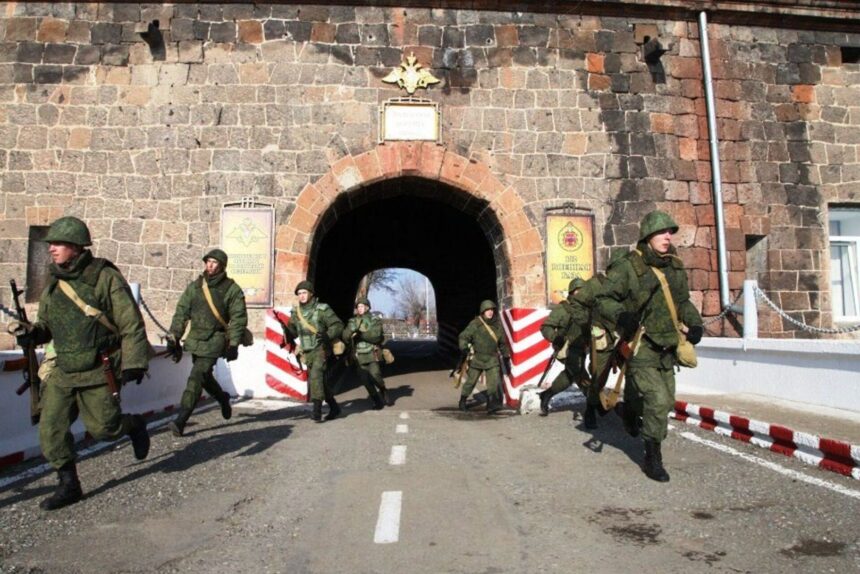
This was reported by Ukrainian military intelligence, which stated that the goal is clear: to strengthen military-political pressure on the countries in the region. Personnel are being recruited from the Russian Armed Forces in the Rostov and Volgograd regions, as well as from the temporarily occupied Crimea. Additionally, Russia is actively seeking volunteers among the oppressed ethnic groups of the Caucasus, particularly in North Ossetia and Adygea, according to Ukraine’s Defense Intelligence agency via Telegram.
One might question this report. After all, amid the war in Ukraine, Russia seems ill-equipped to stretch its military resources further. Moreover, Armenia and Azerbaijan are no longer at war and are reportedly preparing to sign a peace treaty. And there are countless other reasons to doubt the timing and purpose of this deployment.
Yet the problem is that even before this bombshell from Ukrainian intelligence, the Karabakh issue had already begun reappearing in the statements of Russian officials. Multiple recent examples point to renewed Russian interest. A source speaking with Russian state media hinted that Azerbaijan should recognize Russia’s annexation of Ukrainian territories—both occupied and partially occupied—and in return, Russia would acknowledge Karabakh as Azerbaijani. At the same time, Vladimir Medinsky, known for his controversial remarks, referred to Karabakh as a “disputed territory,” though it never was one. International law draws a clear line between disputed and occupied territories.
Last week, Deputy Director of the Fourth CIS Department Dmitry Masyuk, quoted by TASS, accused the West of attempting not only to sideline Russia from the Armenia-Azerbaijan normalization process but also of pushing for a “hasty” peace agreement. His comments betrayed the frustration in Moscow that it failed to impose a “delayed status” for Karabakh—essentially preserving the conflict for “two, three, or preferably four more generations,” as Dmitry Medvedev once suggested during his term as Prime Minister, and thus justifying the presence of Russian peacekeepers in the region.
Meanwhile, The Insider has reported a new leak: Moscow is considering imposing sanctions on “disobedient” countries, introducing visa requirements, and conducting “threatening” military exercises near their borders.
Armenia rushed to declare that its territory would not be used to launch attacks on neighboring countries. But given that Armenia occupied Azerbaijani lands for nearly three decades, supported Russia’s aggression against Georgia, and launched missiles at Azerbaijani cities during the 2020 war, such statements ring hollow. This is especially true amid ongoing provocations at the de facto border, delays in signing a peace treaty, and the construction of offensive outposts along that very line.
Russia is also systematically escalating the internal political climate in Armenia, openly backing revanchist forces. The buildup of Russian troops fits neatly into this strategy. Should these forces come to power—something Moscow appears to be betting on—Russia will need to visibly demonstrate its support. More personnel at its base would serve that purpose well. A military coup scenario cannot be ruled out either. Armenia has experienced such attempts before: in 1998, the first president Levon Ter-Petrosyan was removed through a “creeping coup” and political assassinations. In 1999, armed assailants shot dead key opponents of Robert Kocharyan right in the Armenian parliament. More recently, General Onik Gasparyan attempted a coup following the 2020 war.
Back in the mid-2000s, after Kyrgyzstan’s second “Maidan,” Russian commentators wondered why troops from Russia’s base in Bishkek hadn’t intervened. That debate led to the creation of the CSTO’s Collective Rapid Reaction Forces. When these forces were deployed in Kazakhstan in January 2022, Armenian Prime Minister Nikol Pashinyan hoped the precedent would be applied to Armenia too—specifically, for Russian intervention in the conflict with Azerbaijan. Now, a different scenario seems to be unfolding: with CSTO backing, revanchists could be brought to power in Armenia, and threats or even provocations against Azerbaijan may follow. Be careful what you wish for—it might come true.
Ironically, this scenario is playing out while Moscow hints at its readiness to reduce tensions. According to Telegram sources, a high-level Russian delegation may soon visit Baku, possibly led by Emergency Situations Minister Alexander Kurenkov, formerly Putin’s aide. The delegation reportedly carries a personal message from President Putin, including discussion of prisoner exchanges. Some Russian sources claim that Igor Sechin, CEO of Rosneft, has spoken in favor of stabilizing relations with Azerbaijan.
On the surface, this may seem like a step toward de-escalation. If Moscow genuinely aims to lower tensions—especially tensions it largely instigated—that would be a welcome development. Baku has no interest in heightening the conflict; Azerbaijan is simply defending its sovereignty and citizens. The question remains: will the Russian delegation come to negotiate, or to pressure?
This is where complications begin. Too often, Russia sets deliberately unacceptable conditions in negotiations. Consider the last Karabakh settlement plan revealed by Rashid Nurgaliyev, First Deputy Secretary of Russia’s Security Council. Or the persistent attempts to impose “delayed status” for Karabakh, even after Armenia’s defeat in the 44-day war. Or Russia’s approach to peace talks on Ukraine. Worse still are the missile attacks on SOCAR facilities in Ukraine, including gas stations in Zhytomyr, which hardly signal goodwill.
If and when a formal peace initiative arises, it may resemble a classic “good cop, bad cop” routine. And reinforcing Russia’s military presence in Armenia fits that script precisely.
But such games no longer work with Azerbaijan. It is no longer the early 1990s—let alone the 1920s. Before drawing up new geopolitical blueprints, Moscow’s “strategists” would do well to recall what became of past plans: using Armenia as a proxy against Azerbaijan, starting a new war for new territory, pushing toward pipeline disruption and railway sabotage, undermining the Southern Gas Corridor.
They should also remember that the balance of power in the South Caucasus has changed—and not in Russia’s favor, nor in that of its restless outpost.
Nurani
Translated from minval.az