COP29 in Baku has concluded, and leftists of all stripes have begun lamenting that “COP29 was a failure.” Local civil society activists of a left-liberal orientation echoed this sentiment, lamenting: “Ah, we couldn’t live up to the white man’s hopes for a project of universal happiness for humanity!”
For instance, the World Socialist Website, the mouthpiece of the Fourth International Committee, writes: “COP29 ends with empty deal, as 2024 set to be warmest year on human record.” This statement is particularly ironic, given that this mantra has become the subject of ridicule and memes worldwide, with people witnessing unusually prolonged cooling this year and exposing the manipulation of temperature data by meteorological agencies in their countries.
“Was COP29 in Azerbaijan a failure?” asks the elitist Council on Foreign Relations (CFR) and concludes: “The UN climate summit in Baku, Azerbaijan, was poorly organized, fell far short of goals for climate finance, and raised doubts about the ability of the COP process to halt alarming global warming trends.”
On the other hand, India and Nigeria accused Azerbaijan’s leadership of improperly imposing a last-minute deal. Meanwhile, Canada’s Minister of Environment and Climate Change, Steven Guilbeault, described Baku’s “lack of ambition” as “deplorable.”
A Shift in Neo-Globalist Agendas
However, the truth is that the “modest results” of COP29 have nothing to do with Azerbaijan.
They are tied to an overarching agreement—a consensus reached last year between the industrial and neo-globalist segments of the world’s ruling superclass in Davos. Specifically, this consensus recognized the need to detoxify the neo-globalist reconstruction project known as “The Great Reset,” which was launched under the guise of the pandemic in June 2020. The agreement called for slowing down the woke narrative, the “new normal,” and both the green and pandemic agendas.
In essence, the entire programmatic complex of so-called “inclusive capitalism”—a new post-capitalist formation aiming to transfer all state powers to alliances of transnational corporations—has been put on hold. This is the long-standing dream of left-leaning globalist oligarchs, discussed since the 1960s on all major globalist platforms.
Thus, at this year’s January session of the World Economic Forum (WEF), which functions as the politburo of this grand reconstruction, the superclass arrived in their private jets with a pre-agreed consensus decision regarding Trump’s candidacy for the presidency and the industrialist forces supporting him.
Public and Economic Pushback
There are two primary reasons for the adjustment to the neo-globalist course.
Firstly, the public rejected the “inclusive capitalism” architects’ proposed social contract, recognizing the unsavory motives hidden beneath the positive rhetorical facade (the UN Sustainable Development Agenda) and the construction of a global totalitarian system of social credit. Some of the so-called “useful idiots” began to realize that the extraction of energy from the economy was essentially about dismantling capitalist systems.
Under these conditions, a decision was made to intensify propaganda efforts, leading to the launch of the “Great Narrative” program. By 2022, during the next WEF session, the superclass began to express concern, with speakers from the podium admitting that, unfortunately, the public was not buying into the climate agenda. They proposed shifting to Plan B with a narrative about water scarcity: “This is a more understandable and relatable issue for everyone.” Yet, this also failed.
In 2023, the WEF reported that research indicated a sharp decline in public trust in government institutions, making it impossible to build a “happy future” (happytalism) under such conditions. Finally, in 2024, the WEF launched a mitigation plan called “Rebuilding Trust,” which signaled a retreat from the madness of the so-called “new normal.”
Secondly, there is an economic reason. Despite printing trillions of currency over the past few years, the reserves proved insufficient to fully deploy the grand reconstruction project for implementing a new global system (“The Great Reset”). According to the superclass, this issue can be addressed through reindustrialization, which would allow resources to be accumulated for the next big push.
As a result of this high-level consensus, various ESG indicators collapsed like a house of cards, and transnational corporations began withdrawing from DEI sectors and obligations to fund the “new ethics.”
Simultaneously, scientists who had been banned from media and social platforms in recent years for allegedly spreading “disinformation” about pandemic mandates and management methods were now being awarded medals for their “intellectual courage.” Parliamentary investigations into the legitimacy of pandemic measures and the reasons behind ongoing excess mortality in many countries following widespread vaccination campaigns also began. Key technocratic figures were quietly retired, and, finally, the declaration was derailed during the summer of this year.
In short, the global elite decided to “restore public trust” in governmental institutions, which had plummeted to rock bottom over the past four years of reconstruction. They also aimed to accumulate resources for reindustrialization—essentially extending capitalism. The “happy future for all humanity” is now to be introduced gradually, without abrupt moves, unlike what was attempted in 2020.
It is within the context of this broader shift in global agendas that the outcomes of COP29 should be evaluated.
COP29: The Baku Perspective
The main declaration of COP29 was the “Baku Financial Goal”—a commitment by developed countries to allocate $300 billion annually to developing nations by 2035, with plans to increase this amount to $1.35 trillion through public and private funding sources. For comparison, the United States spent $4 trillion on “fighting COVID-19.” It’s also worth noting that, by some estimates, the “green transition” could cost $34 trillion.
Third-world countries, initially hoping for $2.5 trillion, had to temper their expectations and leave dissatisfied with the “insufficient” $300 billion commitment. For example, the special representative of the Marshall Islands expressed disappointment, warning that “if global warming rises to 2°C, the Marshall Islands will simply disappear underwater as sea levels continue to rise,” attempting to frighten the global public.
This raises the question: why do developing countries flock to the “green agenda” like bees to honey? Don’t they understand that the true aim of financial mechanisms like “net-zero emissions” and the “green transition” is to issue loans to third-world nations, which transnational corporations can then leverage to seize full control over these countries’ natural resources and infrastructure?
Of course, they understand. However, the “green transition” creates financial incentives for technocrats and parasites in both governmental and non-governmental sectors. It offers opportunities to secure loans, subsidies, and “aid,” to embezzle budgets, consume grants, and establish an extensive shadow—or semi-legitimate—economy.
COP summits under the aegis of the United Nations are essentially executive structures of “inclusive capitalism,” a post-capitalist socio-economic formation. Their primary goal is to empower alliances of transnational corporations with state-level authority over the ownership, control, and distribution of resources. Crucially, this includes the ability to shape societal relationships through so-called digital transformation and artificial intelligence.
The core mission of these summits is to find new ways to speculate on carbon emissions via “carbon credits” and “climate finance,” all cloaked in the rhetoric of co-opted leftist ideals.
In this context, Baku played its part quite successfully, as usual balancing between two dominant global agendas, maintaining communication channels with different camps, and establishing platforms within the country.
Firstly, Baku achieved what has already been called a “carbon coup”—the establishment of rules for the global carbon market. Nations were given the choice to either accept or reject an operational framework for trading and crediting carbon emissions between countries.
Secondly, nations with large energy markets backed Baku’s ambitious commitment to energy storage, aimed at a sixfold increase in global capacity by 2030.
However, neo-globalists (leftists of all stripes) lament that Baku successfully deflected the issue of fossil fuel extraction control to the next COP30 in Brazil. The Fourth International is in hysterics: “The fight against climate change, a global problem requiring global solutions, is at odds with the financial and geopolitical interests of the capitalist class… Mass deaths caused by global warming, and even greater scales of death to come, are merely the costs of doing business for this parasitic and outdated social stratum.”
One might be tempted to respond: first, address the mass deaths resulting from your so-called vaccine technologies, and then perhaps slow down the “natural disasters” induced by your climate technologies.
Amid expectations that the new administration might withdraw the United States from various neo-globalist climate negotiations and platforms, neo-globalists among COP29 participants, including U.S. climate advisor John Podesta, advocated for their favored China to take the lead in the “fight against climate change.”
We recall that in Dubai in December 2023, the president of COP28, Sultan Al Jaber (UAE Minister of Industry), stated: “Please help me, show me the roadmap for a phase-out of fossil fuel that will allow for sustainable socioeconomic development, unless you want to take the world back into caves.” He continued: “There is no science out there, or no scenario out there, that says that the phase-out of fossil fuel is what’s going to achieve 1.5C.”
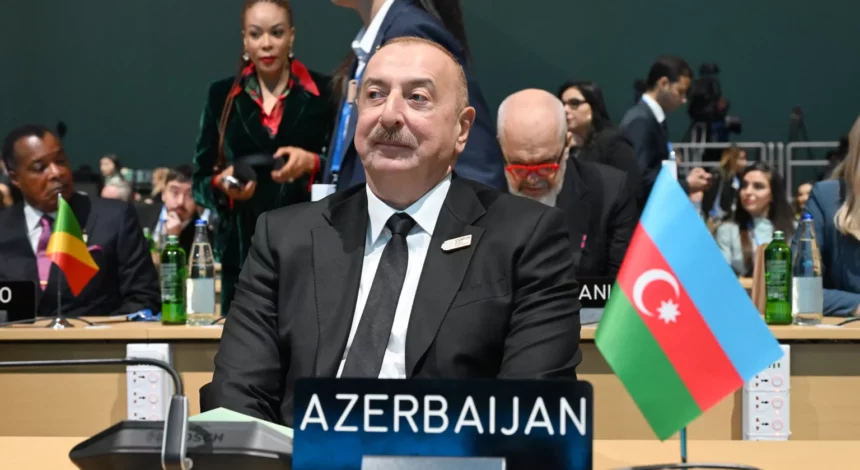
There were no such bold statements at Baku’s COP29. However, for some reason, the neo-globalist media became agitated over an innocent remark by Azerbaijan’s president, who said, “Oil and gas are gifts from God.”
I once wrote that Azerbaijan could serve as a prime example for other small states of how to skillfully adopt a passive-aggressive approach. Perhaps it is no coincidence that the Shirvanshah State, located on the territory of modern Azerbaijan, managed to survive in a super-toxic neighborhood with regional powers from the 9th to the 16th century.
Aytan Gahramanova