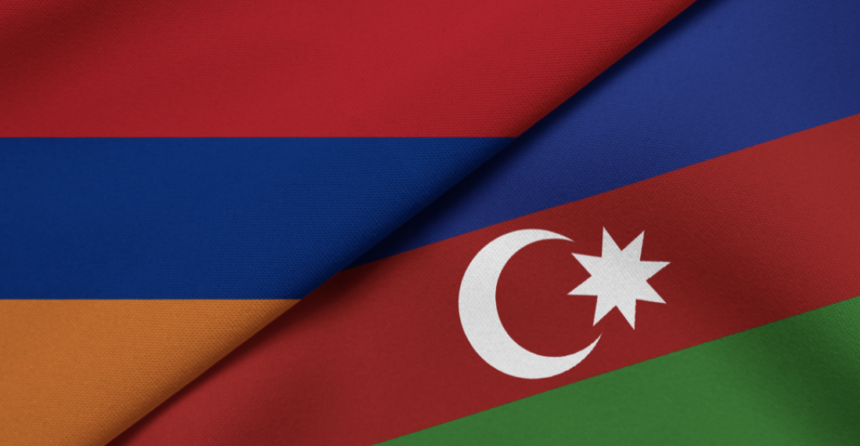
Armenia and Azerbaijan have practically been in a state of war with each other ever since they emerged as independent countries following the dissolution of the USSR in 1991. Over the last three years they have been negotiating, sometimes with the help of others, sometimes on their own, to end the cycle of violence and usher in a new era of peace. So far they have failed to agree on the text of a peace agreement, but it is likely that eventually they will, possibly quite soon. However, even in the absence of a formal peace agreement Armenia-Azerbaijan relations are changing, and will continue to change to become much more nuanced than has been the case so far. A relationship that has so far been based on confrontation and containment is making way for one based on contact and co-operation. The process is unlikely to be very quick, or simple and easy. At least for another decade Armenia-Azerbaijan relations will continue to be a mix of all four elements: confrontation, containment, contact and co-operation. Managing this mix will be the challenge facing the leadership in the two countries. The international community must be ready to support this process tangibly and speedily.
Confrontation will remain inevitable, but needs to be managed
Confrontation was so much the order of the day in the relations between Armenia and Azerbaijan in the last thirty years that for both sides it had become the norm, a safe ideological comfort zone with no political risks. Moving out of that comfort zone has not been easy. Even when the top leaders in Armenia and Azerbaijan have signalled that they want to turn the page, their subordinates have been slow to take the cue. Look at the behaviour of Armenian and Azerbaijani diplomats in many countries. With very few exceptions they seem best at ease when they are hurling insults at each other. This continues even whilst their leaders are saying they are very close to a peace deal. Moving a whole country and society out of such a confrontation mode will take time.
But even with the best of political good-will, there are always going to be contentious issues in Armenia-Azerbaijan relations, given recent history: border disputes; transit arrangements; the fate of the Armenians of Karabakh, property issues of refugees and displaced people; war crimes; landmines, and the fate of missing persons, are all issues that have the potential to develop quickly into confrontations. Some of them inevitably will, which is why both sides must prepare the right mechanism to manage crises in their relations when they emerge, and not to naively assume no such crises will arise.
Containment is the current tool of choice in both Baku and Yerevan, and is likely to remain so for a while
Whilst the leadership in both Armenia and Azerbaijan appear to be now ready to exclude further violent clashes, and will likely bring the negotiations on a peace agreement to a successful conclusion over the coming months, the level of trust between the two sides remains very low. Containment of the other side has now emerged as the tool of choice in the strategy of both Baku and Yerevan. Armenia is trying to find ways to contain current Azerbaijani military superiority by readjusting its foreign policy, strengthening relations with new partners such as India and France and extending the role of the European Union Monitoring Mission so that it will become a political deterrent against future Azerbaijani ambitions. Armenia also sees a peace agreements as another way of containing Azerbaijani strength and ambitions, which is why it wants to involve the international community in its oversight.
For Azerbaijan too, containment is a current tool of choice. It is concerned that nationalist elements in Armenia, and within the influential Armenian diaspora, have not given up on the idea of creating a second Armenian state on Azerbaijani territory, and given half a chance will try to do so again. Azerbaijan has publicly stated that it wants to keep Armenia militarily weak, and has taken issue with those countries that are trying to help Armenia to re-arm. It also wants to exclude external involvement, so has moved away from the EU and US mediation platforms, and continues to reject the presence of the EU Monitoring Mission in Armenia. This is all part of a containment effort.
Containment is risky, because it can very easily and very quickly lead to confrontation, but many countries engage in it as a tool for managing awkward neighbours. For containment not to turn into confrontation in the Armenia-Azerbaijan context there will be a need for the sort of diplomatic finesse that neither of the two sides has shown to have much of in the past. So risks here are high.
Contacts at all levels are necessary
Contacts between Armenia and Azerbaijan, and between Armenians and Azerbaijanis, since 1991 have been negligible. There were official negotiations – in the period up to 2020 a prerogative of the Minsk Group co-Chairs, and a handful of people on both sides; and there were some track 2 and track 1.5 initiatives which involved perhaps a hundred people on both sides. For the mass of the Armenian and Azerbaijani populations contacts were a taboo, a sign of weakness, if not outright treason.
Very slowly this is changing, and it is likely to change much more once a “formal peace” is agreed.
An important prerequisite is the opening of borders, and eventually the easy movement of people. Here the Armenia-Turkey dimension becomes hugely important. The opening of the Armenia-Turkish border will very quickly result in a brisk movement of people and considerable trading. As a people-to-people measure, this will have a big impact, and will make similar trends in Armenia-Azerbaijan relations much easier to achieve.
But the process needs to be helped. Frameworks for exchanges and dialogues involving different levels of society, including professional groups, youth, artists, sportspersons, war veterans etc need to develop very quickly, and the international community should also be ready to support this process generously. It is likely that initially at least, a regional approach, i.e. involving also Georgians in these networks and exchanges, will make the task easier.
One also assumes that if a peace agreement is signed, both countries will establish embassies in each other’s capitals. And could one think of the time when an Armenian consulate is established in Shusha, and an Azerbaijan consulate is established in Syunik? These symbolic diplomatic contacts will send clear signals that peace is inevitable and irreversible.
Co-operation is in the interest of both sides; it must now start in earnest
There were moments in Armenia-Azerbaijan relations over the last thirty years when co-operation was a dirty word. To even suggest it, as I often did to the two sides, was to open oneself to all kinds of insults and criticism. Hopefully, that moment has now passed, and on the horizon, one can see prospects for Armenia-Azerbaijan co-operation in many fields where it is absolutely necessary, and where everyone understands will lead to mutual benefit.
Armenia’s decision in December 2023 to support Azerbaijan’s hosting of COP29 in Baku later this year was a very positive and tangible expression of co-operation. Both sides should now work together to make COP29 a success from which both sides, and the rest of the world, can benefit
The potential for co-operation is enormous. It would be nice to think that somehow Armenia-Azerbaijan co-operation can develop organically, and that the best way is to let the free market and human ingenuity do their thing. Unfortunately, the reality is different since the baggage of the past weighs heavily on the present. Armenia-Azerbaijan co-operation will thus need to be accelerated by high-level commitment on both sides, and for example through the establishment of a Joint High Level Co-operation Council that will monitor the situation, unblock obstacles as they arise and kick start new initiatives. The international community also needs to be fast and flexible in responding, through frameworks regional or bilateral, that promote Armenia-Azerbaijan co-operation.
Managing the mix: confrontation, containment, contact and co-operation will remain a feature for some time
Armenia-Azerbaijan relations over the next decade will be a mix of four ingredients: Confrontation; Containment; Contact; and Co-operation. Managing this mix will determine whether the much anticipated new era of peace in the South Caucasus can emerge. A realistic approach is necessary, and the problems that remain, some of which are so deep-rooted as to be unsolvable, should not be underestimated. But finally, there is hope for a new beginning for the South Caucasus and its people, and for the region’s engagement with the wider world.
Dr Dennis Sammut, Managing Editor of commonspace.eu and Director of LINKS Europe Foundation