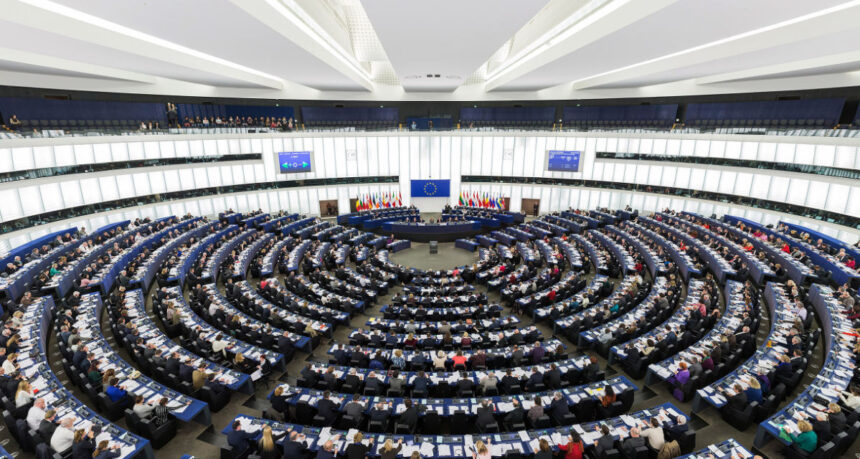
Earlier this year, the Dutch investigative platform Follow the Money reported that 25 percent of sitting members of the European Parliament (MEPs) across twenty-two European Union (EU) member states have been involved in some type of misbehavior or scandal at the national or international level. A common thread throughout the investigation was MEPs’ entanglement with foreign state actors.
The report includes the now-infamous Qatargate scandal, in which several sitting and former MEPs were arrested in December 2022 for a cash-for-influence operation. But the report also includes lesser-known cases, such as a privately funded trip for two Irish MEPs to the headquarters of Hashd al-Shaabi, an Iranian-backed, Russian-allied militant organization in Iraq, to criticize US and European military action in Iraq.
The upcoming European Parliament elections in June amplify the urgency of defending the institution against foreign meddling. To accomplish this, EU institutions should codify stricter definitions of foreign influence and interference, and they should pass future reforms as legally binding EU regulations. At the same time, EU officials must ensure that the organization’s transparency and anti-corruption reforms are crafted so that they don’t infringe on member states’ civil society organizations.
It’s not just Qatargate
Qatargate was the most prominent recent scandal to plague the European Parliament. The scheme’s primary goal was to rehabilitate Qatar’s image before the 2022 FIFA World Cup by stifling European Parliament resolutions critical of Doha and drafting speeches for Qatari ministers at EU hearings in exchange for under-the-table payments.
The case came to a head on December 9, 2022, when authorities conducted nineteen raids with eight arrests in Belgium and Italy, complete with the seizure of more than one million euros in cash. The highest-profile arrest was Greek MEP and then Parliament Vice President Eva Kaili. Her partner, Francesco Giorgi, and his boss, former Italian MEP Antonio Panzeri, were both arrested and confessed to involvement in the scandal. Throughout the investigation, authorities uncovered evidence of three hundred alleged attempts to manipulate the European Parliament, with Qatar at the center of the influence deal, which was purportedly worth four million euros.
The Parliament continues to find its current, former, and prospective MEPs embroiled in scandals with foreign governments, often involving Russia or China, especially during election years. In March, the Parliament opened an investigation into Latvian MEP Tatjana Ždanoka, who faces accusations of operating as a Russian agent since 2004. Regional news sites published numerous emails linking Ždanoka to a handler in the Russian Federal Security Service.
Additionally, the far-right Euroskeptic party Alternative for Germany, currently polling second among German voters, has made headlines for major scandals involving its top two candidates for the European elections, Petr Bystron and Maximilian Krah.
In March, reports emerged that Bystron was linked to the Russian-backed propaganda outlet “Voice of Europe,” a platform that spreads disinformation and provides financial support to pro-Russian politicians in the EU. Czech intelligence authorities claim that Bystron received “about 20,000 euros” from the site’s Kremlin-connected operator. The Munich Public Prosecutor’s Office has announced preliminary investigations against Bystron for “possible bribery of elected officials.”
Voice of Europe’s news reports would blend in with typical Russian propaganda if not for the political legitimacy they gained by featuring sitting MEPs. Additionally, some Voice of Europe videos appear to have been filmed at VoxBox, the Parliament’s in-house studio, using the heart of the institution’s broadcast system to disseminate Kremlin talking points, including arguments against Ukraine’s accession to the EU and in favor of peace talks with Russia.
In addition to the investigation against Bystron, Krah has been involved in multiple scandals. In April, German police arrested Jian Guo, an aide for Krah, over accusations that he used his proximity to Krah to spy for China. That same week, the Dresden Public Prosecutor’s Office announced two preliminary investigations against Krah over alleged payments from Russia and China for his work as an MEP.
Can the EU defend its own democracy?
In the wake of Qatargate, the European Parliament and European Commission moved to tighten rules to protect the EU’s democratic process. Last September, the Parliament adopted new rules requiring detailed declarations on MEP private interests, reporting on external income over five thousand euros per year, and bans on engagement with paid lobbying activity that could directly impact the EU’s decision-making processes.
The EU’s executive, the European Commission, adopted the Defense of Democracy package in December 2023 in tandem with the Parliament’s reforms to prepare for the 2024 European elections. The plan includes rules designed to increase transparency and safeguard European institutions from corruption. This rollout is the most significant package of reforms at the EU level since Qatargate, but it could benefit from stronger and stricter definitions to maximize its impact.
The road to reform
First, the EU should provide stronger definitions for the most basic terms in the defense toolkit. Chapter I, Article 2 of the Directive on Transparency of Interest Representation on behalf of Third Countries (2023/0463) fails to provide working definitions for foreign “influence” versus “interference,” a critical debate in the field, nor for the concept of “transparency.” The absence of these definitions is detrimental to the EU’s enforcement efforts, as there is little consensus across the bloc on what these categories include and exclude, or whether they can be used interchangeably. This lack of clarity is understandable in the short term. Creating a narrow definition related only to commonly used tactics may be too restrictive. At the same time, creating too broad a definition could inhibit political participation. In the long term, however, the EU must stop relying on a principle akin to US Supreme Court Justice Potter Stewart’s nondefinition of obscenity—“I know it when I see it”—and instead create specific, workable definitions for the member states to enforce.
Second, the EU must keep legal precedent in mind when creating legislation relating to civil society. In 2020, the European Court of Justice (ECJ) struck down a Hungarian transparency law on nongovernmental organizations (NGOs). The law mandated that NGOs listed as recipients of foreign funding by the Hungarian government must declare their income each year to the state and include disclaimers in all publications noting their designation. The ECJ ruled that the law taken in totality had a “deterring effect” on NGOs. The decision noted that while increasing transparency is a legitimate aim, states must establish how their additional regulations contribute to increasing transparency, which Hungary failed to do. The ECJ decision demonstrates that the EU must balance its necessity for transparency legislation without overregulating, which could lead to the inhibition of civil society.
Third, the EU should pass future reforms as legally binding EU regulations, rather than as directives, which only require member states to create legislation at the national level. The Defense of Democracy package, for instance, issued directives, meaning member states have flexibility in how they interpret and enforce each of its provisions, which increases the likelihood that it will be enforced in a variety of ways throughout the bloc. Thus, to ensure that future transparency and anti-corruption polices are equitably enforced EU-wide, it is important that they be legally binding regulations.
Taken together, these reforms to corruption-fighting legislation will help the EU’s institutions defend their reputation, integrity, and accountability, particularly in an election year.
Sophia Athan is a young global professional with the Atlantic Council’s Europe Center.