When the first Russian troops rolled into Nagorno-Karabakh, they were greeted with open arms. As a convoy of armoured vehicles snaked its way towards the front lines, Tigran, a 32-year old Armenian conscript, shattered from weeks of bloody firefights, rushed out to welcome them.
“We couldn’t believe they were here – it meant the war was over,” he says, flicking through pictures of himself grinning next to the new arrivals on his phone.
The ceasefire deal, signed between Yerevan and Baku, was brokered by Moscow in November 2020.
Under its terms, a contingent of nearly 2,000 Russian servicemen was deployed to the mountainous region to keep the peace. Inside Azerbaijan’s internationally-recognised borders, Nagorno-Karabakh and much of the surrounding region has been governed by separatists loyal to Armenia since the fall of the Soviet Union.
The brief but brutal war saw the breakaway ‘Republic of Artsakh’ lose swaths of territory to Baku’s forces, until Russia stepped in. Now though, the question of the region’s future is again rearing its head.
For decades, the Kremlin’s policy has been to keep the status quo in the Caucasus. The collapse of the USSR triggered the First Nagorno-Karabakh War, leaving the separatists in control of almost a sixth of the territory of newly-independent Azerbaijan, displacing as many as 600,000 Azerbaijanis.
A truce negotiated by then-Russian President Boris Yeltsin in 1994 froze the conflict, forcing Baku to accept the result.
A quarter of a century later though, Azerbaijan has boomed on the back of its oil and gas exports, building one of the region’s most modern armies and bringing in advanced attack drones from its close ally, Turkey.
When hostilities reignited in September 2020, its troops quickly recaptured virtually all of the land lost a quarter of a century before. Only the narrow Lachin corridor still links the breakaway region to Armenia, bypassing Azerbaijan’s border posts and patrolled by Russian troops.
Now, it seems the Kremlin has overestimated its ability to police its former hinterlands.
Distracted by its disastrous invasion of Ukraine, the once-fearsome reputation of its armed forces shattered, many on both sides doubt whether President Vladimir Putin has the inclination or the capacity to hold the line.
High in their mountain outposts, the peacekeepers have been accused of failing to prevent Azerbaijani troops moving into a number of villages in the ceasefire zone, while drone strikes have reportedly killed at least one Armenian soldier. Baku denies the claims it is moving in, but continues to assert its right to secure its borders, while calls for a political solution are growing.
Yerevan fears that the Russians have become an increasingly unreliable guarantor of its de facto control over Karabakh, and Azerbaijan is increasingly contemptuous of their presence. Given that Moscow presided over a deal that saw its citizens displaced and left the nation divided not on paper but in practice, resentment over its role there runs deep.
With those decades-old tensions flaring once again, the European Union is asserting itself in the conflict.
France, along with Russia and the US, is a Co-chair of the Minsk Group set up by the Organisation for Security and Co-operation in Europe (OSCE) in 1992 to negotiate a peaceful resolution in Nagorno-Karabakh, but the bloc as a whole has largely remained on the sidelines until now.
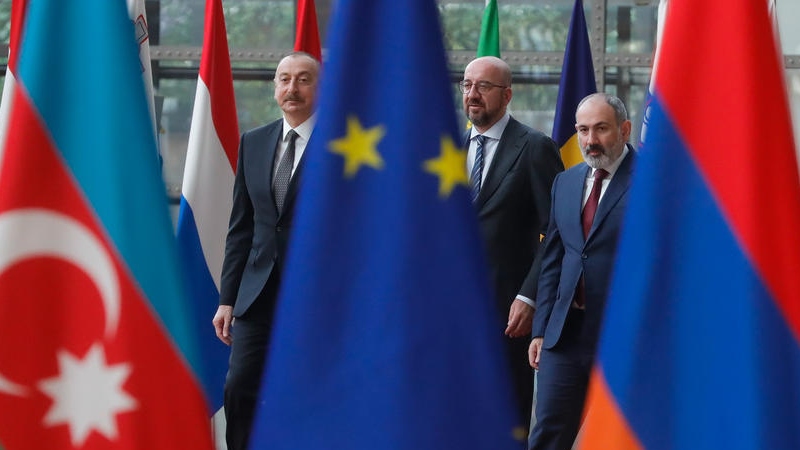
At a meeting in Brussels in May, Armenian Prime Minister Nikol Pashinyan and Azerbaijani President Ilham Aliyev met to hold talks about a lasting settlement to the conflict, agreeing in principle to work together bilaterally on the issue.
Just two days later, a joint commission convened to discuss border demarcation, while European Council President Charles Michel urged both sides to make headway on “advancing discussions on the future peace treaty and addressing the root causes of conflict.”
Russia initially welcomed the news, with Kremlin Press Secretary Dmitry Peskov saying that the developments were “very positive” even if “it is clear that the process will take a long time.”
In principle, both Brussels and Moscow share the same interests in avoiding a resumption of fighting, resuming transport links between Armenia and Azerbaijan, and finding a lasting solution to humanitarian issues.
However, it is clearly uncomfortable for Russia to have the EU assert itself in its backyard, given the tensions with the West in the wake of the invasion of Ukraine.
Foreign Ministry Spokeswoman Maria Zakharova has since hit out at the developments, claiming “we see persistent attempts by the EU to intervene in the process of trilateral agreements at the highest level,” urging the bloc not to play “geopolitical games” in what it sees as its sphere of influence.
And yet, Brussels has a strong hand to play. Unlike Moscow, it isn’t tainted in Azerbaijan with having presided over the two previous ceasefires that created the very conditions Baku sees as unacceptable – being unable to control its borders and perpetuating the political rift indefinitely.
Given that the country is exporting more gas to the EU following sanctions on Russian fossil fuels, Aliyev also knows he is in a stronger negotiating position than ever before.
Armenians too tend to have a positive impression of the EU.
There have long been accusations from leaders in Nagorno-Karabakh that any change from the status quo would mean “genocide” at the hands of the Azerbaijani government, and Brussels’ is seen as a mediator that could help avert a humanitarian catastrophe if the separatists are to make political concessions to Baku.
Any scheme that would see the region accept Baku’s sovereignty would likely have to be underwritten by an external mediator to be accepted by local leaders.
Even then, a deal would be a hard sell in Yerevan, which has seen hundreds detained in street protests over claims Pashinyan could formally recognise Nagorno-Karabakh as Azerbaijani territory following the talks in Brussels.
For the time being though, the standoff continues much as it has for decades. But there is increasingly a sense in the Caucasus and much further afield that something might soon change. If and when it does, it’s looking less and less likely that Russia will be able to do much about it.
Gabriel Gavin is a British journalist covering Eurasian politics and society