The recent Economist article “Russia’s allies are a motley-and shrinking-crew” says: “They are a coalition of the failing; the Soviet Remembrance Society; and a gang of opportunists.” The article takes a look at Russia’s geopolitical influence and countries directly dependent on Russia. The following is only the part of it that pertains to Russia, Armenia, and Iran.
“On paper, Russia’s geopolitical clout looks impressive. It has troops and mercenaries posted to at least 16 other countries. Some prop up friendly autocrats, as in Mali and Syria. Others sustain ‘frozen conflicts’ that keep countries such as Georgia in line and out of NATO. Over the past decade Russia has accounted for more than half of arms imports in 22 different countries, including big ones such as China and India. At the un it has benefited from the support, or at least useful abstentions, of dozens of countries.
Natural resources and technology amplify its power. In the decade before the invasion Russia was the dominant natural-gas supplier to more than a dozen countries, giving it an energy weapon that it has not hesitated to wield against Europe: in 2005, 2009 and again last year. Ten countries generate a major share of their electricity from Russian-built nuclear reactors, or else co-operate closely with Russia on nuclear technologies.
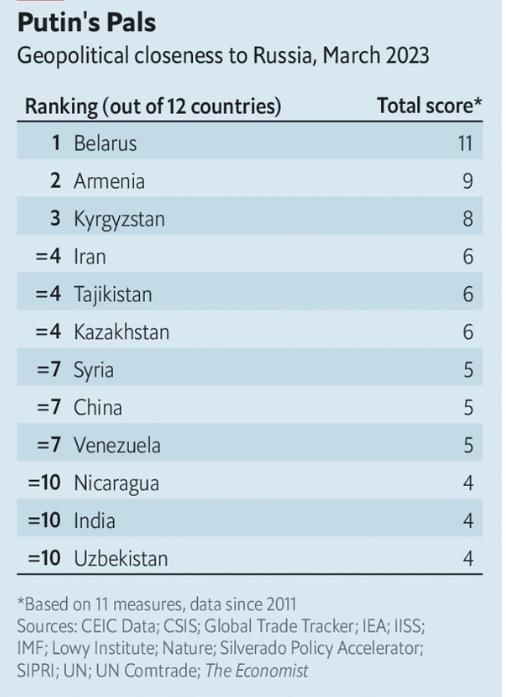 <…> Newspapers, think-tanks and pundits lament that the West has failed to isolate Russia or win over large numbers of developing countries. Yet data collated by The Economist on a broad array of military, economic and diplomatic measures—call it the ‘Putin’s pals index’—show a fuzzier picture.”
The index looks at 11 different measures of support or potential for coercion in three broad areas. The first is diplomatic. Have they voted against Russia or abstained on key un resolutions, or voted with Russia at least twice on these resolutions?
The second is military. Are they treaty allies with Russia? Do they have Russian troops or mercenaries on their territory? Have they supplied arms to Russia since the war began? Do they depend on Russian arms? Have they done maneuvers with Russia since the start of the war?
The third looks at energy and economics. Do they rely on Russian gas, and do they depend on Russian nuclear power stations or technology. Is trade with Russia a large share of their total trade? Have exports to Russia risen since the war?
Countries are scored on a simple total. This is a rough index but it provides a framework for assessing how countries choose to act towards Russia and whether they could be vulnerable to coercion by it.
The half a dozen countries that score most highly are those bound to Russia mainly by politics, history and geography, such as Armenia, Belarus, Iran and Kyrgyzstan. Beneath these is a long list of countries with looser links to Russia, including giants such as China and India and tiddlers such as Bolivia and Mali.
The countries with links to Russia are grouped into three categories: a “coalition of the failing”; the “Soviet remembrance society”; and an “axis of opportunists”.
Armenia is in the “coalition of the failing”. On paper Russia has five formal allies in the Collective Security Treaty Organization (CSTO): Armenia, Belarus, Kazakhstan, Kyrgyzstan and Tajikistan. All are bound by treaty to come to each other’s aid if attacked. Yet not one CSTO member has backed Russia’s war in Ukraine with troops. Belarus has let itself be used as a military base, but has sent no troops of its own.
Some CSTO members are trying to distance themselves from the war. Armenia is angry that the 3,500 Russian troops on its territory did not come to its aid during a war with Azerbaijan in 2020. It has refused to host this year’s CSTO war games, and now seems to be hedging its bets when it comes to political patrons, by inviting an EU mission to monitor its border with Azerbaijan.
Kazakhstan has long been a close ally of Russia. Last year Putin sent paratroopers to put down anti-government protests in several Kazakhstani cities. Yet that did not stop Kassym-Jomart Tokayev, Kazakhstan’s president, from criticizing the Ukraine war in front of Putin during a visit to St Petersburg in June. In February Kazakhstan hosted US Secretary of State Antony Blinken.
Besides Belarus, only Iran and North Korea have sent arms to Russia. America’s government reckons North Korea has delivered a “significant” number of artillery shells, but not enough to alleviate Russia’s shortage or change the course of the war. Iran has sent explosive-laden drones that have helped Russia keep bombing Ukraine, even as its own stocks of missiles have run low. It has also posted “military advisers” to help Russia operate the drones.
“Yet Iran, which was determinedly non-aligned during the cold war, is divided over how much to cosy up to Moscow. Hardliners in the Islamic Revolutionary Guard Corps hope their support will be repaid with modern fighter jets and anti-aircraft missiles. But relative moderates in Iran’s foreign ministry worry about further antagonising the West or condoning the invasion of neighbouring countries—particularly since the Soviet Union conquered much of Iran during the second world war. Set against this group of three allies willing to arm Russia is a Western alliance of 31 countries that have publicly confirmed they are sending weapons to Ukraine,” The Economist says.