In particular, Turkey openly wants Azerbaijan to recognize the Turkish Republic of Northern Cyprus (TRNC) as an independent state. But Baku is wary of the risky ramifications of such recognition along various foreign policy fronts.
Currently, Azerbaijan is experiencing semi-explicit tensions with Russia and Iran. On August 11, the Azerbaijani Ministry of Defense issued a formal statement to condemn the Russian peacekeepers’ inaction to the deployment of Armenian Armed Forces units to Karabakh through the Lachin Corridor (Mod.gov.az, August 11). Both the remnant Armenian-populated Karabakh and the Lachin Corridor itself (which physically links Karabakh to Armenia) are under the control of Russian forces. And on the same day, the Azerbaijani Ministry of Foreign Affairs issued a note of protest to Tehran over Iranian vehicles entering into and out of the Russian peacekeeper–controlled parts of Karabakh (Mfa.gov.az, August 11). President Ilham Aliyev personally voiced his protest to Russia and Iran in his interview to CNN Turk on August 14 (President.az, August 14). Given this, Baku realizes it needs strong, continued Turkish support. Therefore, the Cyprus issue in increasingly becoming a factor for consideration within the Azerbaijani-Turkish alliance.
On July 21, Turkish President Recep Tayyip Erdoğan stated that Ankara “will make every possible effort to ensure [international] recognition of the Turkish Cypriot state as soon as possible” (Anadolu Agency, Hurriyet Daily News, July 21). Ankara is trying to secure at least some limited recognition for the TRNC (currently recognized solely by Turkey) not least because the Turkish leadership is increasingly criticized by domestic opponents for contributing to Turkey’s own foreign policy isolation. Various media reports and expert speculation indicate that Ankara is particularly focused on encouraging the governments of Pakistan, Kyrgyzstan and Azerbaijan to recognize the TRNC’s independence. Indeed, President Erdoğan told journalists earlier this summer that he “constantly discusses” the issue with his Azerbaijani counterpart (Arminfo.info, July 20).
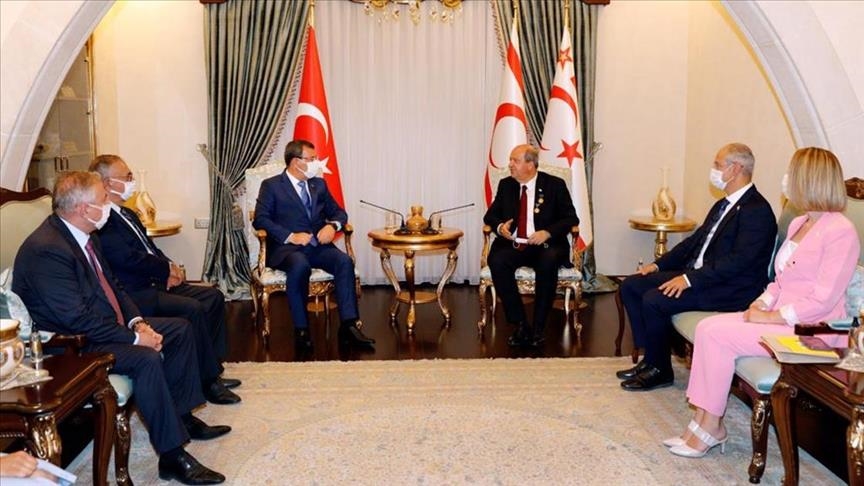
Apparently as a tangible result of those “constant discussions,” an Azerbaijani parliamentary delegation paid a rare visit to Northern Cyprus in mid-July. TRNC President Ersin Tatar, Speaker Onner Senaroglu and Prime Minister Ersan Saner met the delegation. President Tatar described Azerbaijan, Northern Cyprus and Turkey as “one nation, three states”—a reformulation of the famous “one nation, two states” slogan that embodies the closeness of Azerbaijan and Turkey. The new formula is being heavily promoted by the Turkish side (APA, Yenisafak.com, July 17).
Yet Baku realizes that recognizing the TRNC could entail negative ramifications for Azerbaijan when it comes to the Karabakh conflict. The Azerbaijani leadership persistently asserts, perhaps for strategic communication purposes, that the Karabakh conflict “has been resolved” or ended through military actions last autumn (President.az, May 10). But in fact, the war, not the conflict, has ended. Indeed, President Aliyev’s statements in his aforementioned interview to CNN Turk reflected that tension. Should Azerbaijan recognize the TRNC, Greece and Cyprus would likely retaliate by recognizing the de facto local Armenian authorities in Karabakh. Incidentally, the leaders of Russia and France, perhaps the two most pro-Armenian countries, have publicly stated that since Karabakh is Azerbaijani territory under international law, they could not have militarily intervened during the Second Karabakh War. Yet Vladimir Putin also pointedly emphasized that even Armenia itself had never recognized Karabakh as independent (Kremlin.ru, November 17, 2020; Defence.az, November 22, 2020).
Azerbaijan’s relations with Greece as the main supporter of the Greek part of Cyprus (i.e., the internationally recognized Republic of Cyprus) are not simple. Aliyev chose to be frank rather than observing diplomatic tact when he received the credentials from the newly appointed Greek ambassador on September 2, 2020. He lambasted Athens for failing to comply with the conditions of a tender for the acquisition of Greek natural gas grid operator DESFA. Aliyev also openly told the ambassador that Azerbaijan fully supported Turkey in its disputes with Greece (Azertag.az, September 2, 2020). On the other hand, Greece is a transit country for Azerbaijan’s multi-billion-dollar strategic Southern Gas Corridor project, and Azerbaijan’s share in Greece’s gas imports has reached 18 percent (Trend, August 16, 2021). Moreover, on July 12, the Greek ambassador visited Azerbaijan’s highly symbolic de-occupied town of Shusha, sparking much criticism and fury in Armenia and inside Greece. Even the Greek foreign minister was summoned to the parliament for an explanation (Greek Reporter, July 14; Armenian Weekly, August 10). Last but not least, as European Union member states, Greece and the Republic of Cyprus enjoy support from Brussels and other European capitals. Azerbaijan’s problems would, thus, mean problems with the EU more generally, as occurred in 2004.
In January of that year, at the start of Ilham Aliyev’s first presidential term, he told journalists that Azerbaijan would recognize Northern Cyprus as an independent state should the Republic of Cyprus vote against the peace deal in their then-upcoming referendum. But although the referendum results were negative, Baku did not end up recognizing the TRNC. President Aliyev’s critics at that time depicted his original statement as a “diplomatic mistake” in confronting Greece and the EU. Afterward, Baku never touched the issue of Turkish Cypriot independence again (Preslib.az, 2004; BBC News—Azerbaijani service, February 13, 2019).
Considering how Baku eventually backtracked from its statement on recognizing Northern Cyprus back in 2004, it seems all the more unlikely that Aliyev—with 18 years of experience as president since that time—will move to recognize the TRNC now. Exchanging delegations, maintaining cultural, trade and tourism ties, and demonstrating other gestures and acts of engaging with the Turkish Cypriots will likely continue to appease Ankara, at least for the time being.
Incidentally, leaders of the Yukselish (Rise) Party, which was founded in Azerbaijan in December 2020, soon after the Second Karabakh War, visited the TRNC in August 2021 and met with local top officials, including the president, prime minister and speaker of parliament, to discuss the recognition issue (Aypartiya.com, August 10). But both Yukselish and its leadership are essentially unknown to the wider Azerbaijani public. Likewise, the pro-governmental media presented the Azerbaijani parliamentary delegation’s July visit to the TRNC as the first one ever, when in fact, it was the second—the first having happened in July of 2000 (Turan.az, July 15; Azvision.az, July 17). Such gestures from Baku, therefore, should be seen as just sufficient to shape nice optics for Turkish audiences but not enough to lead to formal recognition in the foreseeable future.
Eurasia Daily Monitor