The April 19, 2024, agreement between Azerbaijan and Armenia, aimed at advancing border delimitation, initially signaled a pathway towards sustained peace in the region. However, recent events have revealed a troubling opposition within Armenia, where certain factions, including the influential Armenian Gregorian Church (AGC), are actively resisting the implementation of this pivotal accord.
The geopolitical landscape of the South Caucasus has long been shaped by the conflict between Azerbaijan and Armenia, particularly over the then Nagorno-Karabakh problem. The April 19, 2024, agreement marked a significant development toward resolving border disputes and fostering peace. However, the Armenian Gregorian Church’s opposition to these efforts highlights a complex intersection of religion, politics, and nationalism within Armenia.
The Church’s obstructionist stance
Of particular concern is the boundary-pushing role assumed by the Armenian Gregorian Church (AGC) in opposing border delimitation efforts crucial for regional peace and stability. The AGC’s clergy members have not only articulated political demands but have openly advocated against peace with Azerbaijan, promoting sentiments of vengeance and war.
The church’s obstructionist stance evokes profound concern and uncertainty about the prospects for regional peace, as it pursues a multifaceted agenda that actively undermines peace-building efforts.
The Armenian Gregorian Church, also known as the Armenian Apostolic Church, holds a central place in Armenian society, culture, and national identity. It has historically served as a pillar of Armenian ultra-nationalism, intertwined with the preservation of ethnic consciousness and the legitimization of nationalistic ideas.
Following Armenia’s independence, the AGC maintained a relatively neutral stance towards political affairs, drawing criticism for perceived detachment during administrations led by Robert Kocharyan and Serj Sarkisyan. However, recent geopolitical shifts, particularly the Second Karabakh War and its aftermath, have significantly altered the church’s involvement in temporal issues.
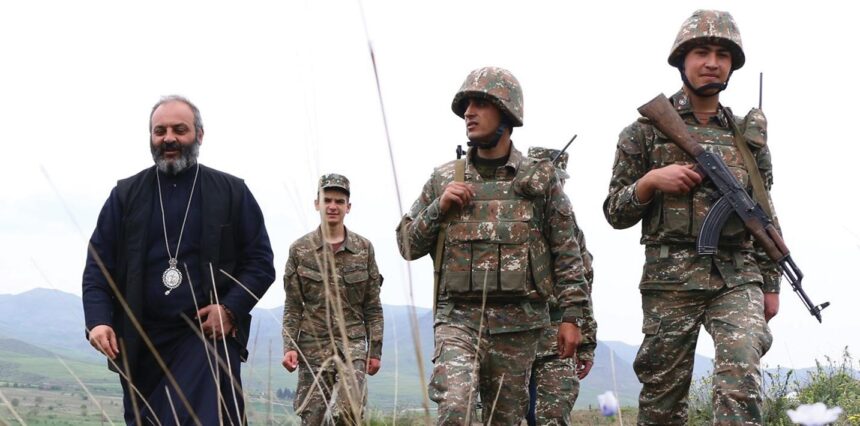
The AGC’s involvement in Armenian-Azerbaijani conflicts, notably the Karabakh wars and subsequent military escalations, has been notable. The church’s provision of clergy to the military and its vocal support for nationalist sentiments have contributed to a perception of the church as a driving force behind revanchism and a resurgence of conflict.
Armenia’s strong religious identity, with over 90% of the population affiliating with the Armenian Gregorian Church, underscores its influence on societal and political dynamics. Despite a decline in church attendance among younger generations, the Church remains deeply ingrained in Armenian identity and societal structures.
Armenia’s constitution recognizes the AGC’s historical mission as a national church, granting it a unique and privileged status. This special status includes state support for educational institutions, public broadcasting, and financial autonomy, raising questions about the separation of church and state in Armenia.
The AGC faces internal challenges, including a perceived disconnect with societal needs and demands for reform. Recent protests targeting the church’s leadership, including calls for the resignation of Catholicos Garegin II, highlight growing discontent and efforts to redefine the church’s role in modern Armenia.
Shifts in political landscape & church-state relations
Following Armenia’s defeat in the Second Karabakh War, the AGC’s stance on political leadership has shifted, with prominent clergy calling for the resignation of Prime Minister Nikol Pashinyan. This reflects broader public sentiments of discontent and loss of national pride.
Recent verbal clashes between the Armenian government and the AGC, particularly over educational curriculum and property rights, illustrate growing tensions between secular governance and the church’s institutional authority.
Over the years, the Armenian church has wielded significant influence in the expulsion of Azerbaijanis from Armenia and has supported Armenia’s military aggressions against Azerbaijan, perpetuating tensions and exacerbating the conflict.
Amid troubling developments in Armenia and the region, it is imperative for the international community and global religious leaders to decisively condemn the actions of the Armenian church and call for a peaceful agenda.
During the occupation of Azerbaijani lands in and around Karabakh, appeals from Azerbaijani religious bodies to world leaders often went unanswered or received inadequate responses. Therefore, there is an urgent need for robust support for lasting peace between Azerbaijan and Armenia.
Conclusion
The resurgence of revanchist rhetoric within the Armenian Gregorian Church represents a pivotal challenge to peace-building efforts in the Azerbaijan-Armenia conflict. The church’s active involvement in promoting nationalist agendas underscores the complex interplay between religion, politics, and historical narratives.
Addressing these challenges requires a concerted effort to promote dialogue, historical accuracy, and the depoliticization of religious institutions in pursuit of lasting reconciliation and regional stability.
Caliber.Az