On September 8, 2025, during his address at the Moscow State Institute of International Relations (MGIMO), Russian Foreign Minister Sergey Lavrov discussed the potential revival of the “3+3” format in the South Caucasus while commenting on Russia’s relations with regional countries. He noted that the initiative was initially proposed by Turkey and Azerbaijan and highlighted that it is also supported by Iran, signalling broader regional backing. Lavrov further referenced the trilateral agreement between Azerbaijan, Armenia, and Russia on restoring transport links and welcomed the ongoing process of normalization between Armenia and Turkey.
Russian MFA spokesperson Maria Zakharova, on September 12, 2025, reiterated that Russia expects Azerbaijan and Armenia to take practical steps to agree on the time and venue for the next “3+3” regional cooperation meeting of foreign ministers. She emphasized that the 3+3 format remains an effective platform for discussing issues crucial to the normalization of Armenia-Azerbaijan relations and broader South Caucasus stability, noting that Moscow is ready to support its partners in all relevant areas.
Armenia’s Ministry of Foreign Affairs expressed its willingness to host the third “3+3” meeting on its territory but noted that further discussions are needed to finalize the timing and venue. Azerbaijani MP Azer Badamov stressed that the next meeting should be hosted by either Azerbaijan or Armenia, highlighting that, following the August 8 Washington agreements, peace between the two countries had been restored and confidence-building measures are ongoing. He also noted that direct bilateral communication channels are now open, allowing Armenian officials to participate in a “3+3” meeting in Baku, and emphasized that both countries could reach a mutual agreement on the venue.
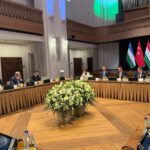
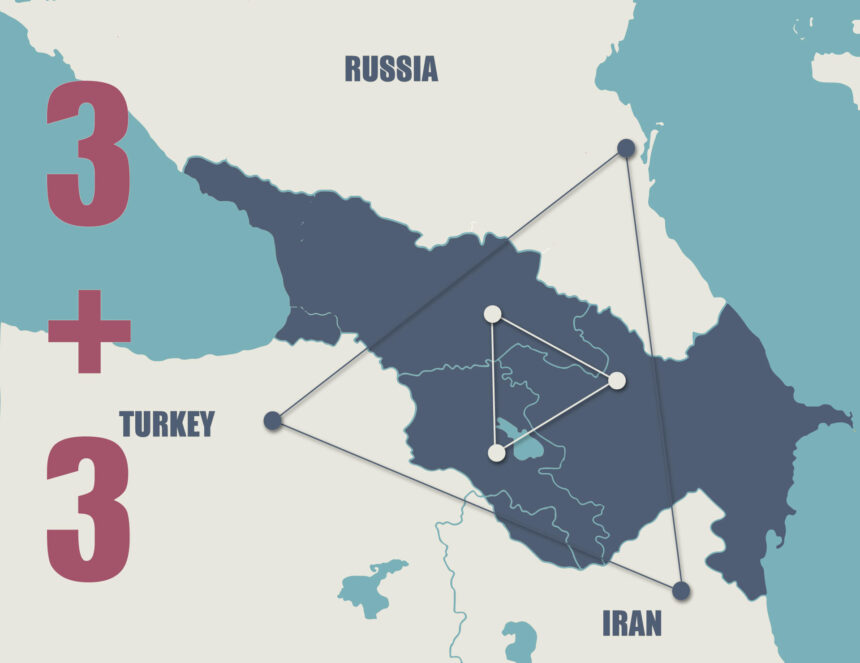
Originally conceived after the 2020 war, the 3+3 format was designed to bring together the three South Caucasus states—Armenia, Azerbaijan, and Georgia—alongside their larger neighbors, Iran, Turkey, and Russia, as a potential mechanism for managing regional conflicts, coordinating infrastructure projects, and reopening transport links. Georgia, due to ongoing territorial disputes with Russia, consistently refused to participate and never attended any meetings.
The 3+3 format has not yet evolved into a formal institutionalized framework, though the parties have met three times: first in Moscow in December 2021, then in Tehran in October 2023, and most recently in Istanbul in October 2024. At the Istanbul meeting, participants agreed to enhance cooperation within the format and decided that the venue and date of the next meeting would be determined through diplomatic channels.
Moscow’s push for the 3+3 format appears to be a strategic effort to reassert its influence in the South Caucasus, aiming to restore Russia as a key player in the ongoing normalization process between Armenia and Azerbaijan, particularly regarding the reopening of transportation channels. Yet, given the current trajectory of Armenia-Azerbaijan normalization and recent regional developments, achieving this goal seems increasingly difficult.
As Russia became engulfed with the war in Ukraine, Armenia and Azerbaijan pursued alternative avenues for peace, including initiatives mediated by the European Union and the United States. This shift culminated in direct bilateral engagement. On July 10, 2025, Armenian Prime Minister Nikol Pashinyan and Azerbaijani President Ilham Aliyev held their first formal bilateral dialogue since the 2023 Nagorno-Karabakh conflict, focusing on border delimitation and mutual recognition of territorial integrity.
This engagement paved the way for the Washington Summit on August 8, 2025, a significant milestone in Armenia-Azerbaijan relations. Mediated by the United States, the summit resulted in the initialing of a peace agreement, centered on security, confidence-building measures, and the reopening of transport and trade links. A key feature of the agreement was the establishment of the “Trump Corridor,” designed to promote regional connectivity, economic development, and secure transit across the South Caucasus.
Russia’s response to the August 2025 Armenia-Azerbaijan peace agreement has been cautiously supportive, albeit skeptical. While acknowledging the deal as a positive step for regional stability, Moscow emphasized that lasting solutions should primarily involve regional actors like Russia, Iran, and Turkey, and cautioned against external interference, particularly from the United States. Recent Russian statements have echoed this stance.
As Azerbaijan and Armenia pursued normalization that increasingly sidelined Russia, Moscow continued exerting pressure on both countries. Incidents such as the downing of an Azerbaijani civilian plane, targeting of Azerbaijanis in Yekaterinburg, and support for opposition forces and the Armenian Church to influence Pashinyan exemplify Russia’s coercive approach. Yet, Russia largely failed, losing significant credibility and influence in both Azerbaijan and Armenia. Lavrov’s remarks acknowledge this failure and signal a renewed emphasis on diplomacy. Recognizing that Russia alone cannot shape outcomes, Lavrov seeks to engage other regional actors.
Today, the South Caucasus exists in a markedly different reality: Russia is losing its ability to treat the region as part of its traditional sphere of influence, a consequence of both its war in Ukraine and its refusal to recognize these states as equal partners. At the same time, Iran’s influence has waned, weakened by the erosion of its Middle Eastern proxies and ongoing conflict with Israel. Under these circumstances, tangible results from the 3+3 format appear unfeasible. Relations between Baku and Moscow continue to deteriorate, showing no signs of improvement. Meanwhile, Armenia is advancing normalization with Turkey while seeking investment and support from the EU and the U.S. Similarly, Georgia is highly unlikely to abandon its strategic isolation to participate, as Russia continues to occupy parts of its territory. Georgia recently joined a statement by 43 countries condemning Russia’s violation of Polish airspace.
The selection of Mr. Badamov by official Baku is noteworthy and serves to raise awareness of ongoing Russian-Azerbaijani tensions. In May 2025, he was deliberately barred from entering Russia—a targeted measure following the downing of an Azerbaijani civilian plane—highlighting one of several factors straining bilateral relations. The Azerbaijani Ministry of Foreign Affairs condemned the move as unfriendly. Although Baku has expressed readiness to participate in the 3+3 format, referring to the recent agreements reached in Washington, it underscores Baku’s broader skepticism about the framework’s relevance regarding ongoing Armenia-Azerbaijan normalization and efforts to open regional communication channels.
Even if revived, the 3+3 initiative is unlikely to offer a genuinely new solution to the regional challenges. Its implementation risks returning the South Caucasus to post-2020 dynamics, where security concessions are exchanged for political compliance—contrary to current realities—and could undermine progress already achieved through bilateral and Western-mediated initiatives. Furthermore, the 3+3 framework would constrain the South Caucasus’s access to broader regional and international engagement and investment opportunities. While Azerbaijan, Armenia, and Georgia could benefit from cooperation in a more open environment, the 3+3 format would tie them to a structure dominated by three powers whose economic and political positions offer limited incentives. Russia’s economy remains weakened by the war in Ukraine and potential sanctions; Iran is constrained by regional conflicts, domestic unrest, and international isolation; and Turkey, despite relative resilience, risks overextension within a framework that could restrict its economic and diplomatic flexibility. Considering the increasing sanctions on Russia, including measures targeting trading partners, the revival of 3+3 could pose significant risks for all participating states, which maintain economic and security relations with the West and must balance regional ambitions with broader geopolitical partnerships.
In practice, the 3+3 framework has remained largely a consultative platform without significant tangible output. Its adoption risks reverting the South Caucasus to the pre-2020 dynamics—marked by limited Russian influence, unresolved territorial disputes, and restricted regional cooperation—which no longer align with current geopolitical realities. Rather than fostering stability or economic development, the framework could entrench outdated power structures, prioritizing political compliance over open, diversified, and mutually beneficial regional arrangements.
Beyrak Hajiyev is an Adjunct Lecturer in EU Studies at Khazar University. He holds a master’s degree in Global Studies with a European focus from Leipzig and Ghent Universities. His research focuses on Azerbaijani foreign policy, the EU’s Common Foreign and Security Policy (CFSP), and the relationship between the EU and the South Caucasus, with an emphasis on connectivity projects.