The discord is primarily driven by differing stances on the delimitation and demarcation of borders with Azerbaijan, following Armenia’s defeat in the 2020 Second Karabakh War.
Historically, the Armenian Apostolic Church has played a significant role in the public and political landscape of Armenia. It has often aligned with nationalist and hardline factions, fostering sentiments that complicate peace efforts in the South Caucasus. The Church’s opposition to the current government’s border delimitation initiatives with Azerbaijan underscores its entrenched position.
The Church’s stance is seen as exacerbating tensions rather than promoting peace and reconciliation. The Azerbaijani Spiritual Board, the main body for religious affairs in Azerbaijan, has consistently criticized the Armenian Church for its role in fueling conflict. The board argues that the Church’s actions are incompatible with religious doctrines that advocate for peace and harmony.
Government’s position & actions
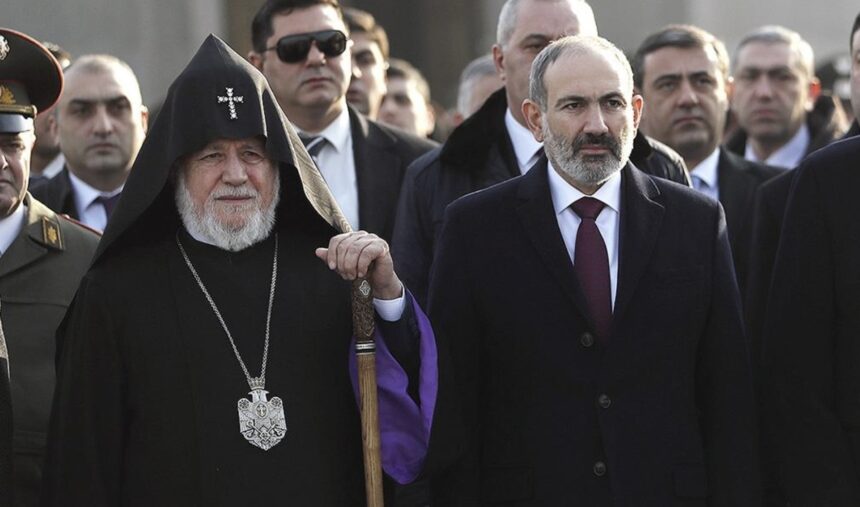
Prime Minister Nikol Pashinyan seems committed to resolving outstanding issues with Azerbaijan to alleviate post-war pressures and stabilize the region and argues that clear border demarcation is crucial for Armenia’s sovereignty and statehood. He has accused the Armenian Apostolic Church of acting as an “agent of influence” from historical times, suggesting that the Church’s current actions are a continuation of its past political meddling.
In a move to curb the Church’s influence, the government is contemplating the appropriation of Church properties for state use. Artur Hovhannisyan, Secretary of the Civil Pact faction, emphasized the need for the Church to emerge from financial and operational obscurity. This measure is presented as part of broader democratic and fiscal reforms aimed at enhancing state control and transparency.
The Armenian Apostolic Church, in concert with opposition factions such as the Tavush in the Name of Motherland movement, led by Archbishop Bagrat Galstanyan, is actively protesting against the government’s policies. The group is being accused of attempting to reignite the conflict with Azerbaijan, driven by a desire for revenge rather than reconciliation.
Prime Minister Nikol Pashinyan’s recent remarks in parliament highlight the deepening rift between his government and the Armenian Apostolic Church, alongside its allied opposition factions. On May 22, the prime minister accused the opposition movement of undermining Armenia’s statehood and sovereignty. Pashinyan characterized the opposition’s ideology as one of “non-statehood, non-independence, non-sovereignty, and non-citizenship”.
He criticized their nostalgic attachment to a “historical Armenia” while ignoring the practical realities and security needs of the present-day state. By contrasting “real Armenia” with “historical Armenia,” Pashinyan underscored the need for pragmatic governance focused on future stability and security, rather than clinging to irredentist dreams.
The prime minister defended the recent border demarcation at the Tavush-Qazax section of the Armenian-Azerbaijani frontier as a legally warranted and strategically necessary measure. He emphasized that the delimitation process had undergone extensive governmental and legal scrutiny, ensuring that the decisions were both de jure justified and crucial for Armenia’s sovereignty.
Pashinyan’s assertion that the border agreement with Baku represents a success rather than a concession is pivotal. He framed the deal as a milestone, marking Armenia’s first instance of independently negotiating and defining its borders. This, he argued, is foundational for the future development of Armenian statehood and sovereignty.
Pashinyan’s vision involves the formation of a new state ideology centered on statehood, sovereignty, and independence and views the ongoing infrastructural projects, such as the road construction in Kirants, not merely as physical developments but as symbolic links between Armenia’s historical past and its future as a sovereign state.
The conflict between the government and the Armenian Apostolic Church, coupled with opposition factions, poses several strategic implications. Pashinyan’s efforts to diminish the Church’s political influence could lead to increased internal tension and resistance from traditionalist and nationalist groups. This could destabilize the public-political environment, making governance more challenging. The successful delimitation and demarcation of borders with Azerbaijan could pave the way for improved bilateral relations and regional stability. However, continued opposition from the Church and nationalist factions may impede these efforts, perpetuating conflict and insecurity.
The ideological battle between a pragmatic, future-oriented statehood and a nostalgic, historical nationalism will shape Armenia’s national identity. Pashinyan’s vision seeks to align the country’s identity with modern statehood principles, while opposition forces advocate for a return to past disgraceful actions, occupations, and destructions.
Prime Minister Nikol Pashinyan’s recent parliamentary remarks crystallize the ideological and political battle lines between his government and the Armenian Apostolic Church, supported by nationalist opposition factions. By advocating for a future-oriented, sovereign, and independent Armenia, Pashinyan challenges the Church’s historical role and its alignment with irredentist and nationalist sentiments.
The outcome of this conflict will significantly influence Armenia’s path towards stable governance, regional peace, and the consolidation of its national identity. As Pashinyan continues to implement his vision, the responses from the Church and opposition will be crucial in determining the country’s trajectory in the coming years.
Conclusion
The tensions between the Armenian government and the Armenian Apostolic Church reflect deep-seated historical and political conflicts. While the government seeks to ensure sovereignty and stability through clear border demarcation with Azerbaijan, the Church’s opposition underscores its longstanding influence and its role in Armenian nationalism.
The Pashinyan government’s efforts to diminish the Church’s dominance could reshape Armenia’s political and social fabric, but also risks provoking significant opposition and unrest.
Fuad Muxtar-Agbabali
Caliber.Az