Some issues of mutual importance relating to the Caspian include the Nagorno-Karabakh War, the Afghanistan and Iraq conflicts, NATO partnerships in the Caucasus region, and the construction of trans-Caspian pipelines.
Iran and Russia doggedly pursue their own goals in the region, which align in some areas but not others. For example, policy makers in both countries do not want the other Caspian states to realize their goals of diversifying their trade routes and markets, which would decrease their reliance on Iranian and Russian oil and gas. Furthermore, Tehran and Moscow share the goal of keeping Western militaries out of the Caspian Sea region. Even when their goals align, Iran and Russia still pursue independent policy lines. Tehran and Moscow can also collaborate for short-term tactical advantage, such as to secure mutual gains at the expense of third parties, even when their long-term objectives may differ. For instance, while offering Tehran some support in its conflict with the West, Russia exploits Iran’s isolation from possible Western partners for economic and security leverage.
Caspian Sea Accords
Tehran’s “Look to the East” policy has emphasized strengthening ties between Iran and the former Soviet republics as well as China and other Asian states. Nonetheless, for years, Iran differed with other littoral states of the Caspian Sea (Azerbaijan, Kazakhstan, Russia, and Turkmenistan) on demarcating the sea’s maritime sectors. Under 1921 and 1940 Iranian-Soviet treaties, Iran had a 50 percent portion of the Caspian Sea, whereas since the Cold War, Tehran demanded to control at least one-fifth of its waters. Tehran also contested how to manage the Caspian’s undersea commercial activities such as the sub-surface mining of resources or oil and gas transportation through underwater pipelines. Those countries with large coasts, such as Azerbaijan and Kazakhstan, wanted to control the territorial waters along them and the corresponding seabeds. They therefore proposed dividing the seabed according to the median line, which gives Iran control over less than 20 percent of the area.
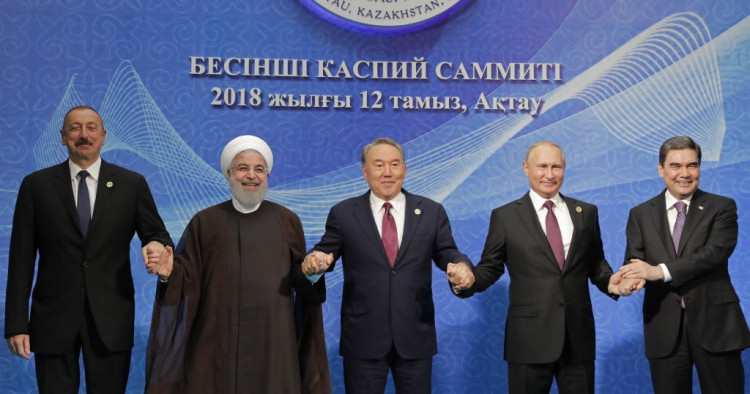
At the August 2018 summit of these states in Aktau, the littoral governments resolved the demarcation issues but not management of the undersea resources. In their Convention on the Legal Status of the Caspian Sea, the five governments sidestepped the question of whether the Caspian should be legally defined as a “lake” or a “sea” by designating the Caspian as having a “Special Legal Status.” According to the agreement, each state could claim the 15 nautical miles from its coasts as sovereign waters, along with an additional 10-nautical-mile exclusive zone for commercial fishing, while any waters beyond 25 miles would be accessible to all, for common usage.
The littoral states have yet to agree how to divide or share substantial deposits of oil and natural gas located below the surface waters. Russia had aligned with Iran in insisting that all the littoral countries must approve the construction of all sub-surface energy pipelines, even ones between two consenting states. Tehran and Moscow wanted to block Azerbaijan, Kazakhstan, and Turkmenistan from building trans-Caspian pipelines that could carry oil and gas to Europe, which could compete with Iranian and Russian exports to the Continent. Iranians also covet the resource-rich Caspian territories claimed by Azerbaijan, particularly the Araz-Alov-Sharg hydrocarbon field, and other littoral countries. The Aktau accord, however, allows construction of undersea pipelines provided all participating littoral countries’ consent. Non-participating states can still raise environmental objections to projects under a separate environment impact protocol, but other countries may not heed them.
The Iranian parliament is the only one of the five legislatures of the littoral countries that has not yet ratified the Convention, despite Russian calls to do so. Since Iran has the smallest coastline, with few known natural gas and oil deposits located there, Iranian negotiators had long sought an equal division of all the Caspian Sea. The Aktau accord, once it enters into force, would offer Iran less. Some members of the Iranian parliament criticized the foreign ministry for making too many concessions in the negotiations. Iranian nationalists also attacked Russia for pressing Iran to accept the Aktau deal. One lawmaker warned that another Treaty of Turkmenchay (a 1828 accord between the Persian and Russian monarchies that gave Moscow control over the contested South Caucasus) might be in the works.
One reason for the Iranian concession at Aktau might be that the Caspian Sea is of only modest importance for Iranian energy goals since the country’s most important oil and gas fields are located elsewhere. With U.S. sanctions hobbling the capital and technology available to their energy sector, Iranians also lack the capacity to exploit fully the resources under the southern Caspian waters, which are much deeper than those in the northern Caspian Sea. Perhaps Tehran also did not want to alienate its Caspian partners at a time when the Trump Administration was intensifying its pressure on other states to curtail their Iranian ties, which contributed to a reduction in Iranian economic exchanges with these countries. Meanwhile, Iran and Russia sometimes coordinate their international oil sales through OPEC, but more ambitious proposals for bilateral energy cooperation in the Caspian region, such as plans for a barter deal exchanging Iranian oil for Russian goods and services, have failed to gain traction.
Military Activities
Another reason for the Iranian and Russian soft line at Aktau was that they have stronger Caspian navies than the other three states. They benefited from the agreement affirming that the surface waters beyond the 25-mile territorial and fishing areas would be accessible to all states as common areas. Tehran and Moscow have long sought to exclude any non-littoral military presence, such as from NATO countries. Provisions of the Aktau agreement, like earlier Caspian Sea accords, prohibit the deployment of navies and military bases of non-littoral states in the Caspian region. Though the agreement also provides for confidence-building measures among the five Caspian navies, the Aktau accord does not limit the size of their fleets.
Russia’s Caspian Flotilla has remained the dominant naval force in the region since Soviet times. Following the disintegration of the unified Soviet Armed Forces in 1991, Russia inherited the largest share of former Soviet military assets, including in the Caspian Sea. In recent years, the Flotilla, like the rest of the Russian military, has received better-trained troops and more modern equipment. Only Russia deploys frigate-class vessels in the Caspian. Russia also enjoys air supremacy throughout the region. Iran has the second most powerful fleet in the Caspian Sea, led by the refurbished Damavand destroyer and supported by several corvettes and minesweepers. The Islamic Republic of Iran Navy (IRIN) Northern Fleet has responsibility for the Caspian region. While the modernization of the IRIN is focused mainly on waters Tehran considers more strategic, namely the Strait of Hormuz and the Gulf of Oman, Iran’s Caspian fleet has also benefited from weaponry upgrades.
Moscow and Tehran have used their Caspian fleets to support various military activities. Russian vessels based in the Caspian have also provided fire support to the Russian contingents in Syria, some 600km away, using the country’s new long-range sea-to-surface cruise missiles. This year, Moscow moved ships from the Caspian Flotilla to the Sea of Azov via its Volga–Don Canal to challenge Ukraine’s Black Sea interests. Meanwhile, Iran has employed its naval forces against other Caspian states. In July 2001, an Iranian naval vessel confronted a research vessel prospecting on behalf of Azerbaijan in disputed waters. Iran later twice sent military aircraft into air space over part of the Caspian claimed by Azerbaijan.
Iranian officials have affirmed their readiness to cooperate with the other littoral states on common security issues. When Tajikistan’s defense minister visited Tehran this April, the two countries established a joint military committee. Nonetheless, Moscow has been Tehran’s leading defense partner among the other Caspian countries. Russian Minister of Defense Sergei Shoigu’s 2015 visit to Tehran resulted in an agreement to cooperate on information exchanges, military training and education, and counter-terrorism coordination. In July 2019, Iran and Russia pledged to enhance military cooperation, including in the Caspian Sea region. During an August 2020 meeting in Moscow, the Iranian and Russian military delegations reportedly agreed to conduct regular naval exercises in the Caspian as well as other locations. In September 2020, the Russian Armed Forces conducted the country’s main annual strategic exercise in the Southern Military District, which includes the Caspian region. Iranian missile boats joined some Russian ships in the Caspian during these drills. Some Russian analysts want to help the Iranian navy acquire more modern warships.
China’s Caspian Connections
Due to its economic power, Beijing’s stance toward Caspian issues invariably affects Russian-Iranian interactions there. PRC managers see the countries of the Caspian region as a source of raw materials, consumers of PRC products and services, an area of opportunities for Chinese investment, and transit zones for reaching European markets more directly than through existing sea routes. Though having Chinese financial support, along with access to the Chinese market, could prove critical for the realization of some commercial plans, Beijing opposes projects that would transport Caspian oil and gas westward to Europe rather than eastward to China.
China is the main trading partner of both Russia and Iran, especially in the energy sector. Iranian and Russian oil exporters directly compete for Chinese purchases. Tehran and Moscow, which have strived to maintain good relations with Beijing in the Caspian and other regions, compete for Chinese infrastructure investment. Beijing’s flagship Belt and Road Initiative primarily supports east-west conduits, especially railways and pipelines. Depending on the advantages for Beijing, in the Caspian, these corridors could either traverse Russian territory or run further south through Iran and other Caspian states.
Last summer, China and Iran finalized a 25-year cooperation agreement that might give Chinese investors privileged access to Iranian ports and other infrastructure. The agreement also facilitates Sino-Iranian defense collaboration. Before the UN Security Council imposed an arms embargo on Iran in 2007, China sold Iran substantial military equipment, especially anti-ship missiles. Now that the embargo has expired, the PRC can resume selling weapons to Iran. Iranian policy makers might decide that PRC arms, typically cheaper than Russian systems, would provide a better price-performance fit for their needs. The Iranian military might be especially interested in acquiring advanced military drones, warships, and missile systems from China. Given the problems Iran had with Russia’s freezing an earlier contract for S-300 surface-to-air missiles, as well as resentment at how Moscow has exploited Tehran’s difficulties with Washington to extract concessions, Iranians might also consider China a more reliable defense supplier.
Still, Beijing and Moscow share a desire to limit Iran’s ties with Western countries, including constraining Iranian hydrocarbon exports to Europe and Western investment in the Iranian economy. In some cases, moreover, Russia, China, and Iran may prioritize their trilateral cooperation over competition in the Caspian to achieve shared economic and security gains while countering Western polices in the region.
Weighty Wildcards
Russian analysts are considering projects to expand the Volga–Don Canal as well as build a new canal from the Caspian Sea to the Black Sea and another through the Caspian and Iran to the Indian Ocean. The recent week-long blockage of the Suez Canal has increased interest in this latter option. The plan is to construct a 700-kilometer-long canal that would run from the Iranian port of Enzeli, where a large roll-on, roll-off terminal for trains and trucks is under construction, to Iran’s Shatt al-Arab port on the Indian Ocean. The new conduit could complement the 7200km North-South Transportation Corridor, launched in 2000, that would encompass Russian, Iranian, and Indian territory. Yet, the financial, environmental, and other impediments to realizing these ambitious connectivity projects—which have been under discussion for decades–are substantial.
Additional wildcards potentially affecting Iranian-Russian cooperation in the Caspian region include: political changes in both countries as well as the other Caspian states; the duration of the COVID pandemic; whether Iran might become a full member of the Shanghai Cooperation Organization (Iran remains an observer, lacking full membership benefits); Iran’s possible membership in the Moscow-led Eurasian Economic Union; the potential strengthening of the Azerbaijan-Turkmenistan-Turkey alignment as a competitor to Iran and Russia in the Caspian; the impact of global climate change in disrupting Caspian maritime projects while facilitating competing opportunities in melting Arctic areas; and especially the reduction of international sanctions on Iran that might arise from a renewed Iranian nuclear deal.
U.S. sanctions on Iran have impeded the expected growth of economic ties between Iran and other Caspian states following the 2015 Iran nuclear deal. Since the U.S. is presently relaxing this pressure, Tehran’s line toward Caspian issues may harden in the future. To hedge against this possibility, Washington can render greater support for Azerbaijan’s recent reconciliation with Turkmenistan. Earlier this year, the two states ended their decades-long dispute over the enormous Dostlug hydrocarbon deposit situated between them under the Caspian. They are now considering ambitious trans-Caspian commercial rail, road, maritime, and digital projects besides their Trans-Caspian Gas Pipeline. Though the latter’s prospects of delivering more non-Iranian, non-Russian gas to Europe have brightened considerably, all these projects still face major obstacles and need Western support. Perhaps easiest of all, U.S officials can elevate the profile of Caspian issues in their diplomatic engagements, beginning by sending more senior-level officials to the region.
Richard Weitz senior fellow and director of the Center for Political-Military Analysis at Hudson Institute. The views expressed here are his own.