One of the most pressing issues on the agenda of Azerbaijani President Ilham Aliyev’s visit to Türkiye on March 5-6, 2025, was the position of the two allies about shifting the global and regional balance of power.
Aliyev’s visit to Ankara coincided with a period that included U.S.-Russia rapprochement, which began with Donald Trump becoming U.S. president for the second time; the U.S. cutting off military, intelligence and financial aid to Ukraine; and the divergence of U.S. and EU policy toward Ukraine and Russia. Some suggest that these developments, specifically Trump’s contacts with Russia, directly result from a broader strategy to isolate China and draw Russia to the U.S. side. When discussions are taking place about forming a new world order, the process of questioning traditional alliances will also have consequences for the South Caucasus and the Turkic geography, where Azerbaijan and Türkiye play an active role.
A similar situation occurred in 2008 during the policy reset period pursued by the Barack Obama administration. According to certain academic interpretations, the goal of the Obama administration was to contain China. Hence, in 2008, U.S. Secretary of State Hillary Clinton, after a meeting with Russian Foreign Minister Sergey Lavrov, announced the “Reset” policy and recognized the South Caucasus and Central Asia as regions belonging to Russia’s sphere of influence. It is assumed that the reason the administration did not speak out against the annexation of Crimea in 2014 was due to this specific policy with Russia.
During that period, Türkiye and Azerbaijan took a preventive role in the security of the South Caucasus. First, Türkiye proposed the South Caucasus cooperation platform. Later in 2010, Azerbaijan and Türkiye signed an agreement on strategic partnership and mutual assistance. Finally, trilateral talks in the Azerbaijan-Türkiye-Georgia format were initiated in 2011. In a way, Türkiye had assumed leadership here. Thus, as a consequence of the new order, Azerbaijan and Türkiye took on important roles in the South Caucasus, specifically through various forms of joint cooperation.
What to expect from the future?
This new era brings considerable challenges. According to some pundits, the U.S. making concessions to Russia on the Ukraine issue may not be enough for the normalization of its relations with Moscow. Additionally, Donald Trump may also make certain concessions regarding the South Caucasus and Central Asia. It must be noted that in recent years, comprehensive cooperation between Azerbaijan, Türkiye and Russia has served as the primary cause of stability and cooperation in the region. However, the disruption of this balance may lead to undesirable consequences and inspire aggressive attitudes of other regional powers. It may also harm the currently ongoing cooperation and integration process of the Organization of Turkic States (OTS).
The alliance between Türkiye and Azerbaijan is entering this new period in a reinforced and stronger position. The U.S.’ desire to withdraw from its role as a security guarantor in Europe and its reluctance to provide security guarantees to Ukraine have increased Türkiye’s strategic value for Europe. Moreover, the desire of European countries to establish a joint military unit in Europe seems impossible without the involvement of Türkiye.
Türkiye is widely recognized as the primary state of this region, and its role has continued to increase. The main indicator of this is Marco Rubio, the new U.S. secretary of state, directly discussing the normalization and peace process in the South Caucasus with Foreign Minister Hakan Fidan. In the meantime, Russian Foreign Minister Sergey Lavrov also discussed the normalization process in the South Caucasus with Fidan during his visit to the region. The fact that both powers, who have traditionally been dominant in the region and have, for decades, tried to assert their interests on the regional agenda, are negotiating directly with Türkiye on matters related to the South Caucasus is a clear indication that they attach major importance to the country’s role in the region.
The same logic applies to Azerbaijan. The country actively and reliably serves as a safe alternative for the European Union in its desire to diversify the source of its natural gas resources, providing alternative transportation arrangements between the East and the West. As of today, Azerbaijan has agreements and declarations on strategic cooperation or partnership with 10 European countries as well as a strategic alliance agreement with Türkiye.
Solidarity in the Turkic world
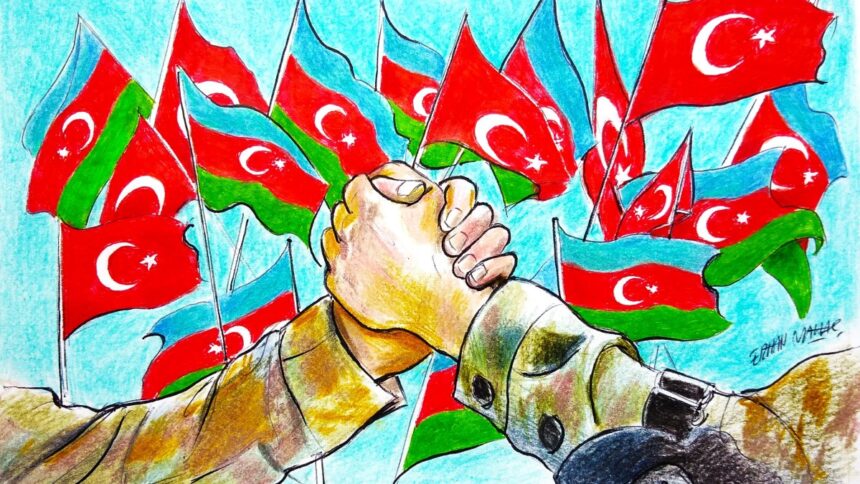
Nevertheless, to be even more resilient in this new period, cooperation and solidarity between Azerbaijan and Türkiye, as well as between all other Turkic states, should be strengthened even further. In fact, the purpose of Aliyev’s visit to Türkiye was to broaden and deepen, in anticipation of this new period, existing cooperation between the two countries in the South Caucasus. In the era of a new geopolitical power struggle, one key area of competition may turn out to be the Turkic republics. With this in mind, the role that Azerbaijan and Türkiye will play in ensuring the continuation of stability and cooperation in the Turkic geography is highly significant and will continue to be reinforced.
As a consequence of this new era, the Turkic world may continue to emerge further through a more intense unification or joining of its forces. Aliyev, who in a ceremony following the presidential elections in 2024 referred to the Turkic world as the country’s only “family,” persistently advocates for cooperation among Turkic states in security and military matters, specifically pertinent given the new reality. It is no coincidence that Aliyev stated the following: “The unity and brotherhood between Türkiye and Azerbaijan is a great contribution to the entire Turkic world. My dear brother, President Erdoğan, plays an important role in unifying the Turkic world.” This statement is a clear caution that in the face of increasing uncertainty and the newly emerging regional and global threats, the Turkic world must remain as united as ever before.
The message delivered by President Recep Tayyip Erdoğan in his statement – “Türkiye and Azerbaijan stand by peace, stability and prosperity” – was also significant in terms of regional peace and cooperation. The statements of the presidents provide a firm message that Türkiye and Azerbaijan see the region as a space for collaboration and not as a space for conflict between different global powers. This message is regularly sent to both regional and global actors.
In sum, the main reason behind Aliyev’s visit to Türkiye was to strengthen the alliance amid the changing global order. It should also be pointed out that Türkiye and Azerbaijan also feel the need to unite with their other allies in this direction. For example, Pakistani Prime Minister Shahbaz Sharif, a friend of Türkiye and Azerbaijan, visited Azerbaijan on Feb. 25, 2025, where he also emphasized his country’s willingness to pursue full cooperation in the face of regional developments. Similarly, after a visit to Azerbaijan, Georgian Foreign Minister Maka Bochorishvili announced during a visit to Türkiye on Feb. 26, 2025, that her country accepts Ankara’s role as the leader in the region.
Cavid Veliyev is board member of the Baku-based think tank Center of Analysis of International Relations (AIR Center) and adjunct lecturer at Khazar University in Azerbaijan.