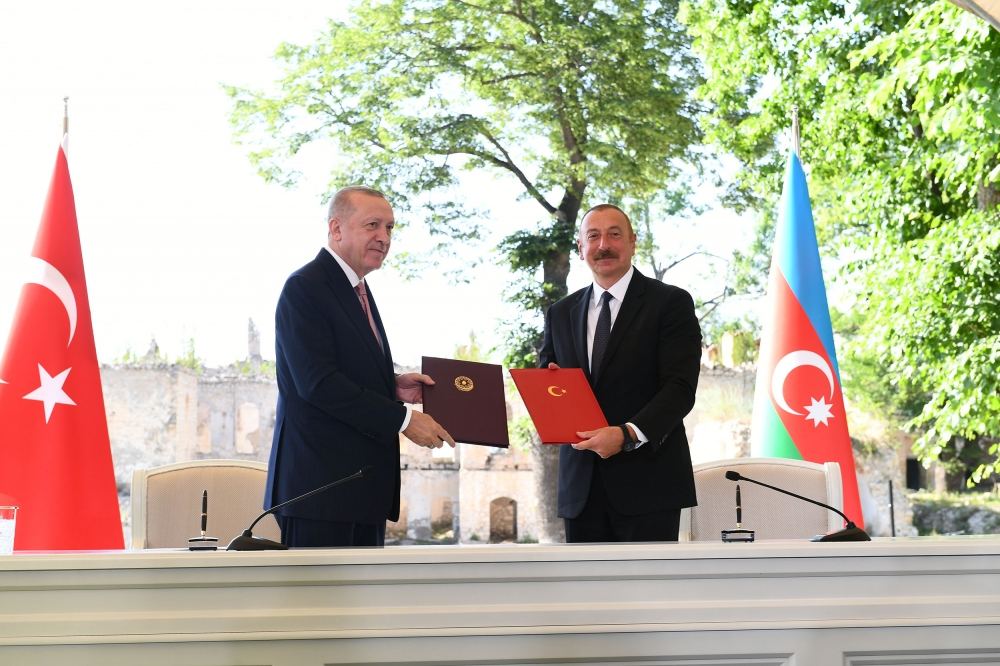
The summit, hosted by the President of Azerbaijan and attended by the Presidents of Kazakhstan, Uzbekistan, and Kyrgyzstan, as well as the Vice President of the Republic of Turkey, signifies a powerful commitment to fostering cooperation among the Turkish states of Eurasia and advancing international collaboration through the establishment of the OTS in 2009. The OTS has expanded its trade, connectivity, science, economy, and defence cooperation by relying on shared history, culture, identity, and language pillars.
Türkiye, Azerbaijan, and Kazakhstan are pivotal in driving the OTS. Their deepening military and defence cooperation aims to make the region more secure and interconnected for stability and prosperity. The ongoing conflict between Russia and Ukraine, coupled with China’s dominant economic and security interests in the region and escalating competition among major powers, underscores the need to facilitate integration and address the issues between the OTS’s member states.
Expanding connectivity, trade and investment
Since its inception, the OTS has fostered regional collaboration on connectivity, trade, science, and economy for integration. The 2011 summit underscored the urgent need to enhance interconnectivity between OTS countries, leading to the expansion of the 860-km Baku-Tbilisi-Kars railway line. In 2015, the OTS recognised the strategic importance of the Trans-Caspian International Transport Corridor (TITR) or Middle Corridor and established a coordination committee for its development.
The modernisation and opening of the Baku-Tbilisi-Kars railway line in 2017, connecting Turkey with Azerbaijan through Georgia, has significantly boosted trade and commerce between OTS countries and facilitated trade between China and Europe. The development of Baku Port and Aktau Port on the shores of the Caspian Sea has further enhanced trade and cargo between the OTS countries and Europe, demonstrating the significant economic impact of the OTS on regional connectivity and trade.
The outbreak of the Russia-Ukraine war and the resulting sanctions on Russia have further boosted strategic cooperation among the OTS along the Middle Corridor. Regional trade between OTS increased from US$ 32 billion in 2022 to US $40 billion in 2023, primarily because of the rise in container traffic along the Middle Corridor. The OTS has placed particular importance on bolstering connectivity between the member states for economic growth and regional integration.
In recent years, the OTS has seen a significant increase in investment among its member countries. Azerbaijan has invested approximately US$ 20 billion in member states, with a substantial portion of that investment directed towards Türkiye. Conversely, Türkiye has invested US $15 billion, with over 330 companies operating in Azerbaijan and implementing various projects. Similarly, Türkiye has invested US$ 4.7 billion in Kazakhstan, and Kazakhstan has invested US $ 1.3 billion in Türkiye. The Turkish Investment Fund was started in 2023 with US$ 500 million as initial capital to further encourage intra-regional investments among the OTS states. Each member country will have an equal share in investment funds to promote cooperation and economic development.
Navigating a complex landscape and defence cooperation
The international rule of law crisis amidst growing geopolitical contestations has forced close regional cooperation among OTS member states on defence and security issues. The abrupt withdrawal of the United States (US) from Afghanistan and the aftermath of the Russia-Ukraine war have diminished OTS’s trust in global organisations like the Collective Security Treaty Organisation (CSTO) and the North Atlantic Treaty Organisation (NATO) for their sovereignty and territorial integrity. Türkiye is a member of NATO and primarily a military contributor to this organisation, while Kazakhstan and Kyrgyzstan are members of CSTO. While Azerbaijan left CSTO in 1999 and has benefitted from non-aligned status, Uzbekistan left CSTO in 2012 after the creation of the Rapid Action Force (RAF). China has increased its influence over the region through the Shanghai Cooperation Organisation (SCO), the Belt and Road Initiative (BRI) and defence technology assistance. China has held many joint military drills within the framework of the SCO and bilaterally or trilaterally. Between 2003 and 2020, Beijing held 45 such military exercises with Central Asian Republics.
To navigate this complex geopolitical landscape, the OTS has focused chiefly on bilateral and intra-regional security and defence agreements, demonstrating its commitment to maintaining stability and security. This approach, while different from a multilateral security or military alliance, is a strategic choice to the growing discontentment in the engagement with the CSTO, NATO, and China at the initial stage. After the growing defence and security relationship between Türkiye and Azerbaijan, many Turkish defence industry companies operate in Azerbaijan to produce defence equipment, drones, etc.
Kazakhstan has signed an enhanced strategic partnership with Ankara and will be the first to produce Turkish drones outside Türkiye. With the transfer of technology and experience, Kazakhstan can make drones independently. Both countries also signed a military cooperation plan to improve combat training and collaboration. In 2022, Tashkent signed a defence cooperation agreement with Ankara on intelligence sharing, logistics projects, and joint training. Finally, in 2023, Uzbekistan acquired Turkish drones to increase its combat capability.
Given its strategic location, Azerbaijan sees OTS as the leading international organisation in the region based on historical cultural routes between the member countries. The vast geography, extensive hydrocarbon resources, and growing connectivity have strengthened the organisation’s future. The Turkish influence can work to hedge against the dominant cooperative hegemony of Russia and China. Developing strategic security and defence capabilities under a strong NATO partner, Türkiye, rather than the tutelage of Beijing or Moscow, can favour the European Union and the US. However, how Beijing and Moscow see it, especially given the geostrategic location of the region and interdependence of OTS via the middle corridor can determine the grouping’s long-term objectives.
Ayjaz Wani is a Fellow in the Strategic Studies Programme at the Observer Research Foundation.