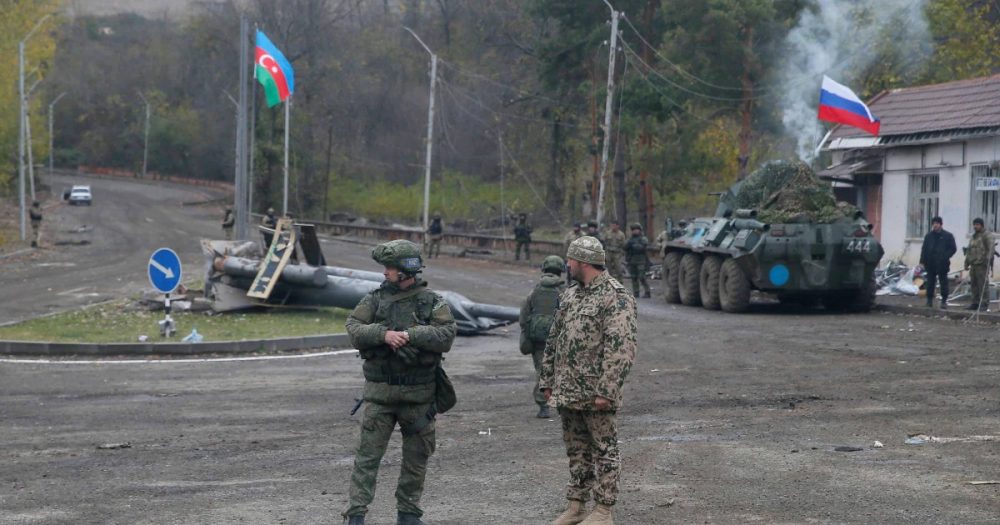
As the world discusses the sudden cessation of fighting in Nagorno-Karabakh and the deployment of Russian “peacekeepers”, one critically important question is overlooked. Why did Russia not discourage Azerbaijan’s military offensive? A powerful security rationale implies a strong Russian interest in deterring a war that might change the regional status quo. Preserving a favorable status quo – by strategic logic – is the central security interest of a regional hegemon like Russia. The war has instead weakened Armenian control over Nagorno-Karabakh, which had endured for over two decades only because it served Russia’s interests. The risk of spill-over across the volatile Caucasus presents another security threat to Russia. The war has altered the balance of interests in the region – unfavorably to Russia – creating openings for regional interventions by Turkey, the United States, and others. So what objectives are worth the Kremlin taking such risks?
Indirect pressure and controlled chaos
Russia’s ultimate goal in the post-Soviet space is to politically reintegrate its former satellites into an interstate union. Yet its attempts to achieve this over the past three decades have produced only failures. The most recent experience with Belarus suggests it might be possible where an authoritarian leadership feels extremely threatened. Heightening insecurity in the population has historically been another favorable condition for political integration. Moscow’s ability to put pressure on Armenia’s prime minister Nikol Pashinyan has been limited. A recent report reveals that the Kremlin views Pashinyan as a “Soros appointee” and accuses him of “promoting pro-American politicians”. The Kremlin’s Armenia desk apparently receives its information from agents representing actors Pashinyan excluded from power. They discreetly sold Kremlin the idea that Pashinyan needs to be replaced by a more loyal politician.
The war and the Azeri territorial gains in and around Nagorno-Karabakh create a context favorable to Russia. First, it allows blame for defeats to be projecting onto Armenia’s present prime minister. Russian media have broadcast statements from Russian political and security experts asserting that Pashinyan is responsible for the war losses and the restrained Russian reaction on account of his unfriendly attitude towards Russia and his favoritism towards the West. They also promoted claims concerning mounting domestic opposition. These signals suggest that Russia’s first goal is to bring to power a more loyal Armenian prime minister. A second goal is to create insecurity among the population, propagating the idea that Armenia cannot survive as a state without Russia. To produce the necessary feeling of threat, Russia allowed Azerbaijan to recover all its territories around Nagorno-Karabakh, making the enclave’s future defense extremely difficult. The defeat by Azerbaijan also underlines the military vulnerability of Armenia itself. Russia will exploit this sense of vulnerability to persuade Armenia’s population and leadership to agree to closer integration with Russia, likely similar to the Union State of Russia and Belarus.
On the other hand, Russia did immense favors to Azerbaijan’s President Ilham Aliyev in choosing not to employ its electronic warfare capabilities against Azeri drones. This was key to Baku’s military success and clearly communicates to the Azeri audience that preserving their war gains is conditional on good relations with Moscow. This will not create the level of vulnerability found in Armenia, but it will start building a dependency.
Ankara’s open involvement in the war offers Russia opportunities to curtail Turkey’s growing regional ambitions or raise their costs. Armenia and the West view Turkey as a party to the conflict and will resist Turkish participation in internationally accepted peace negotiations and peacekeeping mechanisms. This could create an opportunity for Russia to later push for a UN Security Council authorization for its CSTO “peacekeeping forces”. That would be a historic first for Russia and another strategic gain.
Not an accidental escalation
It is legitimate to ask whether Russia acted opportunistically in response to war, or actively contributed to the emergence of the conflict. It is highly unlikely that Russia was unaware of Azerbaijan’s intentions. Russia has extensive intelligence-gathering capacities in the South Caucasus. Its ability to monitor military and civilian communications, movements of troops and materiel, and preparations for offensive operations in the region is pretty much unquestioned. Moreover, the Azeri offensive started on 27 September, one day after Russia’s Kavkaz-2020 strategic exercise ended. The Armenian military participated in various phases of the exercise both in Russia and in Armenia. This suggests great confidence on the Azeri side, in starting the offensive when considerable Russian forces were still deployed in the region. It is highly unlikely that Baku failed to consult Moscow beforehand, given the scale, intensity and far-reaching objectives of its military operation.
Any attempt to change the status quo in the post-Soviet space undermines Russia’s credibility and reputation. Russia has been quick to punish threats to the status quo, witness Georgia in 2008 and Ukraine in 2014. It also threatened Moldova after 2014 by increasing its military exercises in Transnistria from a few dozen to a few hundred per year. Russia reacted unexpectedly calmly to Baku’s invasion. Most surprisingly, it repeatedly rejected Yerevan’s request for military assistance on procedural grounds. Moscow’s ability to stop the Azeri offensive immediately after the fall of Shushi revealed its control. Russia would only have allowed the change of status quo if its expected gains exceeded the related risks and costs. This occurred, while the Kremlin used Baku to pull its chestnuts out of the fire.
Dumitru Minzarari