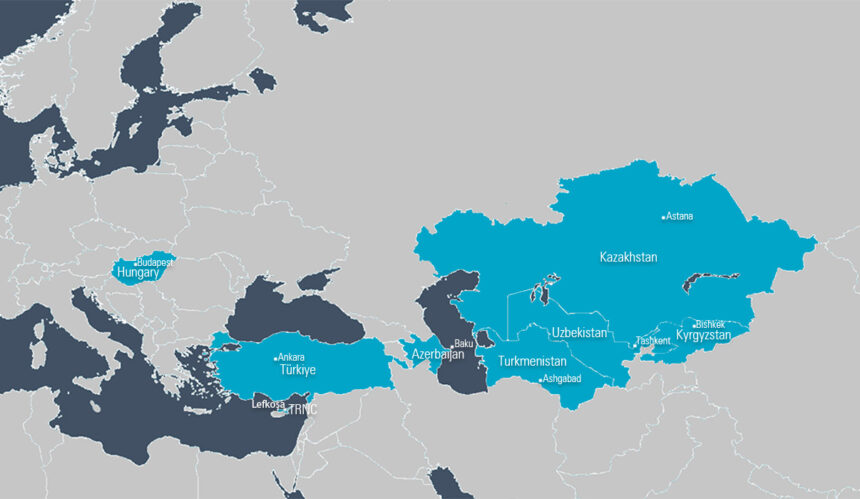
On October 14, an important event took place in Türkiye that could influence the future course of integration processes within the Organization of Turkic States (OTS). A week after the OTS summit in Gabala, President of Türkiye Recep Tayyip Erdoğan signed a decree simplifying labor and entrepreneurship conditions for citizens of Azerbaijan, Kazakhstan, Kyrgyzstan, Turkmenistan, and Uzbekistan.
The decree introduces a streamlined procedure for obtaining work permits and registering businesses for citizens of Turkic countries. It allows employment and entrepreneurship without the bureaucratic barriers that previously restricted labor migration. Certain exceptions remain in place: sectors related to national security and defense remain closed to foreigners, and political rights, including participation in elections, are reserved exclusively for citizens of Türkiye. Thus, the measures are economic and integrative rather than civic or political in nature, aimed at strengthening economic ties without interfering in domestic institutions.
Essentially, the simplification of employment and business opportunities in Türkiye — the largest labor market in the OTS area — creates a new center of attraction for skilled workers, investment, and human potential from Central Asia and the South Caucasus. For citizens of Azerbaijan and other OTS member states, this decree opens up new opportunities for legal employment, education, and business creation in the largest and most dynamic economy of the Turkic world and one of the most vibrant in Eurasia.
The formation of a unified labor market among Turkic states is gradually gaining strategic significance and becoming a key direction of integration. Whereas cooperation among the region’s countries — Azerbaijan, Türkiye, Kazakhstan, Kyrgyzstan, Uzbekistan, and Turkmenistan — was previously focused mainly on energy, transport, and cultural projects, attention is now turning to human capital as the main resource for long-term development. Erdoğan’s decree effectively represents the first institutional step toward creating a common labor market, where the movement of workers is viewed not as external migration but as a natural process within a single economic space.
The first prerequisites for such a market emerged in the late 2010s, when Türkiye and Azerbaijan began coordinating migration and educational policies. In parallel, Central Asian countries developed programs for professional mobility and mutual recognition of diplomas. The OTS summit in Gabala in October 2025 solidified this course, including in its final declaration a provision on “creating conditions for the free movement of labor and specialists within the Turkic space.” The economic rationale is clear: Türkiye needs a labor force for its construction, industrial, and agricultural sectors, while the Central Asian countries possess abundant human resources.
A mutually beneficial model is taking shape: Türkiye gains labor reserves, while its partners gain access to markets, investments, and technology. In the long term, this process could lead to the emergence of a kind of “Turkic Schengen” — a space of free movement for citizens and labor resources. However, the successful implementation of this idea requires a common institutional framework — mechanisms for recognizing qualifications, harmonizing legislation, and providing insurance and social protection for workers. Experts are discussing a potential “Labor Charter of the Turkic States,” which could enshrine these principles and serve as the foundation for a future supranational coordination body.
The humanitarian dimension is equally important. Common language, cultural traditions, and values make labor integration more organic and sustainable. Unlike migration flows to Europe or the Middle East, the movement of labor within the Turkic world does not provoke sharp cultural conflicts and is seen as a natural process of economic and civilizational convergence. To prevent imbalances, joint educational and industrial clusters are being planned, enabling countries to share not only labor resources but also investments in their development.
At the geopolitical level, the creation of a unified labor market reinforces the very idea of Turkic integration as an independent project. Amid unprecedented tensions surrounding the OTS region, the Turkic format is becoming a new center of gravity in Eurasia. It relies not on political ideology but on shared interests and cultural kinship, which makes it more flexible and resilient.
It is important to note that all these developments are taking place against the backdrop of contradictory trends in Russia’s labor market, which has traditionally been the main destination for migrants from Central Asia. For decades, the Russian economy served as the primary destination for millions of workers from Uzbekistan, Kyrgyzstan, Tajikistan, and Kazakhstan. However, in recent years, the situation has changed: social and legal restrictions have tightened, cases of discrimination and everyday conflicts have grown, and incidents between migrants and local populations have increasingly taken on political overtones, straining intergovernmental relations. Against this backdrop, Central Asia’s surplus labor force now has a real alternative — the Turkic integration space, where Türkiye serves not only as an economic hub but also as a political and cultural magnet.
Where once regional labor migrants had little choice but Russia, today more factors are pushing them southwest — toward Ankara and its Turkic partners. Türkiye offers easier cultural adaptation, linguistic familiarity, shared religion, and a less stigmatizing attitude toward newcomers. Moreover, the growing institutionalization of the OTS creates a new framework in which citizen mobility ceases to be a temporary phenomenon and becomes a stable element of economic cooperation.
Thus, President Erdoğan’s new decree should be seen not in isolation but as part of a broader transformation aimed at forming a common market for labor, capital, and knowledge. It symbolizes the Turkic world’s transition from the concept of cultural brotherhood to a model of functional cooperation based on mutual benefit, mobility, and solidarity. If the institutionalization of this unified labor market is successfully completed, the Organization of Turkic States will evolve into a genuine economic and social community — one in which people and their work become the main driving forces of integration.
Ilgar Velizade