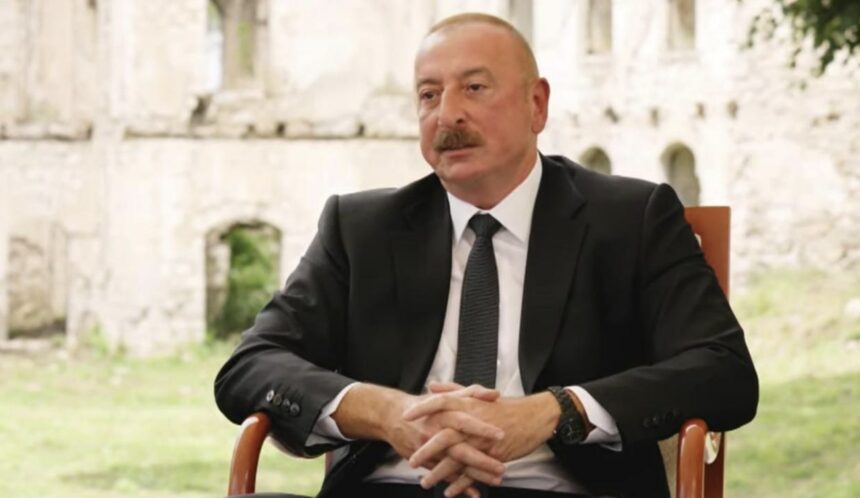
Correspondent: Mr. President Aliyev, thank you very much for having us here. This region has been the stage of some of the most violent episodes in the South Caucasus’s recent history. And the tensions haven’t really gone away completely since the 2020 peace deal. To what do you attribute this constant hostility?
President Ilham Aliyev: Difficult to say. I thought that after the Second Karabakh War situation will be different. We were ready for peace and actually waiting for a while for international players to give us some new suggestions. We understood that it’s a kind of vague. Nobody knows what to do. And the situation, when we had the declaration signed on the 10th November 2020, was not actually providing sustainable peace. It wasn’t a peace treaty. It was a declaration. Actually, de facto, that was a capitulation act by Armenia. Therefore, we started to put forward some initiatives in order to find the final solution to our conflicts with Armenia. We made it public and announced that we need to sign a peace agreement. And then again, it was vague. So then, we elaborated the principles for peace agreement, which are very well-known principles of international law like mutual recognition of territorial integrity, sovereignty, international borders, delimitation of borders, non-use of force or threat of force. We put that proposal on the table. So, we are the country, which suffered 30 years of occupation, and restored justice by force, we were the authors of a new peace process. I would not say it is going very smoothly, but we are still optimistic, because we are now engaged in very active negotiations on the level of foreign ministers of both countries.
Correspondent: And I was gonna ask you about that. I’m sorry to interrupt, but you’ve just returned from Brussels from another round of peace talks. These peace talks have been filling many people with hope of lasting peace between Armenia and Azerbaijan. Are we right to be hopeful considering what came out of this latest round?
President Ilham Aliyev: Yeah, I think it is right thing to be hopeful, but I can tell you that peace negotiations have been held by foreign ministers. Our meetings in Brussels were organized by the President of European Council. These meetings actually allow us to touch upon very sensitive issues.
Correspondent: For example?
President Ilham Aliyev: Like future parameters of the boundaries, because the border between Armenia and Azerbaijan has not been defined. Because as soon as the Soviet Union collapsed, we faced this aggression. So, how the border will look like? What will be the real situation on the ground? What will be situation with the communications? Because Armenia has obligation, which is signed as a result of the Second Karabakh War to allow us access to our exclave Nakhchivan. But still, it is not happening. So, main concentration on paragraphs of peace treaty is made by the ministers. Our meetings just create, I think, a good atmosphere. But if we see a constructive approach from Armenian side, and most important if they totally put down all their aspirations to contest our territorial integrity then we can find the peace solution very soon, maybe even by the end of the year.
Correspondent: We’ll get more into the negotiations later. But I’m curious to ask you. There’ve been many international players attempting to mediate the situation. What does the EU bring to the negotiating table?
President Ilham Aliyev: Actually, the EU was not part of the mediation process during the times of occupation. We had the negotiations since 1992. It was an initiative of President of the European Council Charles Michel, who invited us and we supported that. Because we think that taking into account the level of cooperation between Azerbaijan and EU, and Armenia and EU, it’s natural to be active. Especially when after the Second Karabakh War, the Minsk Group was no longer functional. Actually, it is not functioning any longer. So, there should have been some international institution. I thought that the EU can be the best, because our relations with the EU are based on mutual respect, mutual trust and mutual interest. So, this initiative now is transforming into a very active format of dialogue, because we meet not only in Brussels, we also meet, for instance, on the sidelines of the European Political Community. Last time it was in Chișinău. I think it’s important, because we do not allow a situation to stagnate. Because if it is stagnation, if it’s again kind of a break with them, then we are not guaranteed from any dangerous scenario.
Correspondent: Do you think that the growing mediation of the West, the EU, but also the United States has somewhat antagonized more traditional powerbroker here in the region, Russia, or the other way around the fact that Russia has somewhat been bogged down in Ukraine has left some space for potentially Azerbaijan and Armenia to come to common ground?
President Ilham Aliyev: Well, actually, Russia was a mediator of a ceasefire agreement or declaration of 10 November 2020. It was not the United States or the EU. Our first meetings with my Armenian colleague were organized by Russia in Russia. So, after the Russian-Ukrainian war situation has changed. We started to see that the United States and Europe became more active. It’s not actually a big difference for us, who will lead the process or who will, to a certain degree, monopolize the negotiation process. It is important to come to the result. Whichever actor can produce initiatives that will lead to peace agreement, we will support it. By the way, negotiations between our foreign ministers were held in Washington. Now we got an invitation from Russia to hold a round of negotiations in Russia later this month, and we agreed. So, if there’ll be some other location, of course, we will agree. It’s important for us to come to an agreement and to have a result. Of course, we understand the certain geopolitical rivalries, some attempts of some players to be more active. We can only appreciate if there’s a healthy rivalry, which will lead only to good results.
Correspondent: I understand you have a long historical and complex relationship with Russia. How would you say the Russia’s influence in the region at the moment?
President Ilham Aliyev: Well, it’s difficult for me to say about the region, because the region of the Southern Caucasus consists of three countries. We can only observe Russia’s interaction with our neighbors in the Southern Caucasus. But as far as Azerbaijan is concerned, not many things have changed, because our relations with Russia were already balanced. They were based on recognition of each other’s national interests and of course, territorial integrity and sovereignty. Russia is a neighbor to Azerbaijan and a partner as we have a kind of substantial trade turnover, a lot of projects related to transportation infrastructure, especially now, at this moment. Projects related to energy development and cultural segment, of course, are very important.
Correspondent: You have been striking more deals, especially with regards to the energy sector, especially, with the West?
President Ilham Aliyev: Yes, we have. That was a long time ago when we launched the initiative to build integrated pipeline system from Baku to Italy. It started to be implemented in stages. The final stage was implemented something more than two years ago. It’s already for more than two years Azerbaijan became an important gas supplier to Europe. Of course, situation with sanctions on Russia created a new dimension, because our energy resources now are needed more than before. But whatever we do, we do it based on the plans and contracts, which have been signed many years ago. It is true that now we have more countries, who are applying for additional gas from Azerbaijan. We already do it, we already started. More countries started to get our gas already last year. This year, it will continue. But again, it’s from the point of view of our relations with Russia, not many things have changed since Russian-Ukrainian war started.
Correspondent: Can we talk about the situation here on the ground? Because the International Court of Justice, the European Court of Human Rights, the US the EU have all demanded guarantees with regards to the freedom of movement in the Lachin corridor nearby, citing the danger of effectively potentially holding a population under siege if that corridor is blocked. What do you know of what’s happening in the Lachin corridor right now?
President Ilham Aliyev: Well, actually, for more than two years since the Second Karabakh War ended, the so-called Lachin corridor functioned. It functioned during the times of occupation with one difference. It was under control of the Russian peacekeepers, which was part of the trilateral declaration. There was no disruption and there were no steps from our side to interfere. In the meantime, situation on the ground was changing. The reason why representatives of civil society of Azerbaijan to a certain degree started to control the corridor was because of the fact that illegal excavation of natural resources in Karabakh restarted in the beginning of November last year. Because after the war, it was stopped because it is illegal. These resources belong to us. Several foreign companies were illegally exploiting our gold and copper mines. We could not do anything about during times of occupation. But when the war ended, it was obvious that this activity should have stopped, and it stopped. But, then, in November it restarted. Representatives of civil society asked Russian peacekeepers to allow them to conduct a monitoring in the mines to see what is happening. We have seen that iron ore and golden ore was being transported by trucks from Karabakh to Armenia accompanied by Russian peacekeepers. So, we were denied the right for access, and that is how our civil society representatives started to control it. But again, the road was not closed. It was absolutely free, and the movement was free.
Correspondent: So it was never interrupted, traffic was never interrupted?
President Ilham Aliyev: No, no!
Correspondent: So, why do you think these institutions have asked, especially on the part of Azerbaijan? Because they said you were responsible for the area surrounding it. So, you should ensure the freedom of movement. Why do you think they are only targeting you?
President Ilham Aliyev: The International Court of Justice actually addressed its message to us to communicate with civil society activists not to disrupt any kind of movement. And we did it. As soon as we establish the border checkpoint on our border with Armenia, which is our legitimate right and not contested by anyone, including the International Court of Justice, we communicated it through my representative here in Shusha, with NGOs representatives for them to stop. And they stopped, they left. So, now freedom of movement is not blocked. Since we established the border checkpoint on the 23rd of April, there have been more than 2000 residents of Karabakh who easily moved to Armenia and back. On 15th of June, Armenia made another military provocation and wounded one of our border security guards.
The road was temporarily closed for investigation. But then, it was reopened. The Red Cross restarted again to transport medications and evacuate patients who need treatment in Armenia. But unfortunately, the Red Cross trucks when checked, we found smuggling goods like cigarettes, iPhones, and gasoline. The Red Cross admitted that. They communicated with us saying that they do not bear any responsibility because…
Correspondent: The trucks we’re being used by only drivers…
President Ilham Aliyev: Yes, but these trucks had their logos, and the drivers had their logos on their uniform. So that’s how again, it was blocked. And we asked from the Red Cross to stop it and also asked them to work with us more constructively. Unfortunately, until today, their office in Karabakh has been subordinated not to Baku office, but to Yerevan offices. This is not acceptable. Because the whole world recognizes Karabakh as part of Azerbaijan. Even the Armenian Prime Minister said many times that “Karabakh is Azerbaijan”. That is our legitimate request as to why the Red Cross Khankendi office is not subordinate to Baku office but to Yerevan office.
Correspondent: Would you say that this issue, the issue of the Lachin corridor and that border control and this passageway, this crucial passageway, is one of the main obstacles for peace right now?
President Ilham Aliyev: Well, I don’t think so. Because situation on the road Lachin-Khankendi changed on the ground on 23rd of April, when we established the border checkpoint. Until that time, we had two and a half years of time to come to peace agreement. The only stumbling block was that Armenia didn’t want to recognize Karabakh as part of Azerbaijan officially. Yes, they did it by statements, by oral statements, which is also a position. But they need to sign the document. So, I don’t think that these two issues are interrelated. Because I hope that peace negotiations with Armenia will end with successful scenario, hopefully, in the coming months.
Correspondent: I believe you’ve already answered the question I’m gonna ask you now. But I’m going to ask you anyway, because you’re here, and I won’t get a chance of asking many times. Some 5000 people lost their lives in 2020 on both sides. I was here. I came to the Nagorno-Karabakh and I met many mothers of fallen Armenian soldiers. I’ve also witnessed the pain and a devastation on the other side, on your side through the work of my colleagues here in Azerbaijan. But I remember speaking to one mother, in particular who told me she blamed politicians for the war and for the death of her son. Saying that politicians should deal with things in a diplomatic way and not fall into the trap of a war. What would you say your mission is? Is it to win a war or to bring lasting peace?
President Ilham Aliyev: Well, to win a war was a mission of my life, of my political life, which ended successfully. So, we won the war, despite many factors, political, despite factors of long-lasting infrastructure projects on the occupied territories, which made it very difficult for our military servicemen to break several defense lines. They had in some parts five, in some parts seven defense lines full of mines. And also you have notice coming from Fuzulu that the road climbs up. So, that’s how our military servicemen came here. The road, which you came, the Victory Road, as I called it later, did not exist. It was the road through which our military servicemen were moving towards Shusha. They were climbing these rocky mountains. So, despite these factors, despite strong political support from many countries, which have a big Armenian diaspora, we did what was right to do. We restored justice, and we restored our territorial integrity. We fought on our land. We didn’t fight on the Armenian land and we won. So, that was a mission number one, which is over. Now we talk about peace for a country, which suffered thirty years of occupation because its territory, which was under occupation, is totally ruined.
Shusha was not totally ruined, because there were illegal settlements in Shusha. They wanted to resettle Armenians from the Middle East and there have been a couple of thousands of Armenians living here. That’s why, not all the cities have been destroyed. Fuzuli was totally leveled to ground, Aghdam the same. Almost a million Azerbaijanis were deprived from their homes. So, despite all that pain, we did not take revenge. I said we will take revenge on the battlefield, but as soon as Armenia gave us the dates, when they will withdraw from all the territories, which I demand it from the first day of the war, we stopped, and then, we started to talk about peace. So now, peace is on our agenda. If Armenia wants peace, we will reach it. Because we do not have any territorial claims to Armenia. And we don’t want them to have any territorial claims to Azerbaijan. People who live in Karabakh – in area, which is controlled now temporarily by Russian peacekeepers – they live in Azerbaijan. They should choose whether to live as citizens of Azerbaijan as ethnic minority, as any other ethnic minority, which Azerbaijan is rich of or to leave. So, this is their choice. It is not because we want them to leave or as Armenia accuses us we organize ethnic cleansing. No, we give them a choice. How they can live on our territory being a citizen of either Armenia, without any legal permission, or a citizen of so-called “Nagorno-Karabakh republic”, which is not recognized by anyone? So, I think this is a legitimate approach, which is in line with international practice. It’s in line with practice, which we see in many European countries, which also fight against separatism. Now we see how Europe and the West is united to help Ukraine to fight against separatism. And why in our case our fight against separatism is treated differently? Why Georgia’s approach to separatist regions is fully understood by Western communities and politicians, and our legitimate, the same origin desire, to put an end to separatism is under question? Why Spain does not allow Catalonia to have a referendum though there are five or six million? They don’t have their own state unlike Armenians, which have a state next door. Why should we tolerate separatism? We will not.
Correspondent: You have already issued messages as well of reassurance towards the population saying that they will be allowed to stay if they want to, and protected and allowed to live here. But do you have a message today to Armenians maybe watching us? Not necessarily the government, I know you are in touch with Prime Minister Pashinyan and you don’t necessarily need our cameras to send him a message. But what about other Armenians who may be watching us? What is your message to the other side today?
President Ilham Aliyev: Well, I never thought about that, because that’s the first time in my life I’m asked this question.
Correspondent: Really?
President Ilham Aliyev: Yes. I think I would separate the question in two. First, if they listen to what I say, message to Armenians in Armenia that we want to have peace with their state, we don’t have territorial claims to Armenia though hundreds of thousands of Azerbaijanis lived in Armenia before the war were totally ethnically cleansed, and their cultural and religious heritage was totally destroyed. Nevertheless, we don’t have any territorial claims. We think that Azerbaijanis, who were deported forcefully from Armenia, have a right to return when Azerbaijan and Armenia will normalize their relations and establish diplomatic relations. Another message to them is to clearly realize the current geopolitical situation and the balance of forces. For many years, leaders of Armenia were persuading their people that they have the strongest army in the world, that if the war starts they will come to Baku and that Azerbaijan will not fight for its lands, already agreed with occupation. All these narratives were absolutely false and were nothing more than propaganda. So, the war destroyed those narratives and not only that. It also destroyed a lot of ideological columns of the Armenian state. They realized that they lost the war and most probably it was very painful for them psychologically. So now, when we say that we want peace, it’s not because we are weak and we are seeking peace. No, they know that we are much stronger. It’s because we want this black page of our history to be turned down. We don’t want another war either today or ever in the future.
So for Armenian community, I think they should not oppose peace initiatives of international community. They should understand that if they don’t sign peace agreement with Azerbaijan, situation in the future will be unpredictable. Geopolitical situation in the world and in the region is changing as we see very dramatically. And part of their hopes for their security vanished completely. Now they’re looking for new security guarantors. Who is ready to have a standoff with Azerbaijan on the battlefield in this area, especially after what we demonstrated during the war and after we increased our defense capability after the war? Is there anyone ready to fight for Armenians against us? I doubt it.
So, also another message, which I already conveyed to the Armenian government is that in this particular situation for them the choice is not the best and the very best. For them the choice is among very bad and acceptable, but acceptable based on common sense, on international law, and on recognizing the rights of Azerbaijanis to live on their own land, which they deprived us for 30 years. And for Armenians in Karabakh, I’d like to remind them that we started contacts with them spontaneously. Actually, it was mainly people-to-people contacts when we started to build a new Lachin road, which passed through several villages where Armenian population live. I was informed that the contacts had been established between our road construction workers and Armenian community, and immediately they became almost friends. If in the first months of the construction, Russian peacekeepers were providing security for both sides, then they just left. There were no Russian peacekeepers and people easily communicated without them. So, it demonstrates that ordinary people, in their majority, don’t have this hatred in their hearts.
And Armenians in Karabakh should not follow their so-called leaders. These “leaders” were lying to them all the time – current and previous – before the war, during the war that they were winning. Even when we took control of Shusha, they were telling that Shusha was under their control. They knew it very well. They should not become a hostage of today’s clique, which captured power in Karabakh, and whose main objective is to provide their own interest.
Here in Shusha, there are free villas built during the times of occupation. If you’re interested, maybe, they can show that to you. And these villas were built for the leaders of Karabakh Armenians. They built it for themselves. The city was totally in ruins. What you see now it’s the beginning of our reconstruction process, including this “Qarabag” hotel, the mayor’s office, hotels etc. They built three villas in the best part of the city for themselves – those people who today lead this so-called unrecognized republic. So, the Karabakh Armenians should understand that being part of the Azerbaijan society with security guarantees, we understand it, with their rights, including educational, cultural, religious, municipal rights, they will live normal life. They will stop to be a hostage of manipulation. And also, they should understand that situation, which they are in now today, will not change in their favor, if they continue to ignore us, if they continue to behave like we do not exist or live in so-called country, which has “president”, “ministers”, “parliamentarians”. This is all fake. We offer them normal life. I think if they listen to me, they should understand and they know that I mean what I say.
Correspondent: President Aliyev, thank you very much for speaking to Euronews.
President Ilham Aliyev: Thank you.
Following the interview, President Ilham Aliyev informed the Euronews correspondent about the monuments to well-known figures of Azerbaijan, Natavan, Bulbul and Uzeyir Hajibeyli, which were shot by Armenians in Shusha during the occupation.