The United States’ decision to broker a transit corridor between Armenia and Azerbaijan may appear, at first glance, as a narrow regional intervention. In fact, it offers a revealing window into the logic that came to define Trump-era diplomacy. The so-called “Trump Route for International Peace and Prosperity”, or TRIPP, is more than an infrastructure project in the South Caucasus. It is an expression of Trump’s worldview that treats diplomacy as commercial dealmaking and international order as a series of transactions rather than a system of shared binding rules.
A Contested Transit Corridor
Azerbaijan and Armenia have long been at odds over the terms of a proposed transit route that would connect Azerbaijan to its exclave, Nakhchivan. The exclave is separated from mainland Azerbaijan by Armenia’s Syunik province, historically known as Zangezur, and borders Türkiye, Baku’s closest ally.
Azerbaijan’s demand has been straightforward: an unimpeded corridor across southern Armenia, free from Armenian border controls. Baku frames this as the Zangezur corridor, a project that would physically link Türkiye to Azerbaijan and onward to Central Asia, thus serving as a bridge between Turkic-speaking countries. Armenia, wary of ceding effective control over its territory, has resisted. Instead, it has proposed an alternative project, the Crossroads of Peace, which would reopen regional transport links while preserving Armenian sovereignty.
The dispute is complicated by the region’s broader geopolitical context. Under the 2020 agreement that ended the 2020 war between Armenia and Azerbaijan, border guards of Russia’s Federal Security Service were assigned responsibility for overseeing the prospective transit route. Russian border guards continue to patrol Armenia’s borders with Iran and Türkiye, and the country’s rail network is operated by Russian Railways, a state-run monopoly. Iran, for its part, has warned against any foreign, particularly American, presence near its northern border. The geography of the corridor thus intersects with the strategic anxieties of three regional powers.
The Trump-Brokered Deal
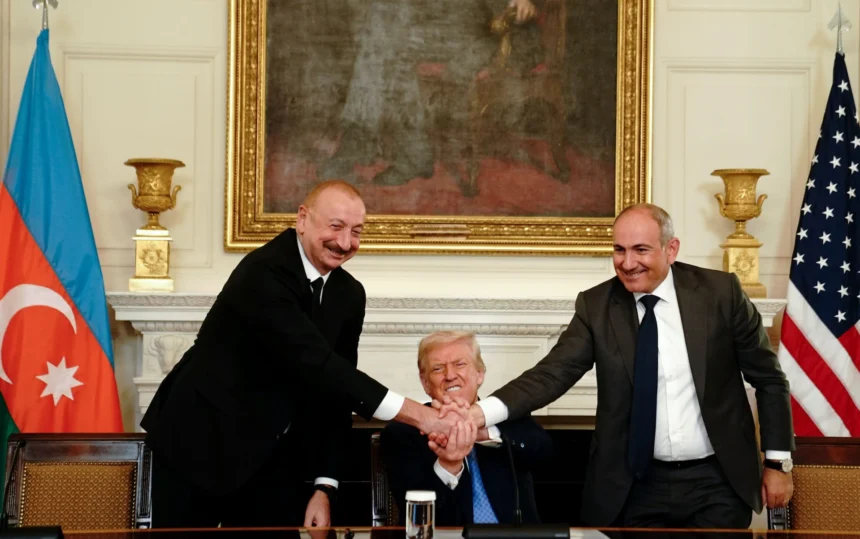
It is into this complicated geopolitical terrain that Trump stepped. In August last year, he brought the leaders of Armenia and Azerbaijan to Washington, where they signed a joint declaration committing to a peace process based on mutual recognition of territorial integrity. The foreign ministers of Azerbaijan and Armenia initialed the prospective peace treaty. More consequentially, the sides endorsed the creation of TRIPP, a transit route to be developed and managed by a US-controlled company, granting Washington exclusive rights and effectively excluding Russia from a strategically important project.
The arrangement bears all the hallmarks of Trump’s foreign policy: the preference for bilateral deals, the pursuit of commercial benefits, and transactional diplomacy.
Since the beginning of Trump’s first presidency in 2017, his foreign policy has frequently been described as transactional. This approach marks a departure from US efforts to manage long-term alliances and uphold a liberal international order. Instead, it emphasizes short-term gains achieved through reciprocal deals prioritizing US economic interests.
The TRIPP agreement reflects this logic in several important ways.
First, TRIPP is led by the United States, sidestepping traditional multilateral institutions. Rather than operating through regional or multilateral frameworks, the deal is based on a joint declaration witnessed by the US president, who assumes the role of guarantor, alongside separate bilateral agreements between Washington and each party. This format sidelines other third-party actors that have previously acted as mediators, such as Russia and the European Union.
Notably, the Trump-brokered agreements excluded the OSCE Minsk Group, which since the 1990s had held the mandate to assist in negotiating a peaceful settlement between Armenia and Azerbaijan. Although the group had long been criticized as ineffective, its formal dissolution following the Washington talks signals a broader retreat from multilateral conflict management.
While this US-led approach helped overcome paralysis caused by deepening Russia-West tensions following the Russian invasion of Ukraine in 2022, it also raised geopolitical stakes. Moscow is likely to view the US control of the transit route as hostile to its hegemonic interests and may use its extensive economic leverage within Armenia to obstruct implementation. Russian officials have already argued that any transit route should account for Armenia’s membership in the Eurasian Economic Union (EAEU), a Russian-led economic bloc, and the presence of Russian border guards along the Iranian border, a tacit signal that these linkages could be weaponized if necessary.
Second, the diplomacy behind TRIPP bypassed traditional channels. Rather than relying on the State Department, Trump entrusted negotiations to Steve Witkoff, a billionaire real estate developer and close personal confidant. Witkoff has also served as Trump’s envoy on Middle East and Ukraine-related issues. This reliance on trusted individuals reflects Trump’s skepticism toward the US foreign policy bureaucracy and his belief that personal relationships and business prowess can deliver results where institutions cannot.
Third, TRIPP is fundamentally a commercial project designed to advance US economic interests. The route offers an alternative to Russian-controlled transit pathways and fits neatly into the Middle Corridor, a transport network connecting Europe to Central Asia and China via the Caspian Sea. Since the Ukraine war disrupted northern supply routes, this corridor has taken on heightened strategic significance, particularly for Türkiye and its Western partners.
At the heart of this geoeconomic calculus lies access to critical minerals. As competition with China intensifies, securing reliable supply chains has become a core US objective. Expanding American access to critical minerals and materials is explicitly referenced in the recently released US National Security Strategy. Azerbaijan’s reserves of copper, alunite (aluminium) and molybdenum, Armenia’s deposits of copper, silver, and antimony, and the region’s broader resource base give TRIPP added appeal. Central Asia holds vast reserves of critical minerals, and US engagement with the five Central Asian states through the C5+1 platform includes a dedicated Critical Minerals Dialogue. The implementation framework with Armenia explicitly emphasizes benefits for US investment, market access, and the flow of raw materials to American industries.
The transactional nature of the arrangement is formalized in the bilateral memoranda signed at the White House. Armenia secured expanded cooperation in infrastructure, energy, artificial intelligence, and semiconductors. Azerbaijan obtained the extension of a waiver to Section 907 of the 1992 Freedom Support Act, removing long-standing restrictions on US assistance and opening the door to potential US defense exports. Each side received something tangible.
An Uncertain Future
Whether TRIPP succeeds on its own terms remains uncertain. Armenia’s prime minister, Nikol Pashinyan, faces critical elections this year, and Russia retains ample tools to influence domestic politics and economic lifelines. Azerbaijan stands to gain economically and strategically as it seeks to diversify an economy still heavily dependent on hydrocarbons. Yet Trump’s emphasis on commercial deals offers little incentive for improving governance and rule of law in the country.
For the United States, the larger question is not whether TRIPP will be built, but what kind of power it represents. Trump may continue to cast himself as a global peacemaker, yet the project will take years to complete, likely extending beyond his tenure. What will endure is the model of diplomacy it embodies: power exercised through transactional deals rather than institutions, profits rather than principled values, and ultimately the erosion of the US-led liberal order.
In the South Caucasus, as in other regions, this approach may deliver agreements. Whether it delivers order is a far more open question.
Farid Guliyev