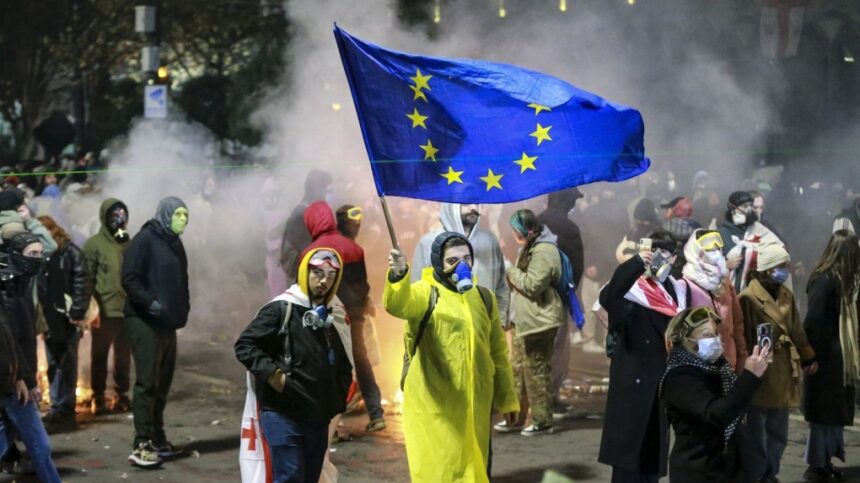
The dramatic events in Tbilisi have once again demonstrated that certain Western circles have not abandoned their plans to stage “color revolutions” in the post-Soviet space and are clearly intent on repeating this scenario not only in Georgia. Too much points to the fact that similar plans are being devised for Central Asian countries as well. Official documents and speeches may talk about supporting democracy, reforms, and so on, but the real goal of Western emissaries is entirely different — to bring a controlled government to power. Whether it is left-wing, right-wing, secular, or clerical is of little interest to the “exporters of revolutions.” The fate of the peoples of these countries even less so.
The background is quite telling. From the moment of the USSR’s collapse, the states east of the Caspian Sea have maintained traditional ties with Russia. However, today the situation is changing. The war in Ukraine, sanctions, and the inevitable economic consequences of geopolitical confrontation have led Central Asian states to diversify their foreign policies. Most likely, they expected the European Union to come to these countries with new projects, investments, technologies, and so on. It’s not to say that none of this has happened. However, certain Western circles are clearly devising plans to radically reshape the political landscape in this region using familiar methods of political provocations already tested in the post-Soviet space.
Too many indicators point to this development. Not least, the “selection of personnel.”
Indeed, as can be observed, the European Union’s representatives in countries east of the Caspian Sea are predominantly individuals from the Baltic states who, in many senses, have been trained in the American school, which is too clearly associated with the CIA.
For example, not long ago, the European Union’s delegation in Uzbekistan was headed by Toivo Klaar. This Estonian diplomat previously held the position of EU Special Representative for the South Caucasus. Klaar, who received his education at the University of Toronto, was mainly deployed to the Caucasus to push U.S. interests. He quickly made himself known as a diplomatic failure and a carrier of the “crusader mentality.” Whatever happened in the field, Klaar consistently supported and voiced exclusively Yerevan’s narratives.
In November 2023, Toivo Klaar, commenting on the fate of the Zangezur Corridor, declared: any road passing through Armenia’s territory must be controlled by Armenia! He conveniently forgot that Armenia has specific signed obligations under the trilateral agreement, which stipulates that the Zangezur Corridor should be controlled by Russian FSB border guards. One might think Klaar’s tough stance against the Kremlin was influenced by the war in Ukraine. However, back in March of the same year, commenting on Azerbaijan’s concerns that the Lachin Road — then under the control of Russian peacekeepers — was being used to transport weapons, conscripts, and even candidates for the presidency of France, Klaar echoed the Kremlin and the Russian Foreign Ministry, declaring that to address this issue, additional equipment should be provided to the Russian peacekeepers rather than establishing an Azerbaijani checkpoint in Lachin. Nevertheless, despite all diplomatic hysteria, a checkpoint was set up in Lachin by late April 2023, and by September 2023, Azerbaijan’s sovereignty over the highlands of Karabakh was fully restored. Let us simply note: when Armenian interests demanded it, Mr. Klaar unhesitatingly promoted Kremlin narratives.
And that’s not all. In February 2023, Klaar made a series of provocative statements, claiming that the trilateral statement said nothing about Azerbaijan’s right to establish a checkpoint in the so-called “Lachin Corridor.” He conveniently overlooked the fact that any sovereign state has the right to control its borders. He then made an even more astounding remark: “The main goal is a sense of security for Karabakh’s residents where they have lived for centuries.” By “residents,” of course, he meant Karabakh Armenians. This raised legitimate questions in Baku: according to the EU representative, do only Armenians have the right to security, but not Azerbaijanis? Moreover, Klaar seemed to believe that Karabakh had been exclusively inhabited by Armenians “for centuries,” ignoring historical facts.
In August of this year, Klaar, who was preparing to move to Tashkent, embarrassed himself once more. In an interview with JAMnews, he claimed that Azerbaijan was obligated to allow Karabakh Armenians to return, while the return of Azerbaijanis to Armenia would depend on successful negotiations. This discriminatory statement by the EU representative was condemned by the Western Azerbaijan Community and Azerbaijan’s Ministry of Foreign Affairs.
Now Klaar is working in Uzbekistan, actively engaging with local grant-funded NGOs, which are being framed as a genuine “civil society.”
One would hope that Klaar is a rare exception. But until recently, the EU delegation in Kazakhstan was headed by Lithuanian diplomat Kęstutis Jankauskas, well-known in Azerbaijan. Jankauskas previously served in the European Monitoring Mission in Georgia and later led the EU delegation in Azerbaijan before handing over the post to Peter Michalko. Jankauskas’s “confidential ties” with NGOs in Azerbaijan are also widely known.
Of course, linking Jankauskas to the scandal involving Lithuanian diplomats in August 2013 — which revolved around discussions about Armenia’s European prospects, while denying such prospects for Azerbaijan — would be incorrect. That scandal ended with the ambassador’s recall, high-profile resignations, and apologies. However, it’s worth recalling that Jankauskas served in the EU monitoring mission in Georgia — the very mission that failed to prevent Russia’s “creeping annexation” in the country. Instead, the EU imposed “arm-twisting” on Georgia regarding NGOs and LGBTQ+ rights, earning a significant backlash: Georgia removed the European integration process from its agenda until at least 2028, refusing to accept diktats and conditions from the EU.
Moreover, Jankauskas took up his post in Kazakhstan in the summer of 2021. By January 2022, major cities in Kazakhstan were engulfed in violent protests, which Astana attributed to radical Islamists. On the surface, it seems implausible that the EU would support radical Islamists, but only at first glance. Experts remind us that many activists from radical Islamic organizations in secular Muslim countries have received political asylum in the EU without significant obstacles. Furthermore, such radicals often become “protected clients” of various Western human rights organizations.
In Uzbekistan, where Klaar has now been deployed, the history is also revealing. In the late 2000s, radical Islamists carried out terrorist attacks in the country. In May 2005, the Uzbek city of Andijan in the Ferghana Valley witnessed a full-blown Islamist uprising, which was suppressed. Instead of moral support from the West, Uzbekistan faced accusations of “human rights violations.”
Judging by recent events, Western interest in Uzbekistan preceded Klaar’s appointment. For instance, in December 2023, Azerbaijan uncovered a network of French intelligence operatives, including diplomats and businessmen. This network was found to be transnational, covering not only Azerbaijan but also Uzbekistan. One agent, who worked at the EU office in Uzbekistan after being transferred from the EU’s Baku office, fled Uzbekistan following the exposure of the network by Azerbaijani intelligence.
Now Toivo Klaar has arrived in Tashkent. Will this EU diplomat focus on building bridges, or will he work to spark revolutions and uprisings?
The countries of the region must stay vigilant.
Nurani